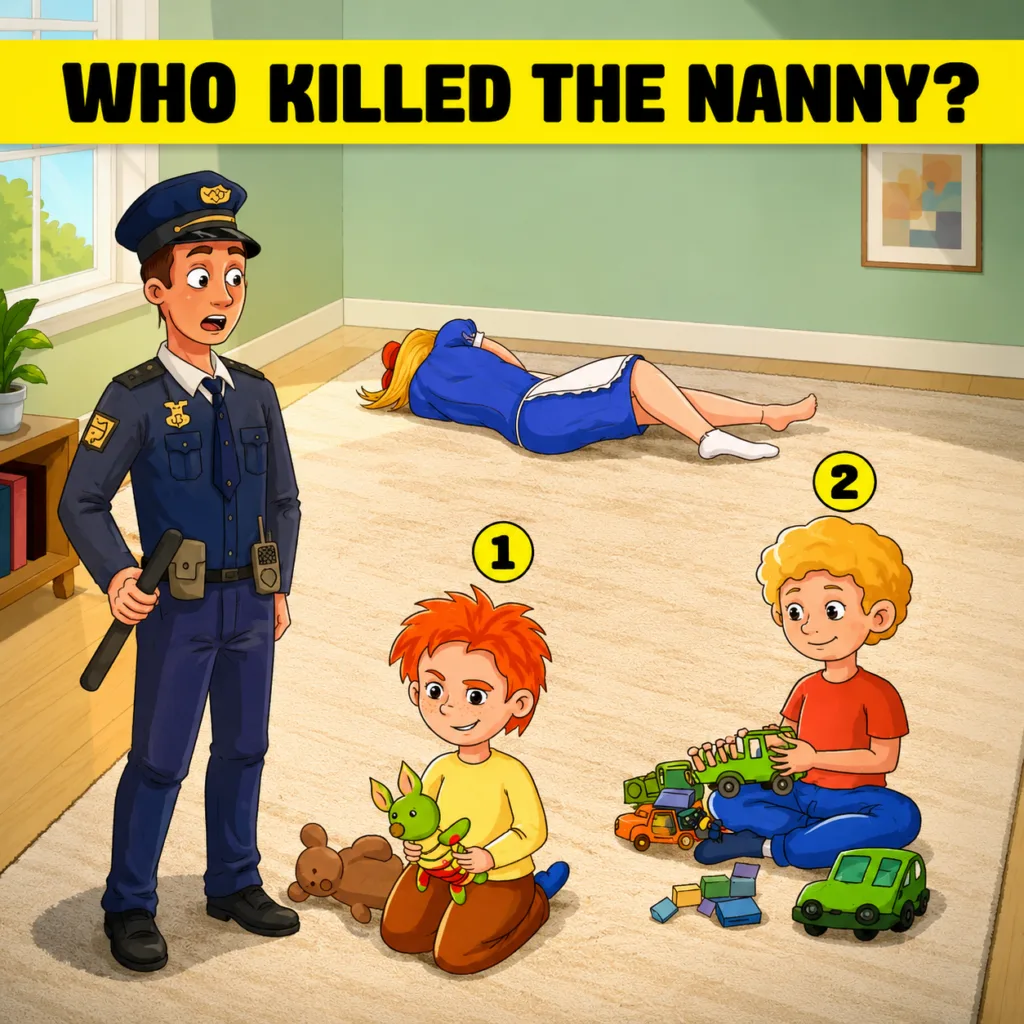
At first glance, this puzzle looks simple: a nanny is lying motionless on the floor while two young boys continue playing with their toys. A police officer has arrived, and the challenge is straightforward:
Which child is responsible — Boy #1 or Boy #2?
But like many visual detective puzzles, the answer isn’t about guessing. It’s about carefully examining the clues hidden in the illustration.
Let’s investigate the scene.
Examining the Crime Scene
The room contains four main characters:
- A police officer who has just arrived.
- The nanny lying face down on the floor.
- Boy #1, holding a stuffed bunny.
- Boy #2, surrounded by toy trucks and building blocks.
Neither child appears frightened or upset, which may seem suspicious. However, facial expressions alone are never enough to solve a mystery.
Instead, we need to focus on physical evidence.
Suspect #2
Boy #2 is sitting quietly with several toy vehicles.
Notice the details:
- His hands are occupied with his toys.
- The toys around him appear undisturbed.
- There are no unusual objects nearby.
- He is positioned farther away from the nanny.
- His clothing and surroundings don’t reveal anything suspicious.
While he seems unusually calm, there is no direct visual evidence connecting him to the incident.
Suspect #1
Boy #1 is kneeling closer to the police officer while holding a stuffed bunny.
At first, everything looks normal.
But several details stand out:
- He is much closer to the victim.
- He appears to be gripping the stuffed toy tightly.
- Part of the toy seems oddly positioned, almost as if something could be hidden behind or inside it.
- His slight smile feels unusual considering the situation.
- A teddy bear beside him suggests he may have been playing closer to where the nanny collapsed.
These clues make Boy #1 appear more suspicious than Boy #2.
Why the Smile Isn’t the Real Clue
Many people immediately choose Boy #1 simply because he’s smiling.
However, that’s not reliable evidence.
Children may smile because:
- They don’t understand what’s happening.
- They’re distracted by their toys.
- The artist intentionally designed the expression to mislead viewers.
Detective puzzles often include red herrings, so it’s important not to rely on facial expressions alone.
The Importance of Position
Location often provides valuable clues.
Boy #1 is:
- Closer to the nanny.
- Closer to the police officer.
- Holding an object that attracts attention.
Boy #2 is:
- Sitting farther away.
- Focused entirely on his toy vehicles.
- Not associated with any unusual object.
Although proximity doesn’t prove guilt, puzzle creators frequently use it as part of the intended solution.
Is There Enough Evidence?
One important point is often overlooked.
The illustration never actually shows:
- A weapon.
- Blood.
- Signs of a struggle.
- Any direct evidence linking either child to the nanny.
In reality, no investigator could conclude who is responsible based on this image alone.
This is why visual puzzles should be viewed as entertainment rather than realistic criminal investigations.
Tips for Solving Picture Detective Puzzles
Whenever you encounter puzzles like this, look for:
1. Objects in each person’s hands
Hidden weapons or unusual items are common puzzle clues.
2. Character positions
Who is closest to the victim?
3. Clothing and surroundings
Look for stains, missing items, or disturbed objects.
4. Facial expressions
Helpful sometimes—but often designed to distract you.
5. Anything out of place
The smallest unusual detail is often the biggest clue.
The Answer
The intended answer is Boy #1.
Puzzle creators likely expect players to choose him because:
- He is positioned closest to the nanny.
- He appears unusually calm.
- He is holding an object that could potentially conceal important evidence.
- Several visual clues subtly draw attention toward him rather than Boy #2.
However, it’s worth noting that the image itself does not provide conclusive proof. There is no visible weapon or definitive evidence, so the conclusion is based on the puzzle designer’s intended logic rather than a complete investigation.
Final Thoughts
Detective puzzles like this challenge our observation skills more than our detective expertise. The goal isn’t simply to guess—it’s to notice the tiny details that most people overlook.
Did you spot the clue before reading the explanation? Or did you suspect someone else? Share your answer in the comments and see if others agree!