Which Key Opens the Lock?
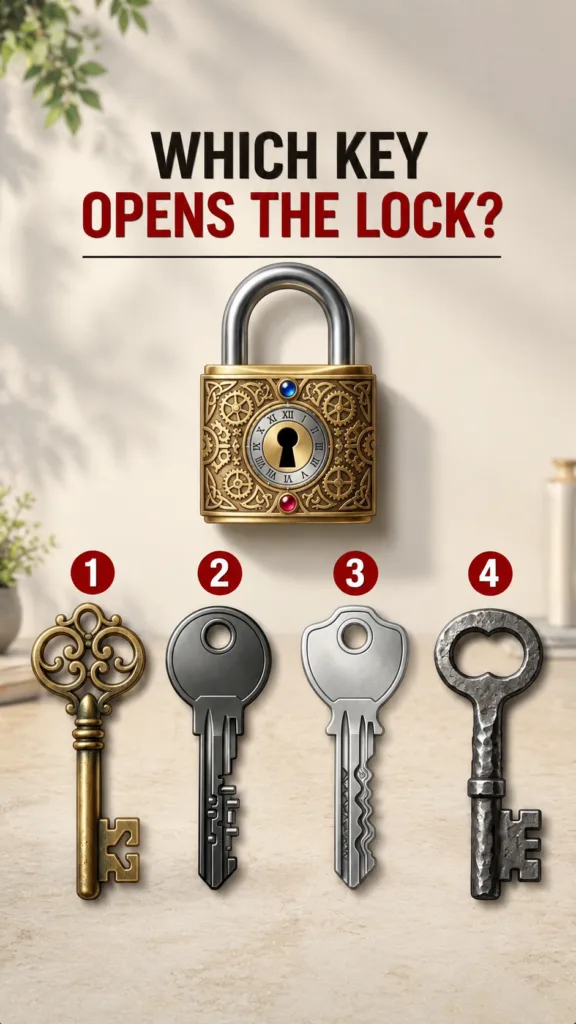
At first glance, all four keys look like they could fit the lock. They each have a different design, making it easy to overthink the puzzle. However, if you carefully compare the shape of the key’s bit—the part that actually interacts with the lock—you’ll notice that only one key has the correct profile.
Step 1: Focus on the Working End
The decorative handle doesn’t matter.
Instead, look closely at the bottom part of each key where it would enter and turn inside the lock.
This is the section that determines whether a key can unlock the mechanism.
Step 2: Compare Each Key
Key 2:
Its modern laser-cut grooves are designed for a completely different type of lock, so it cannot match this traditional keyhole.
Key 3:
Although it has a classic shape, the long wavy grooves don’t match the lock’s simple internal mechanism.
Key 4:
This old iron key has a large, thick bit that is shaped differently from what the lock requires.
Step 3: The Perfect Match
Key 1 has the correct traditional skeleton-key design.
Its bit is properly positioned and shaped to fit the lock’s classic keyhole, making it the only key that could realistically turn the mechanism.
✅ Correct Answer: Key 1
Many people are distracted by the detailed modern keys and assume the more complicated design must be correct. In reality, this vintage lock is meant to be opened with a classic skeleton key.
Sometimes the simplest answer is the right one!
Did you choose Key 1, or did one of the other keys trick you? 🔑😄