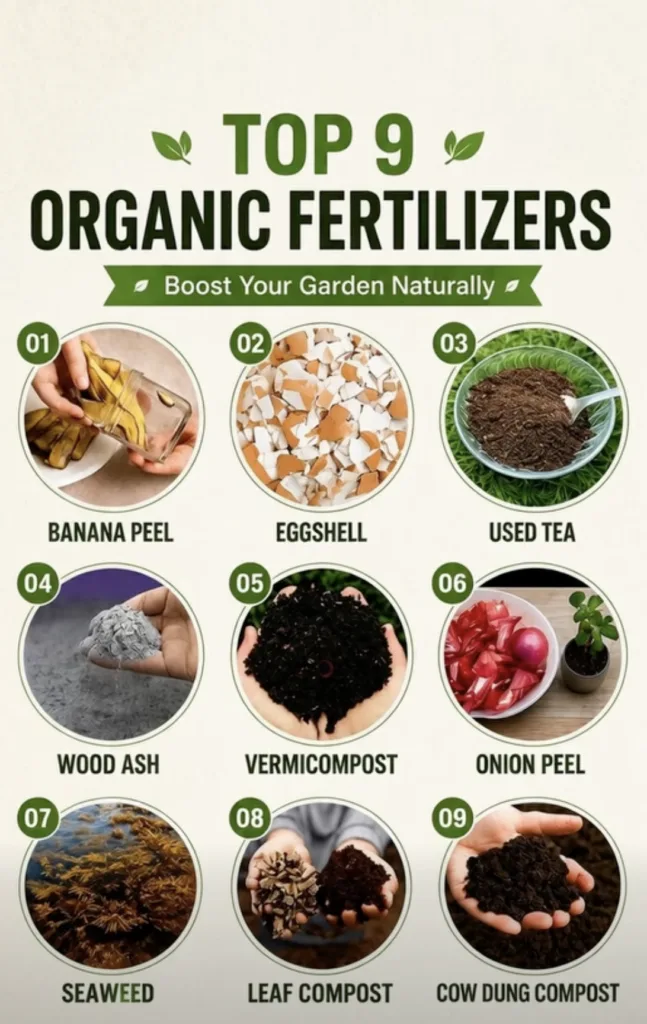
Want healthier plants, richer soil, and a more productive garden without relying heavily on synthetic fertilizers? Some of the best natural soil boosters may already be sitting in your kitchen, compost pile, or backyard.
From banana peels and eggshells to leaf compost and vermicompost, these everyday materials can return valuable nutrients and organic matter to the soil.
Here are 9 organic fertilizers worth saving instead of throwing away.
1. Banana Peels
Banana peels are commonly added to compost because they contain potassium along with smaller amounts of other plant nutrients.
Potassium plays an important role in overall plant health, including water regulation and normal flower and fruit development.
Best way to use them: Chop banana peels into small pieces and add them to your compost pile, or bury small amounts beneath the soil where they can gradually decompose.
Avoid leaving whole peels on the soil surface, as they can attract pests.
2. Eggshells
Don’t toss those eggshells after breakfast.
Eggshells are primarily made of calcium carbonate, making them a useful source of calcium as they gradually break down.
Because decomposition can be slow, crushing clean, dry eggshells into very small pieces or powder increases their surface area.
Best way to use them: Rinse, dry, crush, and mix them into compost or soil.
Think of eggshells as a slow soil amendment rather than an instant fertilizer.
3. Used Tea Leaves
Finished your morning tea? Your garden may appreciate what’s left.
Used tea leaves can be added to compost, where they contribute organic material and nutrients as they decompose.
Best way to use them: Remove staples, strings, and any non-compostable tea bags before adding the leaves to your compost.
Used tea is especially convenient because it’s something many households produce almost every day.
4. Wood Ash
If you burn clean, untreated wood, a small amount of the resulting ash can sometimes be useful in the garden.
Wood ash contains potassium, calcium, and other minerals. However, it is also alkaline and can raise soil pH.
That means more is definitely not better.
Best way to use it: Apply sparingly and ideally test your soil before using wood ash regularly.
Never use ash from painted or treated wood, trash, charcoal briquettes, or other materials that may contain unwanted chemicals.
5. Vermicompost
Vermicompost—often called worm castings—is one of the most versatile additions you can make to garden soil.
Worms process organic material into a dark, crumbly amendment that adds organic matter and supports a biologically active soil environment.
It can be used for vegetables, herbs, flowers, containers, and garden beds.
Best way to use it: Mix a modest amount into potting mixes or garden soil, or apply it around established plants as a top dressing.
6. Onion Peels
Onion skins and scraps don’t need to go straight into the trash.
Like many vegetable scraps, they can become valuable ingredients in a balanced compost pile. Over time, microorganisms break them down and return their organic matter to the soil.
Best way to use them: Add onion peels to compost alongside a balanced mixture of nitrogen-rich “greens” and carbon-rich “browns.”
It’s simple, free, and reduces kitchen waste at the same time.
7. Seaweed
If you have access to seaweed that can be legally and responsibly collected, it can be a useful addition to compost and garden soil.
Seaweed contains various minerals and micronutrients and breaks down into organic matter.
Best way to use it: Rinse away excess salt when appropriate, chop it into smaller pieces, and add it to compost or use a thin layer as part of a mulch.
Always follow local rules before collecting seaweed from beaches or coastal environments.
8. Leaf Compost
Those autumn leaves covering the yard aren’t necessarily waste—they’re future soil.
Decomposed leaves create valuable organic matter that can improve soil structure and its ability to hold moisture.
Leaves are particularly useful for making leaf mold, a simple soil conditioner produced by allowing fallen leaves to decompose over time.
Best way to use it: Shred leaves to speed decomposition, pile them in a designated area or compost bin, keep them slightly moist, and give nature time to work.
9. Composted Cow Manure
Properly composted cow manure can add both nutrients and organic matter to garden soil.
The important word here is composted.
Fresh manure may contain excessive nutrients, salts, weed seeds, or pathogens and isn’t appropriate for casually applying around food crops.
Best way to use it: Choose well-composted or commercially prepared manure and incorporate it according to the product directions and the needs of your soil.
The Secret Isn’t One “Miracle” Fertilizer
A thriving garden usually doesn’t come from finding one magical ingredient.
Healthy soil is built over time.
Compost, decomposed leaves, kitchen scraps, worm castings, and other organic materials can work together to improve soil structure, recycle nutrients, encourage biological activity, and reduce household waste.
Before adding any amendment, remember that different plants and soils have different needs. A simple soil test can help you understand your soil’s pH and nutrient levels so you can add what your garden actually needs instead of guessing.
Turn Waste Into Garden Gold 🌱
The next time you’re about to throw away banana peels, eggshells, tea leaves, onion skins, or fallen leaves, consider whether they could go into your compost instead.
Your trash bin may get a little emptier—and your garden soil may become a whole lot richer.
Which of these 9 organic fertilizers do you already use in your garden? Share your favorite gardening trick with us!