Meta description: Which key opens the lock? Discover why B is the intended answer, spot the matching wavy lines, and see how the other keys differ in this visual puzzle.
URL slug: which-key-opens-the-lock-answer
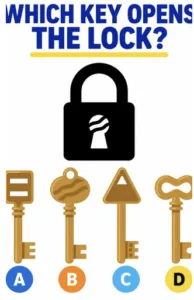
Image alt text: Visual puzzle showing a black padlock with a striped keyhole above four gold keys labeled A, B, C, and D.
Which Key Opens the Lock? Answer B Explained
Four golden keys. One black padlock. A small detail that makes the difference. If you have been studying this picture and wondering which key opens the lock, the intended answer is B.
The clue is the pair of wavy stripes inside the rounded top of the keyhole. Key B repeats that distinctive pattern on its round head, making it the visual match.
Why Is B the Answer?
Start by looking closely at the lock rather than the teeth of the keys. Its white keyhole has a rounded upper section crossed by two dark, curved stripes.
Now compare that design with the four options. Key B has a round gold head decorated with two darker wavy stripes. Both the rounded shape and the flowing pattern connect it to the clue inside the lock.
This is a visual association puzzle: the matching decoration points to the intended answer. It does not demonstrate that a real key with this design would operate a real lock.
How the Four Keys Compare
OptionDistinctive detailMatches the striped clue?ARectangular head with two straight horizontal openingsNo: its openings are straight, not wavy.BRound head with two darker wavy stripesYes: it repeats the keyhole’s distinctive pattern.CTriangular head with a small triangular openingNo: it does not repeat the circular striped design.DBow-shaped head with two connected rounded openingsNo: it lacks the pair of wavy stripes.
All four keys have different teeth, which can draw your attention toward their lower ends. However, the picture gives no view of the lock’s internal mechanism. The clearest clue available is the repeated pattern near the top.
The Detail That Makes This Puzzle Tricky
The question asks which key opens the lock, so it is natural to compare the notches first. Yet the illustration places its most useful clue somewhere else: inside the keyhole itself.
Looking back and forth between the keyhole and each key head makes the connection easier to spot. Once you notice the two wavy stripes, B stands apart from the other choices.
For similar picture puzzles, compare shapes, repeated patterns, and the direction of lines before making a choice. A small decoration may be more useful than the largest object in the image.
Frequently Asked Questions
Which key is the intended answer?
Key B. Its round head and two wavy stripes match the visual clue in the lock.
Do the key’s teeth prove that B would open the lock?
No. The image supports B through pattern matching, not through a mechanical demonstration. Real locks depend on the correct key profile and internal mechanism, not matching decorations.
What is the quickest way to spot the clue?
Look at the rounded section of the keyhole, then find the key with the same pair of wavy stripes. That leads directly to B.
Did you choose B immediately, or did you compare the teeth first? Share your answer in the comments!