Remember that dazzling character from the Roaring Twenties quiz? Her elegant style and poised demeanor truly capture the essence of an unforgettable literary era.
With so many memorable figures emerging from classic novels, pinpointing just one from a single image can be surprisingly tricky.
You probably have a favorite in mind, a name whispered through the pages of time.
Take one last moment to confirm your guess, allowing the flapper fashion and vintage charm to guide your thoughts.
Ready to discover if your literary intuition was spot on?
The correct answer is B — Daisy Buchanan. 📚
If you chose option B, you’ve successfully identified one of literature’s most iconic and complex figures from F. Scott Fitzgerald’s timeless novel, The Great Gatsby. The image perfectly encapsulates Daisy’s blend of beauty, wealth, and a certain elusive charm that defined the Jazz Age.
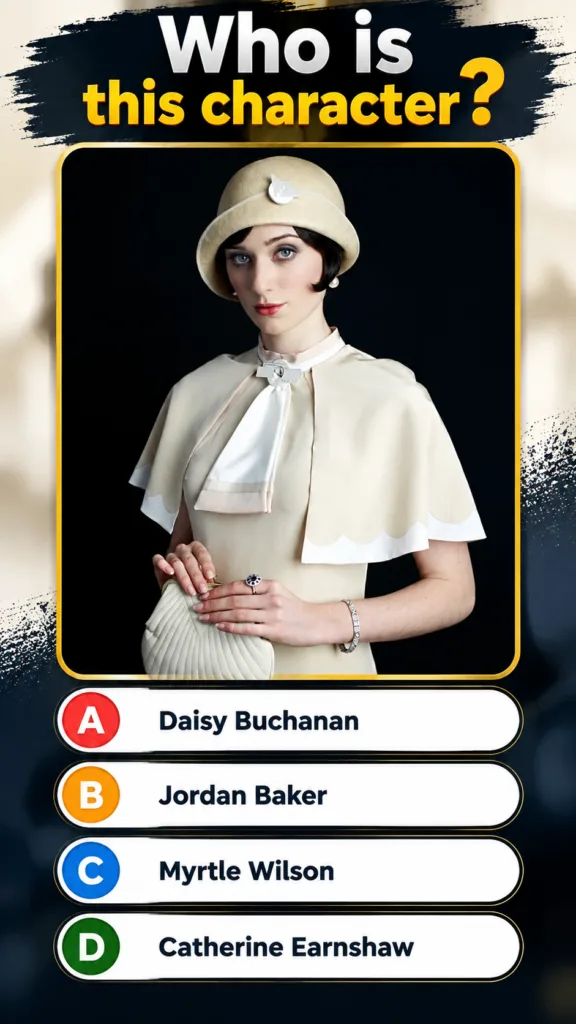 The character’s iconic style captures the essence of the Jazz Age.
Stepping into the Jazz Age
The 1920s, famously dubbed the Jazz Age by Fitzgerald himself, was a decade of unprecedented economic prosperity, cultural change, and social upheaval. It was a time when traditions were challenged, women gained more freedom, and a new kind of glamorous, often reckless, lifestyle emerged. Flapper fashion, jazz music, speakeasies, and extravagant parties became symbols of this vibrant era. Fitzgerald masterfully captured this spirit in The Great Gatsby, creating a world where immense wealth and moral decay often went hand-in-hand.
The Enigmatic Daisy Buchanan
Daisy Fay Buchanan is perhaps one of the most enigmatic characters in American literature. She is the cousin of the narrator, Nick Carraway, and the object of Jay Gatsby’s obsessive affection. Raised in old money Louisville, Daisy embodies the careless charm and superficiality of the East Egg elite. She is beautiful, captivating, and alluring, but also indecisive, materialistic, and ultimately, morally weak. Her voice, described by Gatsby as being “full of money,” perfectly symbolizes her allure and her ultimate inability to escape the trappings of her privileged but unfulfilling life.
Throughout the novel, Daisy struggles between the passionate, idealistic love offered by Gatsby and the comfortable, secure, yet adulterous life she shares with her husband, Tom Buchanan. Her actions, or lack thereof, drive much of the tragic plot, leaving readers to ponder her true feelings and the constraints placed upon women of her social standing during the era.
The Great Gatsby: A Timeless Masterpiece
Published in 1925, The Great Gatsby is widely considered one of the greatest American novels ever written. F. Scott Fitzgerald’s lyrical prose, intricate symbolism, and profound exploration of themes like the American Dream, social class, wealth, idealism, and love have resonated with generations of readers. Set in the summer of 1922 on Long Island, the story is narrated by Nick Carraway, who becomes entangled in the lives of his mysterious millionaire neighbor, Jay Gatsby, and his captivating cousin, Daisy.
Despite initial mixed reviews and modest sales during Fitzgerald’s lifetime, the novel gained significant recognition after his death, particularly during World War II, and has since become a staple in high school and university curricula worldwide. Its portrayal of the Jazz Age serves as both a dazzling spectacle and a poignant critique of the moral emptiness beneath the glitter.
Why Daisy Endures in Literature
Daisy Buchanan’s enduring presence in literature stems from her complex and often frustrating portrayal. She is not a straightforward heroine or villain, but a character who reflects the social and moral ambiguities of her time. Her beauty and charm are undeniable, yet her capacity for carelessness and her ultimate retreat into the safety of her wealth make her a tragic figure, both a victim and an instigator of the novel’s heartbreaking events.
Readers continue to debate whether Daisy truly loved Gatsby, if she was trapped by circumstance, or if she was simply too shallow to truly pursue happiness outside of her gilded cage. This ambiguity ensures her place as a fascinating subject of literary analysis and a compelling character whose choices continue to spark discussion and introspection.
Did You Get It Right? 👀
So, if you picked B, you were right — the elegant woman in the photo was indeed Daisy Buchanan, the captivating character from The Great Gatsby. Did her iconic 1920s style immediately give her away, or did the options make you second-guess your initial literary hunch?