 The Answer Is D — Jude Law
Yes, the young man in the photo is Jude Law.
Years before he became known for sophisticated dramas, thrillers, historical films, and major Hollywood franchises, Jude Law was a young British actor building his reputation on stage and screen.
His distinctive appearance made him instantly recognizable: blond hair, striking blue eyes, strong cheekbones, and an elegant but slightly unconventional screen presence.
But his career became much more than his looks.
Over the decades, Law developed into an actor capable of moving between romantic leads, villains, literary adaptations, blockbusters, independent films, television, and classical theatre.
Growing Up in London
Jude Law was born David Jude Heyworth Law on December 29, 1972, in London, England.
He grew up in a family connected to education, and acting entered his life at a relatively young age.
Law began performing professionally as a teenager and developed much of his early craft through theatre.
This stage background would remain important throughout his career.
Unlike actors who moved immediately into Hollywood films, Law spent years building experience in British television and theatre before becoming an international movie star.
His Early Acting Years
One of Law’s earliest television appearances came while he was still young.
During the late 1980s and early 1990s, he began taking increasingly substantial roles in British productions.
At the same time, he was building a stage career.
That theatre work became especially important because it established him as a serious actor before Hollywood audiences really knew his name.
In 1995, Law earned a Tony Award nomination for his performance in Indiscretions, the Broadway production of Jean Cocteau’s Les Parents terribles.
It was an early indication that he was capable of much more than simply being photographed as a handsome young actor.
Breaking Into Movies
Law gradually moved into cinema during the 1990s.
One of the films that brought him greater attention was Gattaca (1997).
He played Jerome Eugene Morrow, a genetically gifted former athlete living in a futuristic society obsessed with genetic perfection.
The film paired Law with Ethan Hawke and Uma Thurman.
Although Gattaca was not initially a massive commercial blockbuster, it later developed a strong reputation and became one of the most remembered science-fiction films of the 1990s.
Law’s performance stood out because Jerome was both charismatic and deeply damaged.
It was an early example of the kind of complicated characters Law would repeatedly play throughout his career.
The Talented Mr. Ripley Changed Everything
The major international breakthrough came in 1999 with The Talented Mr. Ripley, directed by Anthony Minghella.
Law played Dickie Greenleaf, a wealthy, charming young American living an enviable life in Italy.
The film starred:
- Matt Damon
- Gwyneth Paltrow
- Cate Blanchett
- Philip Seymour Hoffman
- Jude Law
Dickie is magnetic, privileged, carefree, and sometimes cruel.
That combination made the role perfect for Law.
His performance became one of the defining moments of his early career.
For the role, Law received an Academy Award nomination for Best Supporting Actor.
He also won the BAFTA Award for Supporting Actor for the same performance.
After The Talented Mr. Ripley, Jude Law was no longer simply an emerging British actor.
He had become an international star.
Why Dickie Greenleaf Became Such an Iconic Role
Part of the appeal of Dickie Greenleaf was the lifestyle surrounding him.
Beautiful Italian locations, expensive clothing, jazz, sailing, beaches, and an apparently effortless life made the character seem almost impossibly glamorous.
But beneath that charm was something colder.
Law was able to make Dickie attractive and unsettling at the same time.
That tension became one of the most memorable elements of the film.
Even decades later, images of Jude Law from The Talented Mr. Ripley remain some of the most recognizable photographs from his career.

A.I. Artificial Intelligence
In 2001, Law appeared in Steven Spielberg’s A.I. Artificial Intelligence.
He played Gigolo Joe, a highly advanced robotic companion.
It was a very different role from the sophisticated young men he had played previously.
The character was charming, theatrical, artificial, and strangely human at the same time.
Law’s performance helped give the film some of its most memorable moments.
The role also demonstrated his willingness to take unusual parts rather than simply remain a conventional romantic leading man.
Road to Perdition
In 2002, Law appeared in Road to Perdition, directed by Sam Mendes.
The film starred Tom Hanks and Paul Newman.
Law played Harlen Maguire, a sinister photographer and assassin.
For the role, his appearance was dramatically altered.
His hairline, teeth, skin, clothing, and overall presentation were designed to make him look uncomfortable and unsettling.
It was almost the opposite of the glamorous image audiences associated with him.
That transformation helped prove that Law was willing to sacrifice his leading-man appearance for a character.
Cold Mountain
Another major career milestone arrived with Cold Mountain (2003).
Law played W. P. Inman, a Confederate soldier attempting to return home to the woman he loves during the American Civil War.
Nicole Kidman played Ada Monroe, while Renée Zellweger played Ruby Thewes.
The role required Law to carry a large historical drama built around war, survival, romance, and physical hardship.
His performance earned him another major awards-season recognition.
He received an Academy Award nomination for Best Actor and a BAFTA nomination for Leading Actor. BAFTA’s archive lists Law among the 2004 Leading Actor nominees for Cold Mountain.
Sky Captain and the World of Tomorrow
In 2004, Law starred in Sky Captain and the World of Tomorrow.
He played the title character, Joe “Sky Captain” Sullivan.
The movie was notable for its extensive use of digital environments and stylized visual effects.
It looked intentionally like an old pulp adventure brought to life with modern technology.
The film also starred Gwyneth Paltrow and Angelina Jolie.
Although unusual for its time, it demonstrated Law’s willingness to work in experimental productions.
Closer
That same year, Law appeared in Closer (2004).
The cast included:
- Julia Roberts
- Natalie Portman
- Clive Owen
- Jude Law
Law played Dan Woolf, a writer caught in a complicated and destructive web of relationships.
The film was intimate, uncomfortable, and emotionally harsh.
It showed a very different side of Law from the polished movie-star image audiences often associated with him.
The Holiday
For many viewers, one of Law’s most beloved roles came in The Holiday (2006).
He played Graham Simpkins, the brother of Kate Winslet’s character.
Cameron Diaz starred opposite him.
Unlike many of his darker or more complicated roles, Graham was warm, romantic, vulnerable, and family-oriented.
The film became a holiday favorite and helped introduce Law to viewers who may not have seen his earlier dramatic work.
For a large part of the audience, Graham remains one of his most charming characters.
Sherlock Holmes
A major blockbuster chapter began in 2009.
Law starred opposite Robert Downey Jr. in Sherlock Holmes, directed by Guy Ritchie.
Downey played Sherlock Holmes.
Law played Dr. John Watson.
Instead of portraying Watson simply as a quiet assistant, Law presented him as intelligent, capable, disciplined, and physically confident.
The chemistry between Holmes and Watson became one of the film’s central attractions.
The movie was successful enough to lead to Sherlock Holmes: A Game of Shadows (2011).
Watson became one of Law’s most widely recognized mainstream roles.
Anna Karenina
In Anna Karenina (2012), Law played Alexei Karenin, the husband of Keira Knightley’s Anna.
The role was deliberately restrained.
Karenin is emotionally controlled, formal, and deeply affected by his wife’s affair.
Instead of playing him as a simple villain, Law brought considerable sadness and dignity to the character.
BAFTA records from the production list Law as Karenin alongside Knightley, Aaron Taylor-Johnson, Matthew Macfadyen, Domhnall Gleeson and others.
The Grand Budapest Hotel
Law also appeared in Wes Anderson’s The Grand Budapest Hotel (2014).
He played the younger version of The Author.
Although his role was relatively small, the film became one of the most celebrated movies of that decade.
It also showed how comfortably Law could move between major leading roles and smaller ensemble performances.
Spy
In Spy (2015), Law leaned into comedy again.
He played Bradley Fine, a polished secret agent whose confidence is almost exaggerated.
The film starred Melissa McCarthy, Jason Statham, Rose Byrne, and Miranda Hart.
Law’s performance played with the image audiences had of him as the handsome, sophisticated leading man.
Rather than taking that image too seriously, the film turned it into part of the joke.
Becoming Albus Dumbledore
A new generation of viewers discovered Law when he joined the Fantastic Beasts series.
He played a younger version of Albus Dumbledore, a character previously associated with the Harry Potter films.
Law appeared as Dumbledore in:
Fantastic Beasts: The Crimes of Grindelwald — 2018
and
Fantastic Beasts: The Secrets of Dumbledore — 2022
Taking on such a familiar fictional character was a significant challenge because audiences already had strong expectations.
Law portrayed Dumbledore as younger, more physically active, and still dealing with difficult events from his past.
Captain Marvel
In Captain Marvel (2019), Law entered the Marvel Cinematic Universe.
He played Yon-Rogg, commander of an elite Kree military unit.
The role placed him opposite Brie Larson’s Carol Danvers.
It added another major blockbuster franchise to a career that had already included historical drama, literary adaptation, science fiction, comedy, romance, and detective films.
Television and The Young Pope
One of Law’s most acclaimed later performances came on television.
In The Young Pope (2016), created by Paolo Sorrentino, he played Lenny Belardo, who becomes Pope Pius XIII.
The character is young, mysterious, authoritarian, charismatic, unpredictable, and deeply contradictory.
The series gave Law a huge amount of dramatic material to work with.
He later returned to the role in The New Pope.
It was another example of Law moving away from conventional leading-man roles into more unusual character-driven projects.
Return to Neverland
Law later played Captain Hook in Disney’s Peter Pan & Wendy (2023).
Again, it was an example of him taking a familiar character and approaching it differently.
By this stage of his career, Law had moved comfortably into older and more eccentric roles.
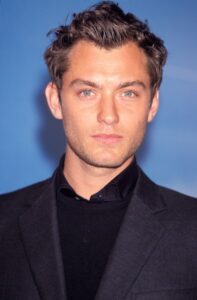
That transition is particularly interesting when compared with photographs of him from his youth.
Some of Jude Law’s Most Memorable Roles
Gattaca — 1997
Role: Jerome Eugene Morrow
A breakthrough science-fiction performance.
The Talented Mr. Ripley — 1999
Role: Dickie Greenleaf
The role that made him an international star and brought him an Oscar nomination and a BAFTA win.
A.I. Artificial Intelligence — 2001
Role: Gigolo Joe
One of his most unusual early characters.
Road to Perdition — 2002
Role: Harlen Maguire
A dark transformation that contrasted sharply with his glamorous public image.
Cold Mountain — 2003
Role: W. P. Inman
A major dramatic leading role that brought further awards recognition.
Closer — 2004
Role: Dan Woolf
A complicated romantic drama.
The Holiday — 2006
Role: Graham Simpkins
One of his most beloved romantic roles.
Sherlock Holmes — 2009
Role: Dr. John Watson
A hugely popular reinterpretation of the classic character.
Anna Karenina — 2012
Role: Alexei Karenin
A restrained and emotional period-drama performance.
The Grand Budapest Hotel — 2014
Role: Young Author
Part of one of Wes Anderson’s best-known ensemble films.
Spy — 2015
Role: Bradley Fine
A comedic twist on his suave leading-man image.
The Young Pope — 2016
Role: Lenny Belardo / Pope Pius XIII
One of his most distinctive television performances.
Fantastic Beasts — 2018–2022
Role: Albus Dumbledore
A younger interpretation of one of modern fantasy cinema’s most recognizable characters.
Captain Marvel — 2019
Role: Yon-Rogg
His entrance into the Marvel Cinematic Universe.
From Heartthrob to Character Actor
One of the most interesting aspects of Jude Law’s career is how his public image changed.
During the late 1990s and early 2000s, he was frequently presented as one of Hollywood’s most handsome leading men.
But Law repeatedly chose roles that challenged that image.
He played damaged men.
Villains.
Robots.
Historical figures.
Romantic leads.
Detectives.
Religious leaders.
Fantasy characters.
Comedy roles.
Even when he could easily have stayed within one type of character, he continued experimenting.
That variety is a major reason his career has lasted for decades.
A Career Built on Both Film and Theatre
Law never completely abandoned the stage.
His theatre work has remained an important part of his identity as an actor.
His early Broadway work earned him a Tony nomination in 1995, demonstrating that his reputation as a performer existed before his Hollywood breakthrough.
That stage foundation also helps explain the confidence and precision that often appear in his screen performances.
Two Academy Award Nominations
Jude Law’s career includes two major Academy Award acting nominations.
His first came for The Talented Mr. Ripley, in which he was nominated for Supporting Actor.
His second came for his leading performance in Cold Mountain.
These two films are important because they represent two different stages of his early career.
One established him internationally.
The other confirmed that he could carry a large dramatic film as its leading man.
Why This Young Photo Makes Such a Good Quiz
Young photographs of Jude Law are particularly effective for a celebrity quiz.
Many viewers recognize the blue eyes and facial structure immediately.
But the blond hair, youthful face, and very different styling can still make people hesitate.
For audiences who mainly remember him from Sherlock Holmes, Fantastic Beasts, or his later television work, the transformation can be striking.
That creates the perfect quiz reaction:
“I know those eyes… but who is that?”
And once the answer is revealed, the resemblance suddenly becomes obvious.
More Than Just a Famous Face
Jude Law’s career is a good example of how a young actor can outgrow the image that first made him famous.
His looks helped make him one of the recognizable faces of late-1990s and early-2000s cinema.
But his longevity came from something else.
He kept choosing different kinds of characters.
From Dickie Greenleaf to Dr. Watson, from Pope Pius XIII to Albus Dumbledore, his career has continually shifted.
That is why an old photograph of him can feel like looking at a completely different era of Hollywood.
Did you recognize Jude Law immediately, or did this young photo fool you?