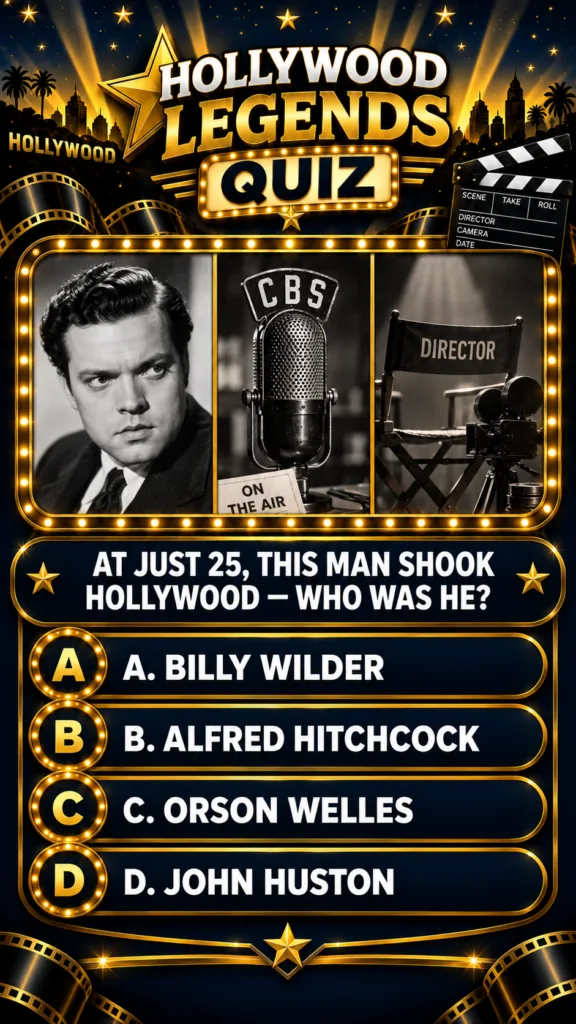
Imagine being just 25 years old and already having completely revolutionized an entire industry. For most, that age is a time of figuring things out, perhaps starting a career, or still exploring passions. But for one visionary, it was the age when he premiered one of the most discussed and influential films in cinematic history. We’re talking about the legendary Orson Welles.
The brief quiz graphic you might have seen highlights a pivotal moment for this titan of the screen. If you guessed Orson Welles, you’re absolutely correct! His journey to Hollywood was unlike any other, marked by an almost unbelievable level of creative freedom and a relentless drive to innovate.
From Radio Waves to Silver Screens
Welles seemed to burst onto the American entertainment scene as if the normal rules of career progression simply didn’t apply to him. Before making his indelible mark on Hollywood, he had already made significant waves in the worlds of theater and radio.
With his renowned Mercury Theatre company, Welles proved his innovative spirit and directorial prowess. But it was his 1938 radio adaptation of H.G. Wells’s The War of the Worlds that truly cemented his reputation nationwide. Presented in the style of a realistic news broadcast, it famously caused widespread panic among listeners who believed an actual alien invasion was underway. This audacious production became one of the most legendary moments in American radio history, showcasing his mastery of suspense and narrative.
Hollywood Calls: Unprecedented Freedom
Such a spectacular track record naturally caught the attention of Hollywood studios. What set Welles apart was the extraordinary level of creative freedom he was granted—a rarity for any filmmaker, let alone a newcomer to the movie industry. RKO Pictures essentially gave him carte blanche, allowing him to write, direct, produce, and even star in his debut feature film.
The Birth of a Masterpiece: Citizen Kane
The result of this unparalleled freedom was the 1941 cinematic masterpiece, Citizen Kane. Welles was only 25 when the film premiered, a fact that becomes even more remarkable when you consider the sheer ambition and groundbreaking nature of the movie. He not only co-wrote the screenplay with Herman J. Mankiewicz but also directed, produced, and played the central character, Charles Foster Kane.
Citizen Kane was a bold departure from traditional filmmaking conventions, introducing a myriad of techniques that would influence generations of filmmakers. These included:
- Unusual Camera Angles: Employing low-angle shots that showcased ceilings, a previously uncommon practice.
- Deep-Focus Photography: A technique perfected by cinematographer Gregg Toland, allowing elements in the foreground, middle ground, and background to all be in sharp focus simultaneously, adding incredible depth to scenes.
- Nonlinear Storytelling: The narrative unfolds through multiple flashbacks from different characters’ perspectives, piecing together Kane’s life in a complex, fragmented manner rather than a straightforward chronology.
- Complex Sound Design: Utilizing overlapping dialogue, innovative sound effects, and a layered audio landscape to create a more immersive and realistic auditory experience.
- Innovative Editing: Employing jump cuts and other dynamic editing techniques that were ahead of their time.
Each of these elements, combined with Welles’s visionary direction, made Citizen Kane a truly revolutionary work. It challenged audiences and critics alike, forever changing the way films were made and perceived.
A Lasting Legacy
Despite initial box office struggles and controversies, Citizen Kane quickly gained critical acclaim and has since been consistently ranked among the greatest films ever made. Orson Welles’s audacious vision at such a young age continues to inspire filmmakers and cinephiles around the world. His legacy is a testament to the power of unbridled creativity and the courage to challenge the status quo, proving that true genius knows no age limit.