The Love Story That Sailed Into Movie History
Some movies are successful for a few months.
Some remain popular for a few years.
And then there are movies that become part of popular culture for generations.
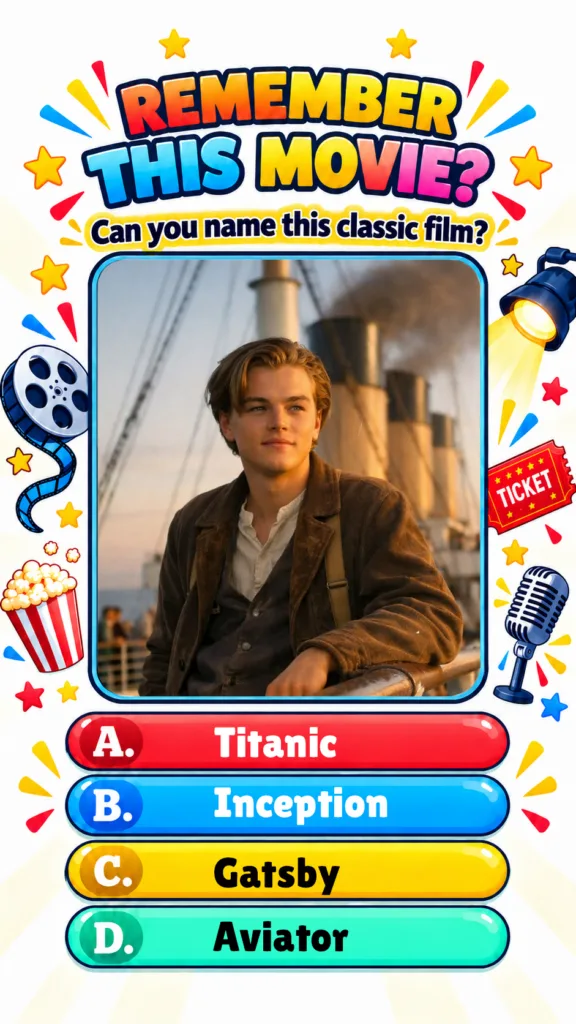
The film in today’s “Remember This Movie?” challenge belongs firmly in that last category.
One young man standing aboard a massive ocean liner.
A wealthy young woman trapped inside a life she never truly wanted.
A chance meeting.
A romance that should never have happened.
And a historic disaster that audiences already knew was coming.
Yet somehow, millions of viewers still hoped the ending might change.
If you selected:
A — Titanic
you got it right.
Released in 1997, Titanic became one of the defining movies of the 1990s and one of the most recognizable films in cinema history.
Directed, written, co-produced and co-edited by James Cameron, the film combines a fictional romance with the real-life sinking of the RMS Titanic in 1912.
At the center of the story are:
Leonardo DiCaprio as Jack Dawson
and:
Kate Winslet as Rose DeWitt Bukater.
But Titanic became much more than a romance.
It was also a technical achievement, a historical drama, a disaster film and a movie that transformed its two young leads into international stars.
The Story Begins in the Present
Interestingly, Titanic does not begin in 1912.
The film opens decades later.
A treasure hunter named:
Brock Lovett
played by Bill Paxton, is exploring the wreck of the Titanic.
He is searching for a valuable diamond known as:
The Heart of the Ocean.
During the expedition, his team discovers a drawing of a young woman wearing the necklace.
That drawing brings an elderly woman named Rose Dawson Calvert to the research vessel.
Played by Gloria Stuart, the older Rose begins telling the story of what happened aboard Titanic more than eighty years earlier.
And suddenly, the movie takes us back to:
April 1912.
Rose DeWitt Bukater
Young Rose, played by Kate Winslet, is traveling aboard Titanic with her wealthy fiancé:
Caledon “Cal” Hockley
played by Billy Zane.
She is also traveling with her mother:
Ruth DeWitt Bukater
played by Frances Fisher.
From the outside, Rose appears to have everything.
Money.
Social status.
Beautiful clothing.
A wealthy future husband.
But emotionally, she feels trapped.
Her marriage to Cal is less about love and more about preserving her family’s social position.
Rose feels as though her entire future has already been chosen for her.
Then she meets someone from the opposite side of society.
Jack Dawson
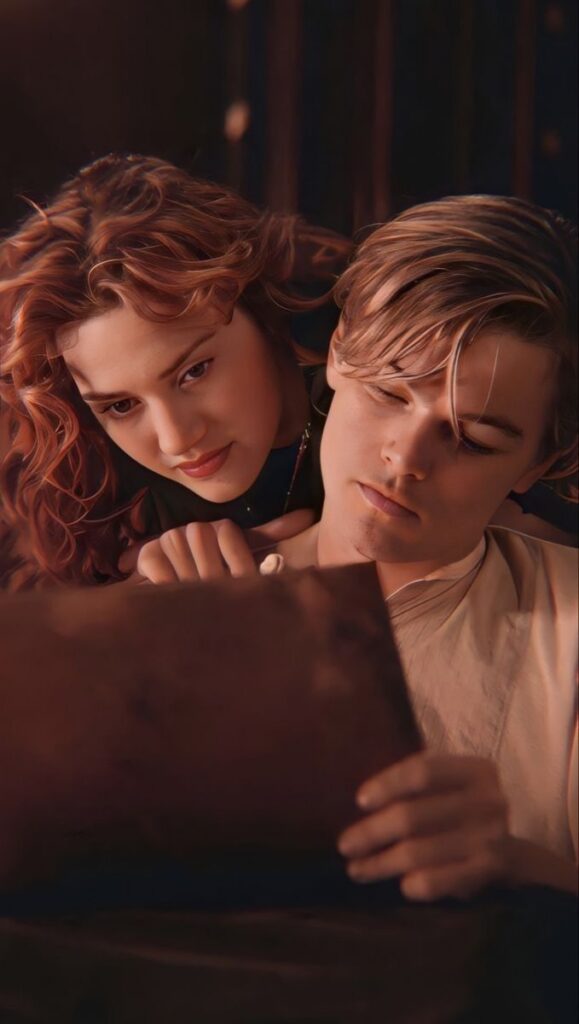
Jack Dawson is played by:
Leonardo DiCaprio.
Jack is a young artist with very little money.
He does not come from wealth.
He does not have powerful connections.
In fact, he wins his ticket aboard Titanic in a poker game shortly before the ship leaves Europe.
Jack travels in third class with his friend:
Fabrizio
played by Danny Nucci.
Jack’s life could not be more different from Rose’s.
He has almost nothing.
But he also has something Rose desperately wants.
Freedom.
Jack goes wherever life takes him.
He draws.
He travels.
He takes chances.
And he does not seem interested in living according to the rules of high society.
That difference becomes the heart of their relationship.
When Jack Meets Rose
One of the movie’s most important early scenes happens when Rose becomes overwhelmed by her situation.
She considers jumping from the ship.
Jack intervenes.
That moment becomes the beginning of their connection.
At first, Rose’s family sees Jack as socially inappropriate.
He is not from their world.
But Rose becomes fascinated by the way he lives.
He shows her a completely different perspective on life.
And gradually, the relationship moves from friendship into romance.
The Famous Dinner Scene
After Jack helps Rose, he is invited to dinner with the wealthy first-class passengers.
It is one of the film’s most memorable sequences because Jack suddenly finds himself surrounded by people from a completely different social class.
Among the passengers is:
Margaret “Molly” Brown
played by Kathy Bates.
Molly helps Jack prepare for dinner and lends him appropriate clothing.
At the table, Jack is questioned about his lifestyle.
Instead of appearing embarrassed, he confidently explains his philosophy.
He does not have a permanent home.
He does not know exactly where he will be tomorrow.
And he likes it that way.
For Rose, listening to Jack is almost revolutionary.
“Make It Count”
One idea runs throughout Jack’s character:
Life is unpredictable, so make every moment count.
That message helps explain why Rose becomes attracted to him.
Jack represents the kind of life she has never been allowed to imagine.
The famous first-class dinner eventually leads to something completely different.
Jack secretly invites Rose to a third-class party.
There, Rose dances, drinks and laughs with people far outside her social circle.
For perhaps the first time in the film, she looks genuinely free.
The Bow of the Ship
Then comes one of the most recognizable scenes in movie history.
Jack brings Rose to the front of Titanic.
She stands at the bow.
He helps her stretch out her arms.
The ocean surrounds them.
And Rose feels as though she is flying.
It became one of the defining images not only of Titanic, but of 1990s cinema.
Even people who have never watched the entire movie often recognize the pose immediately.
The Drawing Scene
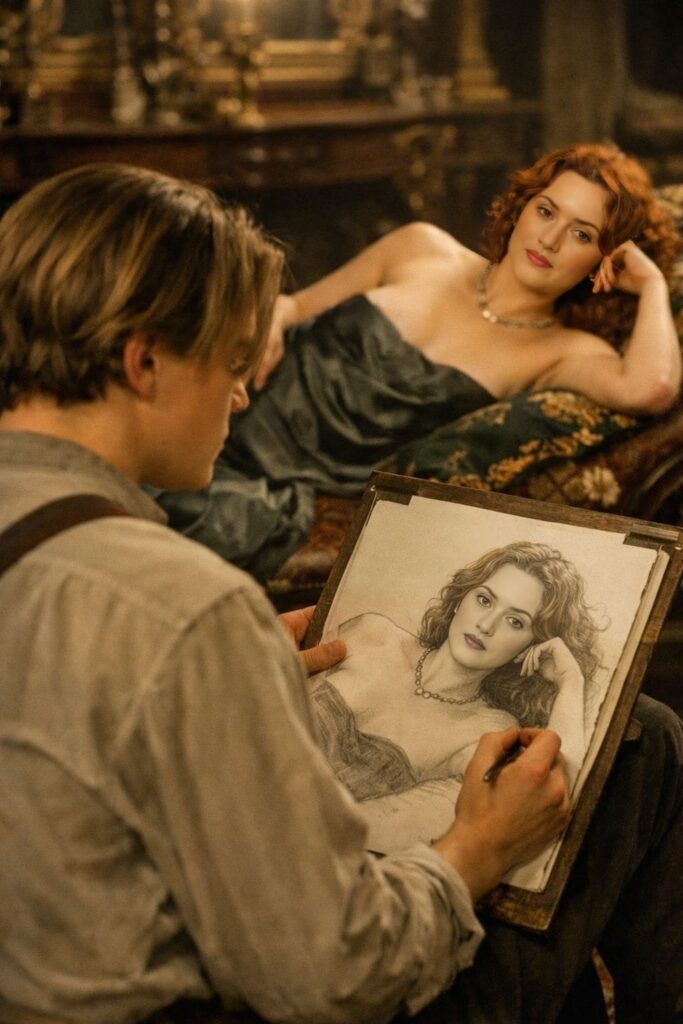
Another famous moment comes when Rose asks Jack to draw her.
She wears the:
Heart of the Ocean
diamond necklace.
Jack sketches her portrait.
That drawing later becomes the object discovered by Brock Lovett’s team at the beginning of the movie.
The scene connects the fictional love story with the modern-day investigation.
It also turns a simple drawing into evidence that Rose’s story really happened within the film’s world.
Cal Hockley
Billy Zane’s character:
Cal Hockley
is essential to the conflict.
Cal represents nearly everything Jack does not.
Wealth.
Power.
Status.
Possession.
He views Rose less as an independent person and more as part of the future he believes he owns.
As Rose becomes closer to Jack, Cal becomes increasingly controlling and angry.
Eventually, Jack is framed for stealing the Heart of the Ocean.
But while the personal conflict is reaching its peak, something much larger is about to happen.
April 14, 1912
Titanic is traveling across the North Atlantic.
The ship receives warnings about ice.
Then, late at night, the crew spots something directly ahead.
An iceberg.
The officers desperately attempt to turn the ship.
But Titanic cannot avoid the collision.
The iceberg scrapes along the ship’s side.
At first, the damage does not seem catastrophic to many passengers.
There is no enormous explosion.
No immediate dramatic collapse.
But below the surface, seawater begins entering several compartments.
The ship’s designer:
Thomas Andrews
played by Victor Garber, realizes the truth.
Titanic is going to sink.
“The Ship Can’t Sink”
One of the most powerful elements of the movie is the contrast between Titanic’s reputation and reality.
The ship had been presented as extraordinarily safe.
Many passengers initially struggle to believe the danger is serious.
The first-class areas still look elegant.
The lights remain on.
Music plays.
But the water continues rising.
And gradually, confidence becomes panic.
Captain Edward Smith
Veteran actor Bernard Hill plays:
Captain Edward John Smith.
The character is based on Titanic’s real captain.
As the scale of the disaster becomes clear, Smith realizes there are not enough lifeboats for everyone aboard.
That historical fact becomes one of the most terrifying elements of the movie.
Even if every lifeboat were filled properly, a large portion of the passengers and crew could not escape.
Women and Children First
The evacuation begins.
First-class passengers have easier access to the boat deck.
Third-class passengers face confusion, barriers and delays.
The movie repeatedly emphasizes the differences between social classes aboard the ship.
Jack and Rose now have to survive both:
Cal
and:
the sinking ship.
As the bow descends into the water, the angle of Titanic becomes increasingly steep.
Objects slide.
Glass breaks.
Passengers panic.
And the enormous ship begins turning into a deadly vertical structure.
The Musicians Keep Playing
One of the movie’s quietest moments becomes one of its most emotional.
As panic spreads, the ship’s musicians continue playing.
The bandleader eventually tells the others they can leave.
Instead, they return.
The film shows them continuing to perform as the ship approaches disaster.
The sequence symbolizes dignity in the middle of chaos.
It is a small moment compared with the enormous visual spectacle around it.
But it became one of the film’s most memorable emotional scenes.
The Final Break
Eventually, Titanic’s structure can no longer survive the forces acting upon it.
The ship breaks apart.
The stern rises high above the ocean.
Then it disappears beneath the water.
Thousands of people are suddenly left in the freezing North Atlantic.
The giant ship that once looked almost indestructible is gone.
And the movie becomes much quieter.
Jack and Rose in the Water
Jack helps Rose climb onto a piece of floating wreckage.
He remains in the freezing water.
The two wait for rescue.
This scene became one of the most debated moments in modern movie history.
For decades, viewers have discussed whether Jack could have climbed onto the floating debris with Rose.
But within the emotional logic of the film, the important point is Jack’s promise.
He tells Rose that she must survive.
She must live.
She must grow old.
She must continue the life she almost gave up at the beginning of the movie.
Jack Dawson’s Final Moment
Eventually, Jack dies from the cold.
Rose is nearly ready to give up as well.
Then she remembers her promise.
She attracts the attention of a returning lifeboat and is rescued.
When the survivors are brought aboard the RMS Carpathia, Rose gives her name as:
Rose Dawson.
It is a small but powerful choice.
She is no longer allowing Cal or her mother to define her life.
Jack is gone.
But the freedom he gave her remains.
The Photographs Beside Rose’s Bed
Near the end of the movie, we see photographs showing Rose’s later life.
She rode horses.
She traveled.
She flew airplanes.
She had a family.
She became the person Jack told her she could become.
That detail is important because Titanic is not simply a tragedy about Jack dying.
It is also a story about Rose surviving.
Jack changes her life even though he is only part of it for a few days.
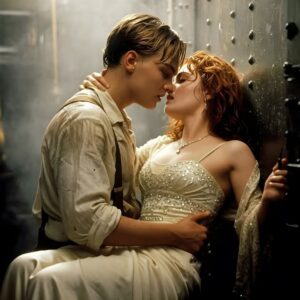
The Final Staircase Scene
After Rose finishes telling her story, the film presents one final dreamlike sequence.
We return to Titanic.
But this time, the ship is beautiful again.
The passengers who died are present.
Rose walks toward the grand staircase.
Jack is waiting for her.
They meet.
They kiss.
Everyone applauds.
The clock behind Jack marks the moment.
It is one of the most emotional endings in 1990s cinema.
The Cast of Titanic
Here are several of the major characters and performers:
ActorCharacterLeonardo DiCaprioJack DawsonKate WinsletRose DeWitt BukaterBilly ZaneCaledon HockleyKathy BatesMolly BrownFrances FisherRuth DeWitt BukaterGloria StuartOlder RoseBill PaxtonBrock LovettVictor GarberThomas AndrewsBernard HillCaptain Edward SmithJonathan HydeJ. Bruce IsmayDavid WarnerSpicer LovejoyDanny NucciFabrizioSuzy AmisLizzy Calvert
The combination of fictional characters and real historical figures helps the movie move between romance and historical drama.
Leonardo DiCaprio as Jack Dawson
For Leonardo DiCaprio, Titanic changed everything.
He had already proven himself as a serious young actor.
His performance in:
What’s Eating Gilbert Grape — 1993
had earned him an Academy Award nomination while he was still a teenager.
He had also appeared in:
This Boy’s Life — 1993
The Basketball Diaries — 1995
Romeo + Juliet — 1996
But Jack Dawson transformed DiCaprio from a respected young actor into an international superstar.
His image appeared everywhere.
Magazines.
Posters.
Television.
Fan collections.
For millions of viewers, particularly during the late 1990s, Leonardo DiCaprio became one of the defining young faces of Hollywood.
Kate Winslet as Rose
Kate Winslet’s Rose is equally essential.
Rose begins the story feeling powerless.
Her clothes, marriage, social life and future have all been chosen for her.
By the end, she has effectively created an entirely new identity.
Winslet’s performance earned her an Academy Award nomination for Best Actress.
She was only in her early twenties when the film was released.
Like DiCaprio, Titanic became a defining early chapter in a career that would continue for decades.
Leonardo DiCaprio and Kate Winslet After Titanic
One of the most beloved aspects of Titanic is the friendship that continued between its two stars.
Years later, DiCaprio and Winslet reunited onscreen for:
Revolutionary Road — 2008.
But the new film could hardly have been more different.
Jack and Rose were young lovers fighting against society and disaster.
Frank and April Wheeler were a married couple whose relationship was falling apart.
For viewers who remembered Titanic, seeing the actors together again created an enormous emotional contrast.
James Cameron’s Massive Gamble
Today, it is easy to look at Titanic as an obvious blockbuster.
Before release, it looked much riskier.
James Cameron attempted to recreate one of history’s most famous maritime disasters on an enormous scale.
The production required:
large sets,
complex water effects,
miniatures,
visual effects,
historical research,
costumes,
and extensive stunt work.
The movie was extraordinarily expensive for its time.
Industry observers questioned whether such a costly historical romance could earn enough money to justify its production.
Then audiences saw it.
Titanic Becomes a Worldwide Phenomenon
The movie opened in December 1997.
Instead of disappearing after a huge opening weekend, Titanic demonstrated remarkable staying power.
Audiences returned repeatedly.
The romance became a phenomenon.
The soundtrack became a phenomenon.
Leonardo DiCaprio became a phenomenon.
Kate Winslet became internationally famous.
And the movie eventually became one of the highest-grossing films ever made.
For years, Titanic held the record as the highest-grossing movie in worldwide box-office history.
James Cameron eventually broke his own record with:
Avatar.
“My Heart Will Go On”
It is nearly impossible to talk about Titanic without mentioning:
“My Heart Will Go On”
performed by:
Celine Dion.
Composed by James Horner, with lyrics by Will Jennings, the song became inseparable from the film.
The opening notes alone can immediately remind people of:
Jack.
Rose.
The ocean.
The ship.
The ending.
The song became one of the signature ballads of the 1990s.
It also won the Academy Award for:
Best Original Song.
James Horner’s Score
The movie’s music extends far beyond its famous song.
Composer:
James Horner
created a score that moves between:
romance,
wonder,
melancholy,
danger,
and tragedy.
Music plays a major role in shaping the emotional identity of the movie.
Some viewers may forget individual lines of dialogue.
But hearing a few seconds of the score can immediately bring back the feeling of Titanic.
14 Academy Award Nominations
At the 70th Academy Awards, Titanic received:
14 nominations.
That tied the record for the most Oscar nominations received by a single film at the time.
The nominations included:
- Best Picture
- Best Director
- Best Actress — Kate Winslet
- Best Supporting Actress — Gloria Stuart
- Cinematography
- Production Design
- Costume Design
- Film Editing
- Sound
- Sound Effects Editing
- Visual Effects
- Original Dramatic Score
- Original Song
- Makeup
Then came the wins.
11 Oscars
Titanic won:
11 Academy Awards.
Among them:
Best Picture
Best Director — James Cameron
Best Cinematography
Best Art Direction
Best Costume Design
Best Film Editing
Best Original Dramatic Score
Best Original Song
Best Sound
Best Sound Effects Editing
Best Visual Effects
Eleven Oscars placed Titanic among the most decorated films in Academy Awards history.
Historical Characters Inside the Story
Although Jack and Rose are fictional, many people aboard the film’s Titanic were real historical figures.
They include:
Captain Edward Smith
Thomas Andrews
the ship’s designer.
J. Bruce Ismay
chairman of the White Star Line.
Margaret “Molly” Brown
a real first-class passenger who survived the sinking.
The movie uses these historical figures to place its fictional love story inside a recognizable real-world tragedy.
Why the Movie Still Works
Technology has changed enormously since 1997.
Movies have become larger.
Visual effects have become more advanced.
But Titanic continues to attract viewers.
One reason is surprisingly simple:
the spectacle is not the main story.
Jack and Rose are.
The audience spends enough time with them before the collision that the disaster means something emotionally.
We know what Rose wants.
We understand Jack.
We understand their relationship.
Then the iceberg appears.
That structure turns a famous historical event into something personal.
More Than a Disaster Movie
At first glance, Titanic could be described as a movie about a sinking ship.
But that description misses most of the story.
It is about:
freedom
Rose wants control over her own life.
class
Jack and Rose live in completely different social worlds.
love
Their relationship is brief but transformative.
survival
Rose ultimately has to choose to keep living.
memory
Older Rose has carried Jack and Titanic with her throughout her life.
Those themes are why the movie continues to work even when everyone already knows the ship will sink.
That Is the Strange Magic of Titanic
Almost every viewer knows the ending before pressing play.
Titanic hits the iceberg.
Titanic sinks.
Jack dies.
Rose survives.
And yet people still watch.
Because the tension is not simply:
“Will the ship sink?”
We already know the answer.
The real questions are:
Will Jack and Rose escape?
What will happen to the passengers?
Will Rose choose the life Jack showed her?
And how will she remember what happened?
That is what gives the movie its emotional power.
Essential Titanic Facts
Movie: Titanic
Released: 1997
Director: James Cameron
Writer: James Cameron
Jack Dawson: Leonardo DiCaprio
Rose DeWitt Bukater: Kate Winslet
Cal Hockley: Billy Zane
Molly Brown: Kathy Bates
Older Rose: Gloria Stuart
Composer: James Horner
Famous Song: “My Heart Will Go On” — Celine Dion
Academy Award Nominations: 14
Academy Award Wins: 11
A Film That Defined the 1990s
Every generation has certain movies that become inseparable from its memories.
For many people who lived through the late 1990s, Titanic is one of those films.
Maybe you remember seeing it in a theater.
Maybe you owned the VHS tapes.
Maybe you had the soundtrack.
Maybe you heard “My Heart Will Go On” constantly on the radio.
Maybe you had a Leonardo DiCaprio poster.
Or maybe you watched the movie years later and finally understood why people had talked about it so much.
Whatever the case, Titanic became much more than another successful movie.
It became part of popular memory.
Final Thought
So if you chose:
A — Titanic
you recognized one of the most famous movies ever made.
More than two decades after its original release, audiences still remember:
Jack and Rose.
The bow of the ship.
The grand staircase.
The Heart of the Ocean.
The iceberg.
The musicians.
“My Heart Will Go On.”
And, of course:
“I’ll never let go.”
The ship disappeared beneath the Atlantic in 1912.
But James Cameron’s Titanic ensured that its story—and the fictional love story of Jack and Rose—would reach generations of moviegoers around the world.
Do you remember the first time you watched Titanic?
And which moment from the movie has stayed with you the longest?
Share your memory in the comments and follow Retro Star Recall for another classic movie challenge.