The Sci-Fi Movie That Changed Action Cinema Forever
Some films are remembered because they were successful.
Some are remembered because they introduced an unforgettable character.
And a very small number change the way movies themselves are made.
The film in today’s “Remember This Movie?” challenge belongs to that last group.
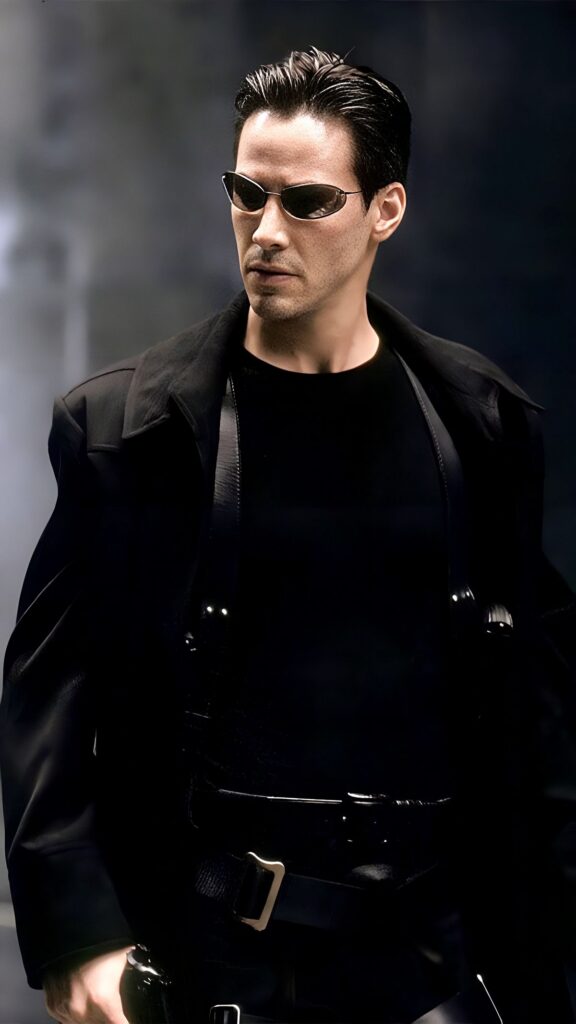
A man dressed in black.
Dark sunglasses.
Bullets suspended in the air.
A mysterious choice between two pills.
A world that looks real—but isn’t.
If you selected:
B — The Matrix
you got it right.
Released in the United States on March 31, 1999, The Matrix was written and directed by Lana and Lilly Wachowski and starred Keanu Reeves, Laurence Fishburne, Carrie-Anne Moss and Hugo Weaving. The film runs 2 hours and 16 minutes and was released by Warner Bros. Rotten Tomatoes
More than 25 years later, it is difficult to appreciate just how unusual the movie looked when audiences first saw it.
Because after The Matrix, everybody started borrowing from it.
Who Is Neo?
At the beginning of the movie, Keanu Reeves plays:
Thomas Anderson
By day, he works as a computer programmer.
By night, he lives another life online under the name:
Neo.
Neo has the persistent feeling that something about the world is wrong.
He does not fully understand why.
Then he begins searching for a mysterious figure named:
Morpheus.
And eventually, Morpheus finds him.
Morpheus
Played by:
Laurence Fishburne
Morpheus believes Neo may be:
“The One.”
According to Morpheus, the world Neo believes is real is actually an artificial simulation.
Human beings are living inside something called:
The Matrix.
Their minds experience ordinary lives.
But their physical bodies exist somewhere very different.

The Red Pill or the Blue Pill
Then comes one of the most famous choices in modern cinema.
Morpheus offers Neo two pills.
Blue pill
Return to the life he knows.
Forget the questions.
Continue living inside the familiar world.
Red pill
Discover the truth.
Neo chooses the red pill.
And from that moment, nothing is the same.
The red-pill/blue-pill choice became so culturally recognizable that it eventually escaped the movie entirely and became a metaphor used far beyond science-fiction fandom.
What Is the Matrix?
Neo learns that the world around him is not physical reality.
It is a computer-generated simulation created to control humanity.
Humans experience the illusion of normal life while machines dominate the real world.
For a mainstream action blockbuster in 1999, this was an unusually ambitious premise.
The film asks questions about:
reality
perception
free will
control
technology
identity
But instead of presenting those ideas through a slow philosophical drama, the Wachowskis wrapped them inside:
martial arts,
gun battles,
science fiction,
cyberpunk,
and extraordinary visual effects.
That combination became one of the movie’s biggest strengths.
Trinity
Neo’s introduction to this hidden world begins partly through:
Trinity
played by Carrie-Anne Moss.
The opening sequence immediately tells audiences that the normal rules of action cinema no longer apply.
Trinity can leap enormous distances.
Run along walls.
Fight several police officers.
And move with an almost impossible combination of martial arts and digital manipulation.
Rotten Tomatoes currently describes the film as an inventive combination of action and groundbreaking special effects, with an 83% Tomatometer score from 209 reviews. Rotten Tomatoes
Agent Smith
Every great science-fiction story needs a memorable threat.
For The Matrix, that threat is:
Agent Smith.
Played by:
Hugo Weaving.
Smith looks almost ordinary.
Dark suit.
Tie.
Sunglasses.
Calm voice.
But within the Matrix, Agents can take control of ordinary human bodies and possess abilities far beyond normal people.
Smith’s controlled, mechanical personality became a perfect contrast to the increasingly powerful Neo.
“There Is No Spoon”
One of the cleverest aspects of the movie is the idea that physical limitations inside the Matrix are not necessarily real.
If the Matrix is software, then many of its apparent rules can potentially be broken.
Gravity.
Speed.
Strength.
Movement.
Even the physical form of objects.
That concept gives the filmmakers permission to create action scenes that deliberately reject ordinary physics.
And this eventually leads to the visual technique most associated with the movie.

Bullet Time
If one image defines The Matrix, it may be Neo bending backward while bullets travel past him.
The sequence became famous for an effect commonly known as:
Bullet Time.
The Academy explains that the filmmakers created this effect using more than 100 still cameras positioned around the action, firing them sequentially. The resulting frames allowed the apparent viewpoint to move around an action while time seemed almost frozen. Oscars
Today, the concept may not seem shocking.
We have seen variations of it in:
commercials,
video games,
television,
superhero movies,
music videos,
and countless action films.
But in 1999, audiences had seen very little that looked quite like this.
Why Bullet Time Was So Important
Traditional slow motion slows both:
the action
and:
the camera’s view of the action.
Bullet Time created a different sensation.
The subject could appear almost frozen while the point of view traveled around them.
The Academy’s educational material notes that the technique effectively expanded a tiny moment of physical action into a much longer moving-camera sequence. Oscars
Suddenly, cinema could show audiences a moment from an almost impossible perspective.
And filmmakers everywhere noticed.
The Lobby Shootout
Another sequence became equally influential.
Neo and Trinity enter a heavily guarded building.
They are dressed completely in black.
Then comes:
guns,
explosions,
slow motion,
flying debris,
martial arts,
and exaggerated physical movement.
It became one of the most imitated action sequences of its era.
But what makes it interesting today is how much of the movie’s visual identity remains immediately recognizable.
You can show someone:
black trench coats,
dark sunglasses,
green computer code,
or a bullet suspended in the air—
and many people will immediately think: