The Movie That Made Dinosaurs Feel Real
Some movies entertain audiences.
Some become huge box-office hits.
And a very small number permanently change what moviegoers believe is possible on a cinema screen.
The film in today’s “Remember This Movie?” challenge belongs to that final category.
A tropical island.
A visionary billionaire.
Scientists invited to inspect an impossible new attraction.
And then one unforgettable moment:
a living dinosaur walks across the screen.
For audiences in 1993, it was extraordinary.
If you selected:
D — Jurassic Park
you got it right.
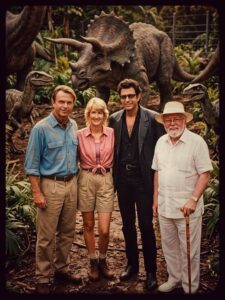
Directed by Steven Spielberg and released in the United States on June 11, 1993, Jurassic Park stars Sam Neill, Laura Dern, Jeff Goldblum and Richard Attenborough. The film follows a group invited to preview an island theme park populated by genetically recreated dinosaurs—before the park’s security systems collapse and those creatures escape. Rotten Tomatoes
More than three decades later, the original movie remains the critical high point of the Jurassic franchise, with Rotten Tomatoes currently listing it at 91% from critics and 91% from audiences. Rotten Tomatoes
But in 1993, none of that legacy existed yet.
Audiences were simply about to see dinosaurs in a way they had never seen them before.
Welcome to Jurassic Park
The story begins with billionaire entrepreneur:
John Hammond
played by Richard Attenborough.
Hammond has created something that sounds impossible.
On a remote island called:
Isla Nublar
his company has built a theme park populated by actual dinosaurs.
Not mechanical replicas.
Not museum skeletons.
Living animals.
The dinosaurs have been recreated through genetic engineering using ancient DNA.
Hammond wants to open the park to the public.
But after a serious accident raises questions about safety, investors demand that outside experts inspect the facility first.
So Hammond invites several specialists.
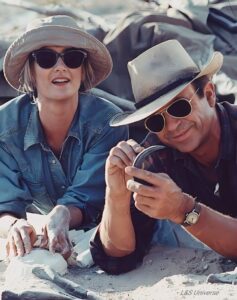
Dr. Alan Grant
Sam Neill as Dr. Alan Grant
Grant is a paleontologist.
He has spent his professional life studying dinosaurs through fossils.
For someone like him, Jurassic Park should be the discovery of a lifetime.
Instead of examining bones buried underground for millions of years, he suddenly has the opportunity to look at the animals themselves.
Grant also begins the movie noticeably uncomfortable around children.
That detail becomes important later when he is forced to protect Hammond’s grandchildren during the disaster.
His journey is therefore not only about surviving dinosaurs.
It is also about changing emotionally.
Dr. Ellie Sattler
Laura Dern as Dr. Ellie Sattler
Ellie is a paleobotanist and Grant’s professional partner.
She is intelligent, practical and much more willing than some of the other characters to immediately question whether Hammond actually understands the ecosystem he has created.
The park may have spectacular technology.
But nature does not necessarily care about business plans.
Ellie increasingly realizes that the danger is not simply one dinosaur escaping.
The entire system has been designed with human confidence that nature can be controlled.
That assumption becomes the movie’s central mistake.
Dr. Ian Malcolm
Then there is perhaps the film’s most charismatic character:
Dr. Ian Malcolm
played by:
Jeff Goldblum.
Malcolm is a mathematician specializing in chaos theory.
From the beginning, he is deeply skeptical of Jurassic Park.
While Hammond sees:
wonder,
Malcolm sees:
unpredictability.
The scientists behind the park are so focused on whether dinosaurs can be recreated that, in Malcolm’s view, they have not spent enough time considering whether they should be.
That philosophical conflict gives the movie much more depth than a simple monster adventure.
John Hammond
Richard Attenborough’s Hammond is also more complicated than a conventional villain.
He genuinely believes in what he has built.
To him, Jurassic Park is a dream.
He wants children to see real dinosaurs.
He wants to create something magical.
The problem is that his enormous ambition has created something his organization cannot reliably control.
Hammond repeatedly insists that the park is safe.
Then the movie demonstrates how quickly a supposedly perfect system can collapse.
The First Dinosaur
One of the greatest moments in the movie happens surprisingly early.
Grant and Ellie arrive on the island.
Their vehicle suddenly stops.
Grant looks into the distance.
His expression changes.
He stands.
He removes his sunglasses.
Then he physically turns Ellie’s head toward what he is seeing.
A:
Brachiosaurus.
For modern audiences accustomed to photorealistic digital creatures, the scene may seem straightforward.
In 1993, it was astonishing.
Spielberg does not introduce the dinosaur as a monster.
He introduces it with wonder.
John Williams’ music rises.
The characters stare.
And the audience effectively reacts with them.
This scene tells us what Jurassic Park was supposed to be before everything went wrong.
The Park Tour
Hammond introduces his guests to the technology behind the attraction.
Scientists have extracted dinosaur DNA and used genetic engineering to recreate extinct species.
The group learns about the hatchery.
They see a baby velociraptor emerge from an egg.
And they are told that the park’s dinosaurs have been carefully controlled.
Everything has been designed to prevent reproduction and keep the animals contained.
At least, that is the theory.
“Life Finds a Way”
Malcolm is not convinced.
His concern is simple:
Nature is too complicated to control perfectly.
The movie repeatedly contrasts:
Hammond’s confidence in systems
with:
Malcolm’s belief in unpredictability.
That conflict is expressed through one of the movie’s most famous ideas:
“Life finds a way.”
The line eventually becomes almost a thesis statement for the entire franchise.
Dennis Nedry
The disaster begins not because the dinosaurs suddenly become evil.
It begins because of a human decision.
Computer programmer:
Dennis Nedry
played by Wayne Knight, secretly agrees to steal dinosaur embryos.
To bypass the park’s security, he disables important systems.
Electric fences lose power.
Doors stop functioning normally.
Security systems collapse.
And dinosaurs that had been safely separated from visitors suddenly have opportunities to escape.
One mistake creates another.
Then another.
The carefully controlled park begins falling apart.
The Tyrannosaurus Rex
And then comes the scene many viewers never forgot.
It is raining.
Two vehicles are stopped beside the Tyrannosaurus enclosure.
The electric fence is no longer functioning.
A cup of water begins to shake.
Then:
another vibration.
The goat is gone.
The fence moves.
And finally—
the T. rex appears.
It is one of the defining sequences of Steven Spielberg’s career.
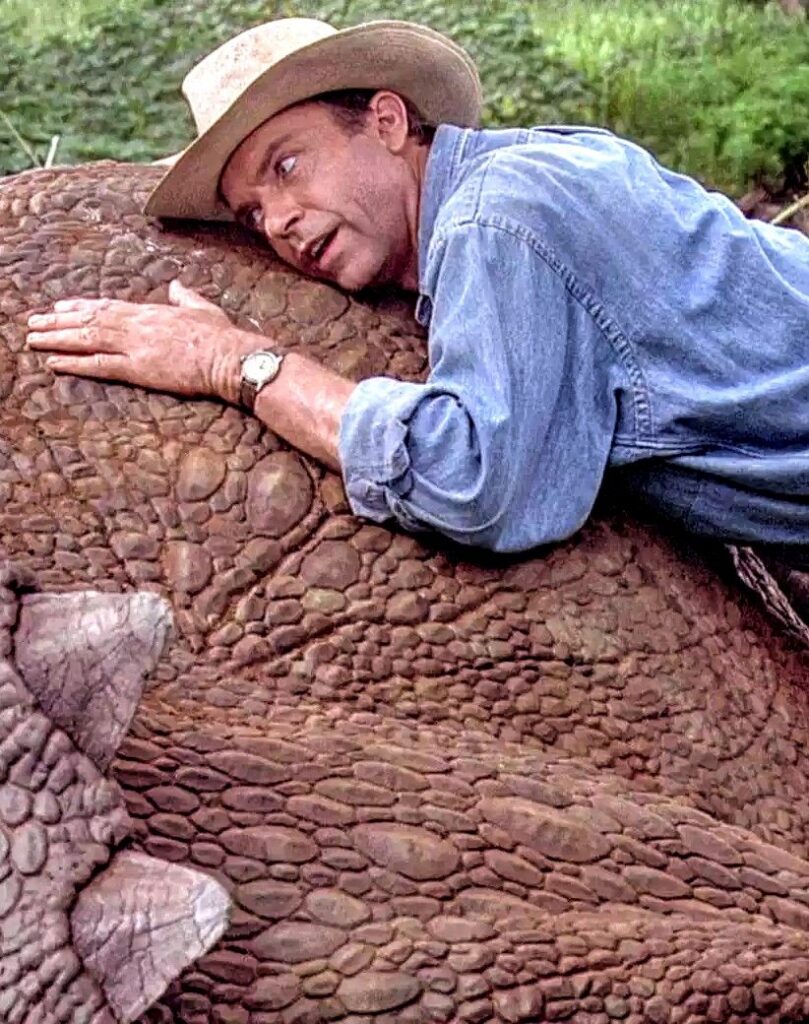
Why the T. rex Scene Still Works
The sequence is remarkably patient.
Spielberg does not simply throw the dinosaur onto the screen immediately.
He builds anticipation.
The shaking water.
The missing goat.
The broken fence.
The darkness.
The rain.
The children’s fear.
Only then does the animal fully emerge.
The scene alternates between enormous spectacle and intimate danger.
We understand exactly where the characters are.
We understand what is protecting them.
And then that protection disappears.
Animatronics Made the Dinosaurs Feel Physical
One reason the scene remains convincing is that Jurassic Park did not depend exclusively on computer-generated dinosaurs.
The filmmakers combined several techniques.
For close interactions, the production used sophisticated practical dinosaur effects and animatronics.
For other shots requiring full-body movement, computer-generated imagery was used.
The Academy later described Jurassic Park as a benchmark in visual effects because its creative teams helped bridge the transition from traditional stop-motion approaches to computer-generated animation in motion pictures. Oscars
That combination was crucial.
The dinosaurs did not merely look digitally impressive.
They appeared to occupy physical space with the actors.
Stan Winston’s Dinosaurs
Legendary effects artist Stan Winston and his team created major practical dinosaur effects for the production.
That meant actors sometimes had something physically present on set.
Something with:
texture,
weight,
teeth,
skin,
and movement.
Then the visual-effects teams could use CGI where practical effects were impossible.
The result was a hybrid approach rather than complete dependence on one technology.
That is one reason many sequences continue to look convincing decades later.
ILM and a New Era of CGI
The computer-generated dinosaurs were another revolution.
Industrial Light & Magic helped create full-body dinosaurs moving through the environment.
Today this sounds normal.
In 1993, it was not.
The success of those digital dinosaurs demonstrated that computer-generated creatures could convincingly interact with live-action photography on a scale audiences would accept.
The Academy explicitly credits the film with changing moviemaking through groundbreaking computer imagery. Oscars
Hollywood noticed.
The Velociraptors
The T. rex may have been the biggest star.
But the velociraptors may actually be scarier.
Earlier in the movie, game warden:
Robert Muldoon
played by Bob Peck, warns the visitors about their intelligence.
The velociraptors test fences.
They coordinate.
They learn.
And by the end of the movie, they are loose inside the park’s buildings.
This creates some of the film’s most suspenseful sequences.
The Kitchen Scene
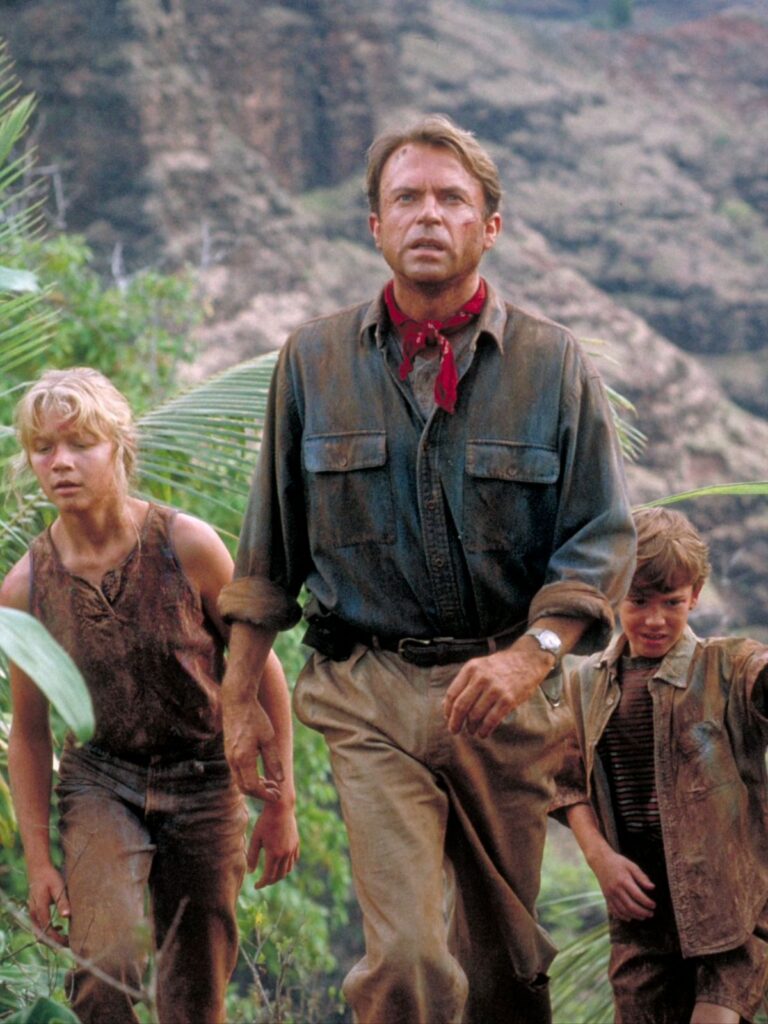
Perhaps the most memorable raptor sequence involves Hammond’s grandchildren:
Tim
played by Joseph Mazzello
and:
Lex
played by Ariana Richards.
The children hide inside a kitchen.
Two velociraptors enter.
What follows is almost pure suspense.
The dinosaurs search.
The children move quietly.
Reflections create confusion.
Objects fall.
The audience knows that one mistake could reveal where they are hiding.
There is no giant battlefield.
No enormous explosion.
Just two children trying not to make a sound.
That restraint is what makes the sequence effective.
The Dilophosaurus
Dennis Nedry also receives one of the movie’s most memorable encounters.
After becoming lost during the storm, he meets what appears at first to be a relatively small dinosaur.
The situation almost seems humorous.
Then the creature reveals itself to be far more dangerous.
The sequence combines:
comedy,
surprise,
and horror
in a way typical of Spielberg’s approach throughout the movie.
The dinosaurs can inspire wonder.
But they are still wild animals.
The Gallimimus Stampede
Another unforgettable sequence shows Grant and the children encountering a herd of:
Gallimimus.
The dinosaurs race across an open field.
For a moment, the characters simply watch them move.
Then the T. rex appears.
Again, the film moves between:
wonder
and:
danger.
That balance is one of the central reasons Jurassic Park works so well.
If the dinosaurs were only monsters, the movie would lose much of its emotional appeal.
We are supposed to fear them.
But we are also supposed to love seeing them.
John Williams’ Music
Then there is the score.
Composer:
John Williams
had already created some of the most recognizable music in American cinema through collaborations with Spielberg.
For Jurassic Park, he created music capable of expressing both:
enormous wonder
and:
suspense.
The main theme is inseparable from the first view of the park.
It gives the dinosaurs majesty.
Without that music, the arrival sequence would still be impressive.
With it, the moment becomes emotional.
Steven Spielberg
By 1993, Spielberg already had:
Jaws.
Close Encounters of the Third Kind.
Raiders of the Lost Ark.
E.T.
Indiana Jones.
Yet Jurassic Park still represented a major technical leap.
The film allowed Spielberg to combine the suspense instincts of Jaws with the sense of childhood wonder seen in E.T.
The dinosaurs could function like the shark in Jaws—
but the audience was also allowed to admire them.
That combination created something unusual.
Based on Michael Crichton’s Novel
The film was adapted from Michael Crichton’s novel.
Crichton also received screenwriting credit alongside David Koepp; Rotten Tomatoes lists both among the film’s screenwriters. Rotten Tomatoes
The concept was perfectly suited to early-1990s concerns about:
genetic engineering,
technology,
corporate ambition,
and humanity’s confidence that science can control nature.
The movie simplifies some of the book’s scientific and philosophical material, but keeps its central warning.
Technology is extraordinarily powerful.
That does not necessarily mean it is predictable.
The Movie Cost About $63 Million
According to Box Office Mojo, Jurassic Park had a production budget of approximately:
$63 million.
It opened domestically with:
$47,026,828
during its opening weekend. Box Office Mojo
For 1993, that was enormous.
But the opening weekend was only the beginning.
Three Consecutive Weekends at No. 1
The movie remained No. 1 at the domestic box office during each of its first three weekends.
Its first three weekend grosses were approximately:
Weekend 1 — $47.0 million
Weekend 2 — $38.5 million
Weekend 3 — $27.7 million Box Office Mojo
That relatively gradual decline shows how strong the audience response was.
People were not simply rushing to opening night.
The film had staying power.
$357 Million in Its Original Domestic Run
During its original theatrical release, Jurassic Park earned approximately:
$357.1 million
in the United States and Canada.
Internationally, it generated another:
$621.1 million.
Its original worldwide theatrical total reached approximately:
$978.2 million. Box Office Mojo
Remember:
the reported production budget was only around $63 million.
The scale of that box-office performance was extraordinary.
The Biggest Movie of 1993
Box Office Mojo’s worldwide chart places Jurassic Park at:
No. 1 worldwide for 1993
with its original worldwide gross of approximately $978.2 million. Box Office Mojo
It did not simply succeed.
It dominated its year.
And the film’s commercial story continued long after 1993.
More Than $1.1 Billion Across All Releases
Jurassic Park returned to theaters several times.
Those releases included:
the 2013 3D re-release,
later anniversary showings,
and additional theatrical engagements.
Box Office Mojo currently lists lifetime theatrical grosses from all releases at approximately:
$1.103 billion worldwide. Box Office Mojo
That means a film originally released in 1993 eventually crossed the billion-dollar mark through its continuing theatrical life.