The Time-Travel Adventure That Became an ’80s Movie Icon
Some movie premises sound complicated.
Others can be explained in one irresistible sentence:
What if a teenager accidentally traveled back in time and met his parents before they fell in love?
That idea became the foundation of one of the most recognizable American movies of the 1980s.
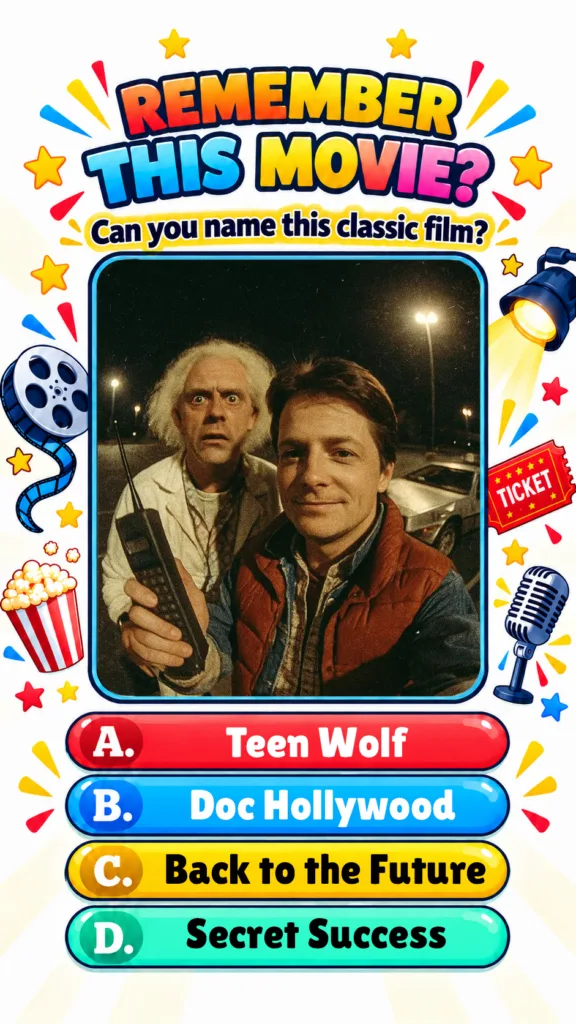
A teenager in a red vest.
A wild-haired scientist.
A DeLorean.
A clock tower.
And one very dangerous trip from 1985 back to 1955.
If you selected:
C — Back to the Future
you got it right.
Released in the United States on July 3, 1985, Back to the Future was directed by Robert Zemeckis, with a screenplay by Zemeckis and Bob Gale. It stars Michael J. Fox as Marty McFly and Christopher Lloyd as Dr. Emmett “Doc” Brown. The film runs 1 hour and 56 minutes and blends science fiction, comedy, adventure and teenage coming-of-age storytelling. Rotten Tomatoes
More than four decades later, the basic idea still feels wonderfully simple.
But the movie does something much smarter than merely sending its hero into the past.
It forces Marty to repair his own family history before he disappears from existence.
Meet Marty McFly
At the center of the story is:
Marty McFly
played by:
Michael J. Fox.
Marty is a teenager living in the fictional California town of:
Hill Valley.
He loves music.
He plays guitar.
He dreams of performing with his band.
But his family life is considerably less exciting.
His father:
George McFly
is shy, nervous and constantly bullied by his boss.
His mother:
Lorraine
often talks about how different teenagers supposedly behaved when she was young.
Marty sees his parents as adults who seem stuck in lives they never imagined for themselves.
Then he receives an opportunity to see exactly how they became those people.
Doc Brown
Marty’s closest and strangest friend is:
Dr. Emmett Brown
played by:
Christopher Lloyd.
Doc is everything a movie scientist should be.
Wild hair.
Enormous enthusiasm.
Unpredictable experiments.
And absolute confidence that one impossible idea may actually work.
His greatest invention is not hidden inside a laboratory.
It is parked in a shopping-mall parking lot.
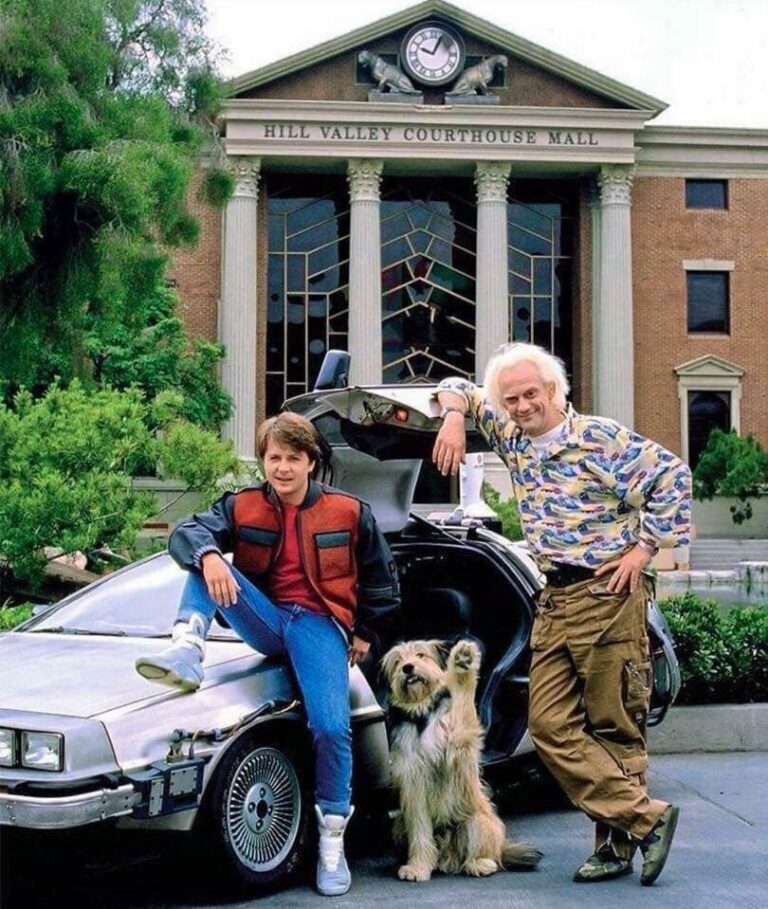
The DeLorean
Doc Brown has built a:
time machine.
And instead of placing it inside some enormous futuristic device, he has built it into a:
DeLorean DMC-12.
The stainless-steel sports car eventually became almost inseparable from the movie itself.
Even people who have never watched Back to the Future may recognize:
the gull-wing doors,
the futuristic machinery,
and the idea that this particular car can travel through time.
There is one important requirement:
the DeLorean must reach 88 miles per hour.
Once it does, the impossible becomes possible.
October 26, 1985
Doc demonstrates his invention to Marty.
But the experiment does not go according to plan.
A dangerous confrontation occurs.
Marty escapes in the DeLorean.
He accelerates.
The car reaches its critical speed.
And suddenly—
1985 is gone.
Marty finds himself thirty years earlier.
1955.
Hill Valley Looks Completely Different
One of the movie’s greatest pleasures is seeing the same town in two different eras.
In 1985, Hill Valley feels familiar to Marty.
In 1955, almost everything is different.
Buildings are newer.
Businesses have changed.
Cars are different.
Music is different.
Fashion is different.
And people Marty knows as adults are now teenagers themselves.
This lets the movie play with one of time travel’s most entertaining possibilities:
What were your parents like before you knew them?
Marty is about to find out.
Young George McFly
Marty encounters his father:
George
played by Crispin Glover.
But this is not the father Marty recognizes from 1985.
George is a teenage outsider.
He lacks confidence.
He is awkward around girls.
And he is already being tormented by:
Biff Tannen.
Biff Tannen
Played by:
Thomas F. Wilson,
Biff becomes one of the franchise’s defining villains.
In both time periods, Biff attempts to dominate George.
He is aggressive.
Arrogant.
And accustomed to getting his way.
For Marty, seeing this relationship in 1955 provides an explanation for what he saw in 1985.
His father’s problems did not suddenly appear in adulthood.
They began much earlier.
And Marty now has an opportunity to change something.
Then Marty Meets His Mother
This is where the time-travel adventure becomes much more complicated.
Marty encounters the teenage version of:
Lorraine Baines
played by:
Lea Thompson.
Lorraine does not know that Marty is her future son.
And because Marty accidentally interferes with the event that originally brought Lorraine and George together, history begins changing.
Worse:
Lorraine becomes interested in Marty.
Suddenly the problem is not merely:
How does Marty get home?
It becomes:
How can Marty make sure his parents fall in love?
Because if they do not—
Marty may never be born.
The Photograph Begins to Change
Marty carries a photograph of himself with his brother and sister.
As the timeline changes, something alarming starts happening.
The people in the photograph begin disappearing.
It is a brilliantly simple visual device.
The movie does not need a complicated explanation of temporal mechanics.
The photograph tells us everything.
History is changing.
Marty is running out of time.
And if his parents do not become a couple, he will disappear too.
Finding the Younger Doc Brown
Marty’s best chance of returning to 1985 is obvious.
He needs:
Doc Brown.
There is only one problem.
The Doc Brown of 1955 has not yet built a time machine.
Marty arrives at his house and tells him an unbelievable story:
they are friends in the future,
Doc successfully invents time travel,
and Marty needs his help getting home.
Naturally, Doc is skeptical.
Eventually, however, Marty proves that he knows things about the future that he could not possibly know otherwise.
Now the two have another problem.
The Power Problem
The DeLorean requires an enormous amount of energy for time travel.
In 1985, Doc has a solution.
In 1955, the necessary power source is not easily available.
Then Marty remembers something.
He knows exactly when and where an enormous burst of energy will occur.
A lightning strike.
At the Hill Valley courthouse clock tower.
This gives the movie its perfect final objective:
Marty must reunite his parents and reach the DeLorean in time for the lightning strike.
Two storylines.
One deadline.
The Enchantment Under the Sea Dance
The emotional heart of the movie takes place at the school dance.
George needs to win Lorraine’s affection.
Marty has a plan.
Of course, the plan quickly goes wrong.
But the crisis finally forces George to do something he has rarely done before:
stand up for himself.
George confronts Biff.
And for the first time, Marty sees his father become the confident person he always had the potential to be.
That moment matters far beyond the romance.
Marty is changing his father’s life.
George and Lorraine Finally Kiss
But there is still one problem.
George and Lorraine must fall in love.
Marty begins physically weakening as the timeline approaches the point where his existence may be erased.
Then:
George and Lorraine kiss.
The photograph restores itself.
Marty recovers.
History has been repaired.
At least partly.
Now he still needs to get home.
Marty Plays Guitar
The school dance also gives the movie one of its most famous musical sequences.
Marty performs onstage.
At first, the music fits comfortably into 1955.
Then Marty becomes increasingly enthusiastic.
His guitar playing begins sounding much more like music from the future.
The joke works because Marty is bringing a cultural influence backward through time before his audience is ready for it.
The sequence perfectly captures the movie’s tone:
nostalgia,
music,
comedy,
and time-travel paradoxes,
all inside the same scene.
The Clock Tower
The finale is one of the great examples of cinematic timing.
Doc has calculated exactly when lightning will strike the courthouse clock tower.
A cable has been arranged.
The DeLorean must pass underneath at precisely the correct moment.
Naturally, everything begins going wrong.
Cables disconnect.
Timing becomes uncertain.
Marty has limited time.
Doc races to repair the equipment.
The storm intensifies.
And the audience already knows the exact second the lightning is coming.
This is what makes the sequence work so well.
The problem is complicated.
But the goal is extremely clear.
Back to 1985
The lightning strikes.
The DeLorean disappears.
And Marty returns to:
1985.
But this is not exactly the same 1985 he left.
Because Marty’s actions in 1955 changed his parents.
George became more confident.
His relationship with Lorraine changed.
His family changed.
Even Biff’s place in their lives changed.
Marty has successfully returned home—
but the past has rewritten the present.
The Movie’s Cleverest Idea
This may be the reason Back to the Future works better than many time-travel stories.
Time travel is not simply a science-fiction gimmick.
It becomes a way for Marty to understand his parents.
At the beginning, he sees them only as:
Mom and Dad.
In 1955, he sees them as teenagers.
Insecure.
Romantic.
Embarrassing.
Confused.
And still trying to figure out who they will become.
The movie uses fantasy to tell a surprisingly human story:
your parents had entire lives before you existed.
Michael J. Fox as Marty McFly
Michael J. Fox’s performance is central to why the movie moves so effortlessly between comedy, science fiction and emotion.
Marty needs to seem believable as:
a normal teenager,
a musician,
a time traveler,
and someone desperately trying not to destroy his own existence.
Fox gives the character enormous energy.
But Marty is never presented as an invincible action hero.
He panics.
He improvises.
He makes mistakes.
That keeps the impossible story grounded.