Some movies become classics because audiences love their characters.
Others are remembered because they introduce a new technology.
And occasionally, one movie manages to do both.
A cowboy. A space ranger. A little boy named Andy. A bedroom filled with toys that secretly come alive. And a friendship that would eventually become one of the most recognizable relationships in animation history.
If you selected:
B — Toy Story
You got it right!
Released in the United States on November 22, 1995, Toy Story wasn’t just another animated film; it was a monumental leap forward, forever changing the landscape of cinema and solidifying Pixar’s place as a groundbreaking studio.
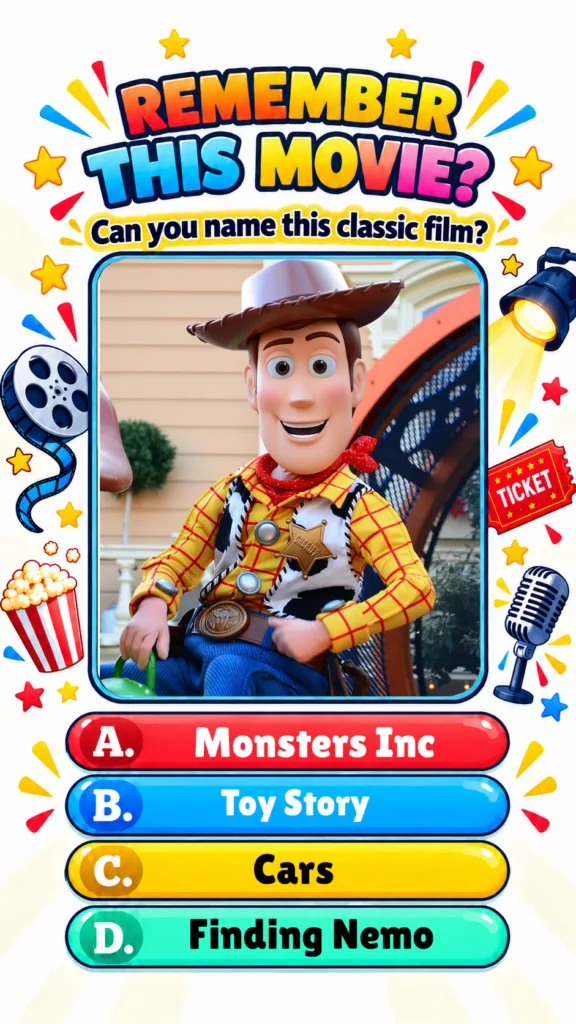
A CGI Revolution: How Toy Story Broke New Ground
Before Toy Story, animated films were predominantly hand-drawn. While beautifully crafted, they had inherent limitations. Pixar, then a relatively small studio, dared to dream bigger. They envisioned a feature film entirely rendered using computer-generated imagery (CGI), a feat never before attempted on such a scale. The result was nothing short of miraculous.
The fluid movements, the detailed textures, the depth of field – everything looked refreshingly new. Critics and audiences were stunned by the visual fidelity, which allowed for a level of dynamic storytelling previously impossible in animation. This wasn’t just a gimmick; it was a fundamental shift that paved the way for countless animated blockbusters to come.
The Dynamic Duo: Woody and Buzz Lightyear
At the heart of Toy Story‘s enduring appeal are its unforgettable characters, led by Sheriff Woody, the pull-string cowboy doll, and Buzz Lightyear, the new, high-tech space ranger action figure. Their initial rivalry, born from Woody’s jealousy over Buzz’s arrival and Andy’s attention, quickly evolves into an unlikely and heartwarming friendship.
Voiced brilliantly by Tom Hanks as Woody and Tim Allen as Buzz, these characters embody classic archetypes: the insecure leader and the confident newcomer. Their journey from adversaries to inseparable friends is filled with humor, peril, and genuine emotional depth, making them relatable to viewers of all ages. Their bond became a cornerstone of the entire franchise, teaching us about acceptance, loyalty, and finding your place.
More Than Just Toys: The Story’s Enduring Themes
Beyond the technological marvel and charming characters, Toy Story resonated deeply because of its universal themes. It explored ideas of belonging, friendship, jealousy, and the fear of being replaced. For children, it brought to life the secret lives of their toys; for adults, it tapped into nostalgic feelings about childhood and the passage of time. The film expertly blended laugh-out-loud comedy with moments of profound emotional impact, a hallmark of Pixar’s storytelling prowess.
Critical Acclaim, Box Office Dominance, and Oscar Recognition
Upon its release, Toy Story was an immediate critical and commercial success. It garnered a rare 100% approval rating on Rotten Tomatoes, with critics praising its innovative animation, witty script, and emotional resonance. The film grossed over $373 million worldwide, making it the highest-grossing film of 1995.
Its impact wasn’t limited to the box office. Toy Story received three Academy Award nominations for Best Original Screenplay, Best Original Score, and Best Original Song for
