Some Hollywood stars are remembered for a particular movie.
Others are remembered for a voice.
And then there are performers whose entire personality becomes part of popular culture. This woman belonged to the third group.
The expressive eyes. The perfectly timed reaction. The unmistakable comedy.
But when you strip away the famous red hair and show her in an older black-and-white portrait, even longtime fans can hesitate.
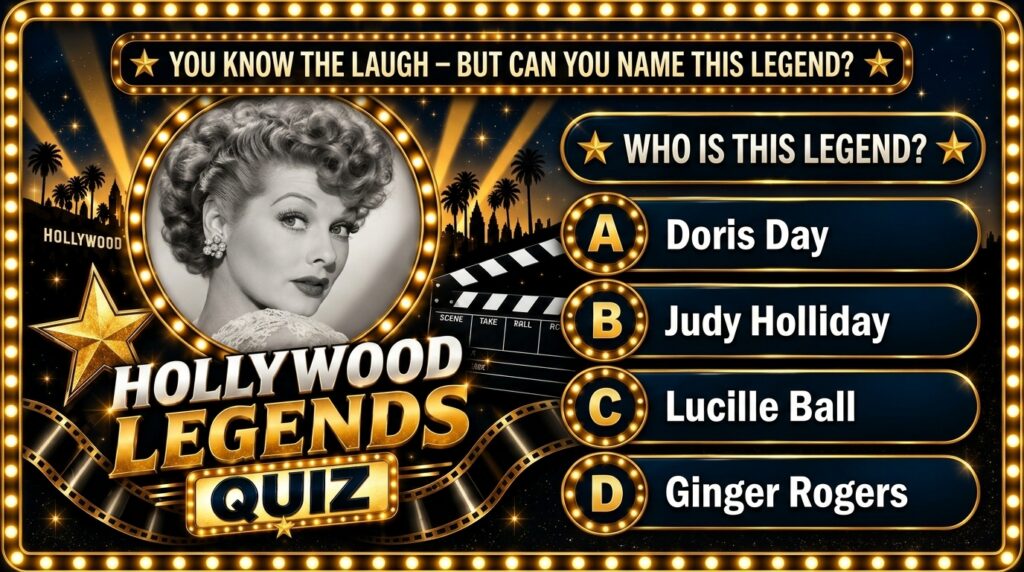
The correct answer is Lucille Ball. And her story is much bigger than I Love Lucy.
Before Lucy: The Path to Stardom
Lucille Ball was born in 1911 in Jamestown, New York. She moved into entertainment while still young and worked as a model before gradually finding acting opportunities. Her road to stardom was not immediate. Throughout the 1930s and 1940s, Ball appeared in many films, working in comedies, musicals, dramas, and supporting roles. Despite her undeniable talent and striking looks, Hollywood had not yet found the role that would make her truly unforgettable. That all changed with television.
The Phenomenon of I Love Lucy
In 1951, I Love Lucy premiered, forever changing the landscape of American television. Ball starred as the hilariously ambitious Lucy Ricardo, a housewife constantly trying to break into her husband’s show business career. She co-starred with her real-life husband, Cuban-American bandleader Desi Arnaz, who played the charismatic Ricky Ricardo. The chemistry between them was palpable, both on and off screen, contributing significantly to the show’s massive success.
I Love Lucy wasn’t just a popular show; it was a groundbreaking phenomenon. It was one of the first television programs to be filmed in front of a live studio audience using a multi-camera setup, a technique that is still widely used today. This allowed for better production quality and the ability to syndicate reruns, something unprecedented at the time. The show tackled innovative storylines, often drawing from Ball’s real-life experiences and Arnaz’s Cuban heritage, bringing a unique blend of humor and heart to millions of homes.
Beyond the Laughter: A Business Mogul
What many don’t realize is that Lucille Ball was also a shrewd businesswoman. Along with Desi Arnaz, she co-founded Desilu Productions, the studio responsible for producing I Love Lucy. Desilu grew into a major television production company, creating or housing iconic shows like Star Trek and Mission: Impossible. After her divorce from Arnaz, Ball bought out his share, becoming the first woman to head a major Hollywood studio. This was a remarkable achievement in an era when women held very few positions of power in the entertainment industry.
Lucille Ball’s Enduring Legacy
Lucille Ball’s impact extends far beyond her iconic red hair and the catchphrases of Lucy Ricardo. She was a pioneer who broke barriers for women in Hollywood, both as a performer and as an executive. Her comedic timing and physical humor set a standard that few have matched, inspiring generations of comedians and actors. Even decades after her passing in 1989, her work continues to entertain and influence, proving that her legend truly is timeless. Her contributions to television and film cement her status as one of Hollywood’s most beloved and influential figures, a true icon whose legacy lives on.