Are you ready to build a stronger, more toned lower body? Developing strong glutes is not just about aesthetics; it’s essential for overall body balance, posture, and athletic performance. This 4-week glute challenge is designed to help you strengthen and shape your glute muscles effectively through a series of targeted, compound, and isolation exercises. Consistency and proper form are key to seeing great results, and we’re here to guide you every step of the way!
Why Strong Glutes Are So Important
The gluteal muscles (gluteus maximus, medius, and minimus) are among the largest and most powerful muscles in your body. They play a crucial role in many daily activities and movements. Strengthening them can offer a variety of benefits:
- Improved Posture: Strong glutes can help stabilize your pelvis and spine, contributing to better posture and reducing the risk of lower back pain.
- Enhanced Athletic Performance: Whether you’re running, jumping, or lifting, powerful glutes are vital for generating force and improving speed and agility.
- Injury Prevention: By providing stability to the hips and knees, strong glutes may help prevent common injuries, especially in the lower body.
- Balanced Body Aesthetics: Toned glutes contribute to a well-proportioned and strong lower body physique.
Understanding Your 4-Week Glute Challenge
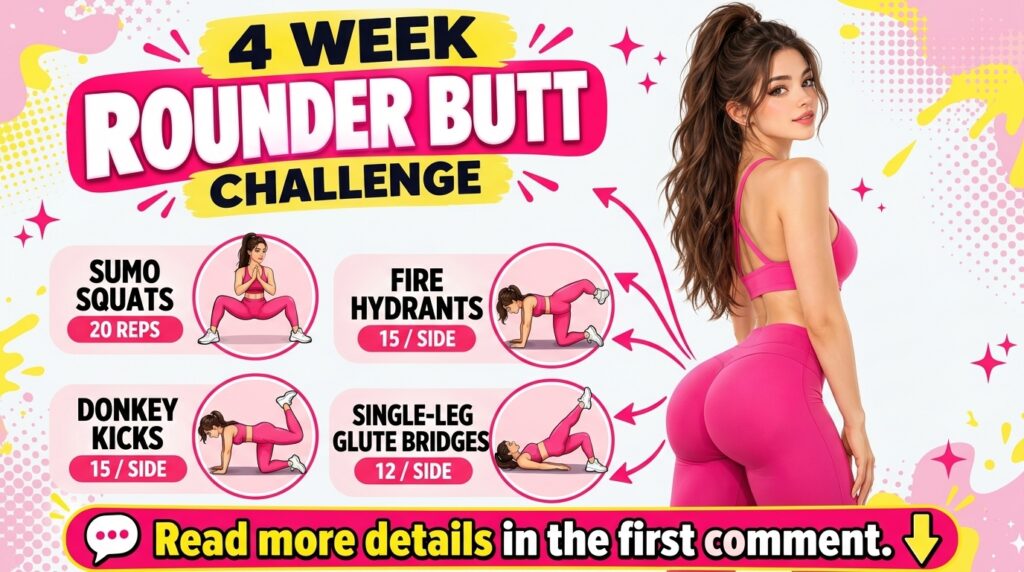
This challenge focuses on five core exercises that target different parts of your glute muscles. The idea is to perform these exercises regularly throughout the four weeks, progressively increasing your repetitions or sets as you get stronger. Listen to your body and adjust as needed.
The 5 Essential Glute Exercises
Here’s a breakdown of the exercises you’ll be focusing on:
1. Sumo Squats
Sumo squats are a fantastic compound exercise that deeply engages the glutes and inner thighs.
- How to Perform: Stand with your feet wider than shoulder-width apart, toes pointed out at about a 45-degree angle. Lower your hips as if sitting back into a chair, keeping your chest up and back straight. Aim for your thighs to be parallel to the floor, or as low as comfortable, then push through your heels to return to the starting position.
- Benefits: Targets the gluteus maximus, quadriceps, and adductors (inner thighs).
2. Donkey Kicks
Donkey kicks are an excellent isolation exercise for the gluteus maximus.
- How to Perform: Start on all fours, hands directly under your shoulders and knees under your hips. Keeping a neutral spine, lift one bent leg behind you, pushing the sole of your foot towards the ceiling as if kicking up, squeezing your glute at the top. Lower with control.
- Benefits: Primarily targets the gluteus maximus, helping to build strength and definition.
3. Fire Hydrants
Fire hydrants effectively target the gluteus medius and minimus, which are crucial for hip stability.
- How to Perform: From the same all-fours position, keep your knee bent at 90 degrees and lift one leg out to the side, keeping your core stable and hips facing forward. Lift as high as you can without tilting your torso. Lower with control.
- Benefits: Strengthens the outer glutes and hip abductors, important for hip stability.
4. Glute Bridges
Glute bridges are a fundamental exercise for activating and strengthening the glutes and hamstrings.
- How to Perform: Lie on your back with your knees bent, feet flat on the floor hip-width apart, and arms by your sides. Press through your heels to lift your hips off the floor until your body forms a straight line from your shoulders to your knees, squeezing your glutes at the top. Lower your hips back down slowly.
- Benefits: Activates the gluteus maximus and hamstrings, promoting hip extension.
5. Single-Leg Glute Bridges
This variation increases the challenge and helps address muscular imbalances.
- How to Perform: Start in the same glute bridge position, but extend one leg straight out. Press through the heel of your grounded foot to lift your hips, keeping your extended leg in line with your lifted hips. Perform all reps on one side before switching to the other.
- Benefits: Enhances core stability and targets each glute individually, helping to correct imbalances.
Your 4-Week Training Plan
For optimal results, aim to perform this routine 3-4 times a week on non-consecutive days, allowing your muscles time to recover and grow. Here’s a suggested structure:
- Weeks 1 & 2: Focus on mastering form. Perform 3 sets of 10-12 repetitions for each exercise.
- Weeks 3 & 4: Challenge yourself by increasing repetitions or sets, or by adding resistance (e.g., a resistance band around your thighs for squats and bridges). Aim for 3-4 sets of 12-15 repetitions.
Remember to always warm up for 5-10 minutes with light cardio and dynamic stretches before your workout, and cool down with static stretches afterward.
Tips for Success in Your Challenge
- Focus on Form: Proper technique is more important than speed or the number of reps. Watch videos or use a mirror to ensure your form is correct.
- Progressive Overload: To continue making progress, gradually increase the intensity. This could mean more reps, more sets, longer holds, or adding external resistance.
- Nutrition & Hydration: Support your muscle growth and recovery with a balanced diet rich in protein, complex carbohydrates, and healthy fats. Stay well-hydrated throughout the day.
- Listen to Your Body: If you feel pain, stop the exercise. Rest days are crucial for muscle repair and growth.
- Consistency is Key: Sticking to your plan will yield the best results. Mark your workout days on a calendar to stay motivated!
Important Considerations
Before starting any new exercise program, especially if you have any pre-existing health conditions or concerns, it’s always a good idea to consult with a healthcare professional. This article provides general information and is not a substitute for personalized medical or fitness advice.
Embarking on this 4-week glute challenge is a fantastic step towards a stronger, more functional, and confident you. Remember, every effort counts, and your dedication will lead to positive changes. You’ve got this!