Ever wonder why some plants thrive while others struggle, even with the same amount of sunlight and water? The secret often lies beneath the surface – in your soil! Understanding your garden’s soil is like getting to know its personality, and it’s the first step towards a truly flourishing garden.
Healthy soil is the foundation of a vibrant garden, providing essential nutrients, proper drainage, and aeration for strong root development. You don’t need fancy equipment to unlock your soil’s secrets; many valuable insights can be gained right with your own hands and a few household items. Ready to become a soil detective?
We’ve put together six simple, hands-on tests that will help you understand your soil’s composition, drainage, and overall health. Let’s dig in!
The Power of Healthy Soil
Before we dive into the tests, let’s quickly reiterate why healthy soil is paramount. It’s not just dirt; it’s a living ecosystem teeming with microorganisms, providing a perfect balance of nutrients, water retention, and air pockets. When your soil is healthy, your plants are less stressed, more resistant to pests and diseases, and produce more bountiful yields. It’s nature’s healing power in action!
6 Easy Soil Tests You Can Do With Your Hands (and a Few Simple Tools!)
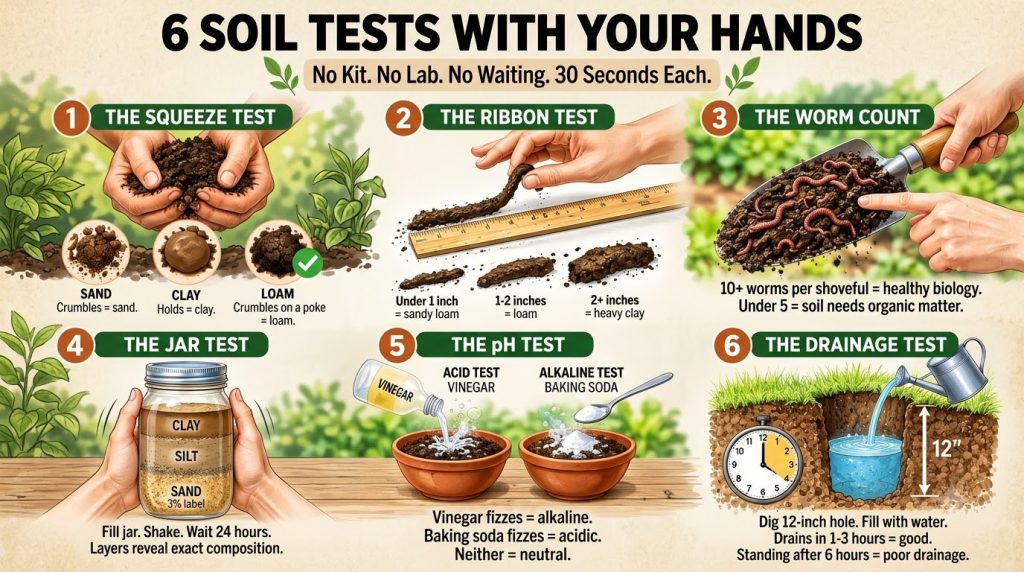
1. The Squeeze Test (Texture Test)
This test helps you understand your soil’s texture – whether it’s predominantly sand, silt, or clay. Grab a handful of slightly damp soil and squeeze it firmly in your fist.
- Sandy Soil: It crumbles apart immediately when you open your hand.
- Silty Soil: It holds its shape briefly but then falls apart easily when poked. It feels smooth, almost flour-like.
- Clay Soil: It holds its shape firmly and feels sticky or slick. It can be molded like play-doh.
- Loamy Soil (Ideal): It forms a loose ball that you can break apart easily with a gentle poke. It feels gritty, smooth, and sticky all at once.
2. The Ribbon Test
A more refined texture test, the ribbon test helps further distinguish between silt and clay. Take a small, moist ball of soil and press it between your thumb and forefinger, pushing it out to form a thin ribbon.
- Sandy Soil: Won’t form a ribbon at all.
- Silty Soil: Forms a short ribbon (less than 1 inch) that breaks easily.
- Clay Soil: Forms a long, flexible ribbon (over 2 inches) that doesn’t break easily.
3. The Worm Count
Earthworms are excellent indicators of soil health! They aerate the soil, improve drainage, and help decompose organic matter. Dig a small hole (about 6×6 inches) and count the number of worms you find.
- Plenty of Worms (10+): Indicates rich, healthy soil with good organic matter.
- Few Worms (0-5): Suggests your soil might be lacking organic matter or compacted.
4. The Jar Test (Sedimentation Test)
This test visually separates your soil into its main components: sand, silt, and clay. Fill a clear jar halfway with soil, then fill the rest with water, leaving a few inches at the top. Add a teaspoon of dish soap (to help separate particles) and shake vigorously for a minute. Let it settle for 24 hours.
- Bottom Layer: Sand (settles quickly)
- Middle Layer: Silt (takes a few hours to settle)
- Top Layer: Clay (takes up to 24 hours to settle, might make water cloudy)
- Floating Layer: Organic matter
The proportions of these layers give you a clear picture of your soil’s composition.
5. The pH Test
Soil pH measures how acidic or alkaline your soil is, which directly impacts nutrient availability for plants. You can buy inexpensive home pH testing kits, or try these DIY methods:
- Baking Soda Test: Take two small soil samples. Add half a cup of water to one, then sprinkle baking soda on top. If it fizzes, your soil is acidic.
- Vinegar Test: To the second sample, add half a cup of water, then pour half a cup of vinegar. If it fizzes, your soil is alkaline.
Most garden plants prefer a slightly acidic to neutral pH (6.0-7.0).
6. The Drainage Test
Good drainage is crucial to prevent waterlogged roots. Dig a hole about 1 foot deep and 1 foot wide. Fill it with water and let it drain completely. Once drained, fill it again and time how long it takes for the water to drain away.
- Fast Drainage (less than 1 hour): Suggests sandy soil that might dry out quickly.
- Moderate Drainage (1-4 hours): Ideal for most plants.
- Slow Drainage (over 4 hours): Indicates heavy clay or compacted soil, which can lead to root rot.
Why These Tests Matter
By conducting these simple tests, you gain invaluable knowledge about your garden’s soil. This understanding allows you to make informed decisions:
- Choosing the Right Plants: Select plants that naturally thrive in your soil type and pH.
- Improving Soil Structure: Add organic matter like compost to heavy clay soils to improve drainage, or to sandy soils to improve water retention.
- Adjusting pH: Use lime to raise pH (make it more alkaline) or elemental sulfur to lower pH (make it more acidic), if necessary.
Next Steps: Improving Your Soil
Once you know your soil’s characteristics, you can start amending it. The good news is that most soil problems can be significantly improved by consistently adding organic matter, such as compost, well-rotted manure, or leaf mold. Organic matter improves soil structure, enhances nutrient retention, and encourages beneficial microbial activity, bringing life and vitality back to your garden.
Conclusion
Taking a little time to understand your soil is one of the most rewarding steps you can take for your garden. These easy, hands-on tests empower you to unlock its secrets, leading to healthier plants, more abundant harvests, and a garden that truly thrives. So, roll up your sleeves, get your hands dirty, and connect with the very foundation of your garden’s success!