The Cowboy Who Conquered Hollywood: Discover the Legendary Star Behind the Photo
Hollywood’s golden age produced some of the most unforgettable actors in cinema history. From thrilling Western adventures to powerful war dramas, these legendary performers created characters that continue to inspire audiences generations later.
Among them was one extraordinary actor whose commanding presence, distinctive voice, and unforgettable cowboy image made him a symbol of American cinema.
Today’s classic Hollywood celebrity quiz challenges you to recognize a true legend of the silver screen.
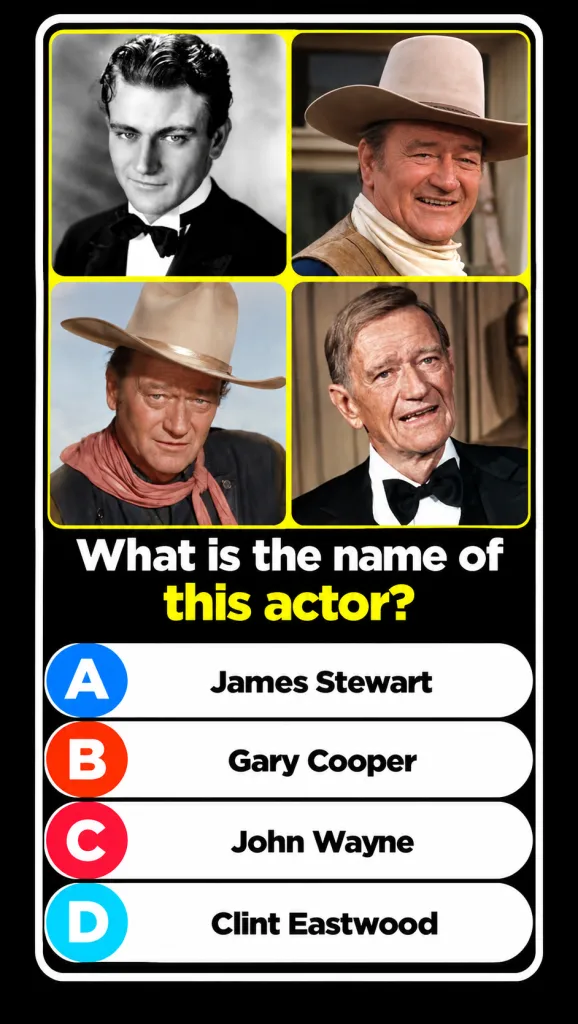
Can you identify the famous actor featured in these four photographs?
The images show a performer at different stages of his life, from his early Hollywood years to his later appearances as one of cinema’s most celebrated Western heroes.
Before revealing the answer, take a moment to consider the four choices.
Classic Hollywood Quiz: Who Is This Legendary Actor?
Look carefully at the photographs and choose the correct name.
A. James Stewart
B. Gary Cooper
C. John Wayne
D. Clint Eastwood
Each of these actors made significant contributions to Hollywood, particularly the Western genre. However, only one matches the star featured throughout this quiz.
Have you made your guess?
The Correct Answer: C — John Wayne!
The answer to today’s Hollywood celebrity quiz is C. John Wayne!
<Entity category=”people” value=”John Wayne”/> was one of the most influential and recognizable actors in American film history.
Known for his commanding screen presence, distinctive speaking voice, and memorable performances in Western and war movies, Wayne became a cultural icon whose career lasted more than five decades.
His cowboy hat, confident posture, and unmistakable acting style helped define the image of the American Western hero.
Wayne appeared in more than 170 film and television productions, becoming one of the biggest box-office attractions of his era.
He is particularly remembered for his roles in Stagecoach, Red River, The Searchers, Rio Bravo, and True Grit.
But behind his legendary Hollywood image lies a fascinating story of ambition, perseverance, and extraordinary cinematic success.
Let’s explore the life and career of the man affectionately known as “The Duke.”
Who Was John Wayne? Early Life and Biography
John Wayne was born Marion Robert Morrison on May 26, 1907, in Winterset, Iowa, United States.
His family later moved to California, where he spent much of his childhood.
Before entering the entertainment industry, Wayne attended the University of Southern California, where he played football.
An injury disrupted his athletic ambitions, and he eventually found opportunities working in the motion picture industry.
His early film work included jobs behind the scenes and minor acting appearances.
During this period, Wayne developed a connection with director John Ford, who would later become one of the most important collaborators in his career.
Although success did not arrive immediately, Wayne continued working toward his goal of becoming a professional actor.
Quick Facts About John Wayne
- Full Name: Marion Robert Morrison
- Professional Name: John Wayne
- Nickname: The Duke
- Date of Birth: May 26, 1907
- Date of Death: June 11, 1979
- Age at Death: 72 years old
- Birthplace: Winterset, Iowa, United States
- Profession: Actor, producer, and director
- Best Known For: Western films and war dramas
- Major Award: Academy Award for Best Actor for True Grit (1969)
Wayne’s journey from a young aspiring performer to one of Hollywood’s most recognizable stars remains an important chapter in American cinema history.
How John Wayne Became a Hollywood Star
John Wayne’s acting career began during the silent-film era.
He initially appeared in small roles while gaining experience in film production.
His first major starring opportunity came with The Big Trail in 1930, directed by Raoul Walsh.
The ambitious Western showcased Wayne as a leading man, but the film did not immediately establish him as a major box-office star.
Throughout the 1930s, he continued appearing in lower-budget Western productions.
These movies helped him develop the confident physical presence and distinctive performance style that audiences would eventually associate with his name.
His persistence paid off in 1939, when he starred in a film that transformed his career.
Stagecoach (1939): The Movie That Changed Everything
One of the most important turning points in John Wayne’s career came with the release of Stagecoach in 1939.
Directed by John Ford, the film follows a group of passengers traveling through dangerous territory in the American West.
Wayne portrayed the Ringo Kid, a young outlaw whose courage and sense of justice make him one of the story’s central characters.
Why Stagecoach Was So Important
Stagecoach became a landmark Western film, celebrated for its storytelling, cinematography, action sequences, and memorable characters.
Wayne’s performance introduced him to a much wider audience.
His portrayal of the Ringo Kid demonstrated a combination of toughness, charisma, and emotional depth.
The film helped establish him as a leading Hollywood actor and launched a long period of success in Western cinema.
Red River (1948): A Powerful Western Performance
In 1948, John Wayne starred in Red River, directed by Howard Hawks.
The film tells the story of a demanding cattle rancher who leads a dangerous cattle drive across the American frontier.
Wayne portrayed Thomas Dunson, a determined and increasingly authoritarian rancher whose leadership creates conflict with his adopted son.
Why Red River Became a Classic
The movie explored themes of ambition, loyalty, generational conflict, and personal responsibility.
Wayne delivered one of the most complex performances of his career.
His character was not simply a traditional Western hero but a flawed individual whose determination sometimes turned into cruelty.
The film received critical acclaim and remains one of the most respected Westerns ever produced.
The Searchers (1956): One of the Greatest Westerns Ever Made
John Wayne delivered another unforgettable performance in The Searchers, released in 1956.
Directed by John Ford, the movie follows Ethan Edwards, a Civil War veteran who embarks on a years-long search for his kidnapped niece.
Wayne’s portrayal of Ethan Edwards revealed a darker and more complicated side of the Western hero.
What Makes The Searchers Special?
Unlike many traditional Western protagonists, Ethan Edwards is deeply flawed.
His character struggles with bitterness, prejudice, obsession, and emotional isolation.
Wayne’s performance demonstrated his ability to portray morally complex individuals.
The film is widely regarded as one of the most influential Westerns in cinema history.
Its visual storytelling, cinematography, and character development have inspired generations of filmmakers.
Rio Bravo (1959): A Legendary Western Adventure
In 1959, John Wayne starred in Rio Bravo, directed by Howard Hawks.
The film follows a small-town sheriff who must defend his jail against a powerful rancher determined to free his imprisoned brother.
Wayne portrayed Sheriff John T. Chance, a determined lawman who relies on a small group of unlikely allies.
The film also starred Dean Martin, Ricky Nelson, Angie Dickinson, and Walter Brennan.
Why Audiences Loved Rio Bravo
The movie combined action, suspense, humor, and memorable character relationships.
Wayne’s portrayal of Sheriff Chance highlighted his ability to balance authority with loyalty and friendship.
The film became a beloved Western classic and remains influential among filmmakers and movie enthusiasts.
True Grit (1969): John Wayne’s Oscar-Winning Performance
One of John Wayne’s greatest career achievements came with True Grit, released in 1969.
Directed by Henry Hathaway, the Western adventure follows a determined young girl seeking justice for her father’s murder.
Wayne portrayed Rooster Cogburn, an aging, hard-drinking U.S. marshal hired to help capture the killer.
The character was rough, stubborn, humorous, and unexpectedly compassionate.
Why True Grit Was a Career Milestone
Wayne brought warmth and humor to the role while maintaining the rugged personality that had made him famous.
His performance became one of the most celebrated of his career.
At the 42nd Academy Awards in 1970, Wayne won the Academy Award for Best Actor for his portrayal of Rooster Cogburn.
It was his only competitive acting Oscar.
The victory represented an important recognition of his decades of contributions to American cinema.
The Cowboys (1972): A Memorable Late-Career Western
In 1972, John Wayne starred in The Cowboys, directed by Mark Rydell.
The movie follows Wil Andersen, an aging rancher who recruits a group of schoolboys to help drive his cattle after his regular workers leave.
Wayne’s character becomes a mentor and father figure to the young cowboys.
The film explores responsibility, courage, maturity, and the challenges of life on the American frontier.
Why The Cowboys Remains Memorable
Wayne’s performance emphasized the relationship between generations.
His character teaches the boys valuable lessons about discipline, teamwork, and perseverance.
The movie combined traditional Western action with emotional storytelling.
It remains one of Wayne’s notable later films.
The Shootist (1976): John Wayne’s Final Film
John Wayne’s final film was The Shootist, released in 1976.
Directed by Don Siegel, the movie follows J.B. Books, an aging gunfighter who discovers that he is terminally ill.
The film also featured Lauren Bacall, Ron Howard, and James Stewart.
Wayne’s portrayal of Books was particularly poignant because it explored mortality, dignity, and the end of an era.
A Fitting Conclusion to a Legendary Career
The Shootist offered audiences a reflective story about an aging Western hero confronting his final days.
Wayne delivered a restrained and emotional performance.
The film received positive reviews and became an appropriate farewell to his remarkable acting career.
It remains especially meaningful to fans of classic Western cinema.
John Wayne’s Awards and Hollywood Achievements
John Wayne’s career included numerous honors and achievements.
Academy Award for Best Actor
In 1970, Wayne won the Academy Award for Best Actor for True Grit.
His performance as Rooster Cogburn remains one of his most famous roles.
Academy Award Nominations
Wayne also received an Academy Award nomination for Best Actor for Sands of Iwo Jima (1949).
Additionally, The Alamo (1960), which he directed and produced, received a Best Picture nomination.
Presidential Medal of Freedom
In 1980, John Wayne was posthumously awarded the Presidential Medal of Freedom.
The honor recognized his cultural contributions and lasting influence.
Hollywood Walk of Fame
Wayne received a star on the Hollywood Walk of Fame in recognition of his work in motion pictures.
His legacy continues to attract movie fans from around the world.
Why John Wayne Became the King of Western Movies
John Wayne’s success was not based on a single performance.
Instead, his career reflected several distinctive qualities that helped him become one of Hollywood’s most enduring stars.
1. His Unmistakable Screen Presence
Wayne possessed a commanding physical presence that made him immediately recognizable.
His tall stature, deliberate movements, and distinctive speaking voice contributed to his iconic image.
2. His Connection to Western Cinema
Although Wayne appeared in different film genres, Westerns became the foundation of his fame.
His characters often represented courage, independence, loyalty, and determination.
3. His Long Career
Wayne worked in the film industry for more than five decades.
His ability to remain popular across generations was a remarkable achievement.
4. His Memorable Collaborations
Wayne worked with some of Hollywood’s most influential directors, including John Ford and Howard Hawks.
These partnerships produced numerous cinematic classics.
5. His Cultural Influence
Wayne became closely associated with the traditional American cowboy image.
His influence extended beyond movies into popular culture, television, advertising, and public discussions about American identity.
His legacy remains significant, even as modern audiences and historians continue to examine the historical and cultural ideas represented in his films.
Why the Other Quiz Answers Are Incorrect
The remaining options include three legendary actors who also made important contributions to cinema.
However, none of them is the intended answer to this quiz.
A. James Stewart
<Entity category=”people” value=”James Stewart”/> was an American actor known for his distinctive voice, relatable personality, and performances in films such as It’s a Wonderful Life, Rear Window, Vertigo, and The Philadelphia Story.
Stewart also appeared in Westerns, including Winchester ’73 and The Man Who Shot Liberty Valance.
Although he worked alongside John Wayne in several productions, he was a different Hollywood star.
B. Gary Cooper
<Entity category=”people” value=”Gary Cooper”/> was one of Hollywood’s most celebrated leading men.
He was known for his understated acting style and performances in High Noon, Sergeant York, and Mr. Deeds Goes to Town.
Cooper won two Academy Awards for Best Actor.
Like Wayne, he became closely associated with Western films, but he is not the correct answer to this quiz.
D. Clint Eastwood
<Entity category=”people” value=”Clint Eastwood”/> is an acclaimed actor and filmmaker famous for his performances in Westerns and crime dramas.
His notable movies include A Fistful of Dollars, The Good, the Bad and the Ugly, Dirty Harry, and Unforgiven.
Eastwood became a major Western star during a later era and developed a distinctive screen persona.
Although both Eastwood and Wayne became icons of Western cinema, their acting styles and careers were different.
John Wayne’s Lasting Legacy in Hollywood
John Wayne died on June 11, 1979, at the age of 72.
His death marked the end of one of the most influential careers in American film history.
However, his movies continue to be watched and discussed by audiences around the world.
Classic Westerns such as Stagecoach, The Searchers, Rio Bravo, and True Grit remain important parts of cinema history.
His work also continues to influence filmmakers interested in Western storytelling, heroic characters, and the history of Hollywood.
For many movie enthusiasts, John Wayne remains one of the defining faces of classic American cinema.
Final Quiz Reveal: Did You Recognize This Hollywood Cowboy Legend?
Let’s return to today’s celebrity identification challenge.
Question: What is the name of the actor featured in the photographs?
A. James Stewart
B. Gary Cooper
C. John Wayne
D. Clint Eastwood
Correct Answer: C — John Wayne!
John Wayne was more than a famous actor. He was a defining figure of Hollywood’s golden age and one of the most recognizable Western stars in cinema history.
His unforgettable performances, distinctive personality, and remarkable career helped establish a legacy that continues to influence film culture.
Whether portraying a fearless sheriff, a determined rancher, or a legendary gunfighter, Wayne created characters that audiences remember decades later.
Did You Get the Answer Right?
Were you able to recognize John Wayne from the four photographs?
Which of his legendary Western movies is your favorite?
Do you prefer The Searchers, Rio Bravo, True Grit, or Stagecoach?
Share your answer in the comments and challenge your friends to test their classic Hollywood knowledge!
Stay tuned for more exciting Hollywood celebrity quizzes, legendary actor biographies, vintage movie trivia, and fascinating stories from the golden age of cinema.