Sculpt Your Glutes & Core: The Ultimate Routine
Want to achieve better results from your workouts and enhance your overall well-being? Focusing on strengthening your glutes and core muscles can profoundly transform your strength, stability, and daily movement quality!
These muscle groups are the powerhouse of your body, essential for almost every movement you perform, whether you’re lifting weights at the gym, carrying groceries, or simply maintaining good posture throughout your day. A strong core acts as a natural protector for your spine, reducing the risk of back pain, while powerful glutes are crucial for improving balance, posture, and athletic performance across various activities.
By building a stronger foundation in these key areas, you’re not just enhancing your physical capabilities; you’re also investing in a healthier, more active future. Let’s dive into why these muscles are so important and how you can effectively train them.
Why Strong Glutes and Core Matter for Overall Wellness
The glutes (gluteal muscles) and core are more than just aesthetic assets; they are fundamental to functional movement and injury prevention. Understanding their roles can motivate you to prioritize them in your fitness regimen.
- Enhanced Stability and Balance: Your core muscles act like a natural corset, stabilizing your spine and pelvis. Strong glutes support your hips and legs, which together provide a solid base for all movements, significantly improving your balance and reducing the risk of falls.
- Improved Posture: Weak core and glute muscles can lead to compensatory movements and poor posture, often resulting in slouched shoulders or an anterior pelvic tilt. Strengthening these areas helps pull your body into proper alignment, alleviating strain on your back and neck.
- Back Pain Prevention: A robust core is critical for supporting the lower back. When your core is weak, other muscles, particularly those in your lower back, may overcompensate, leading to pain and discomfort. Similarly, strong glutes help absorb impact and stabilize the pelvis, further protecting the spine.
- Increased Athletic Performance: Whether you’re running, jumping, cycling, or lifting, strong glutes and core muscles translate directly into more power, speed, and efficiency. They are the prime movers and stabilizers in almost all athletic endeavors.
- Better Everyday Function: From bending down to pick something up to reaching for an item on a high shelf, daily activities become easier and safer with a strong core and powerful glutes.
Essential Glute & Core Exercises for All Levels
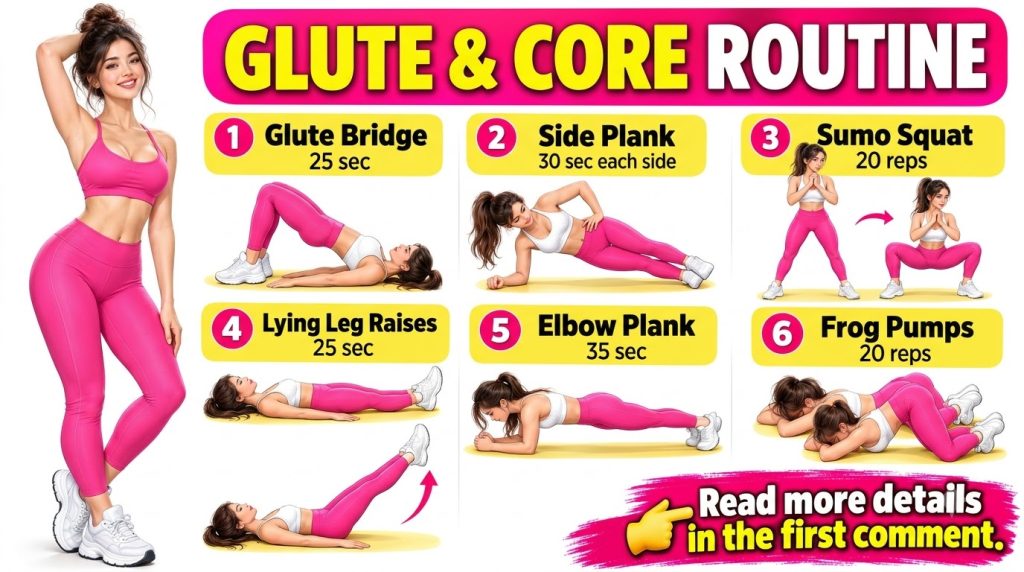
Incorporating a variety of exercises that target different parts of your glutes and core is key for comprehensive strength. Here are some effective exercises you can start with:
1. Glute Bridges
This exercise primarily targets the glutes and hamstrings. Lie on your back with your knees bent, feet flat on the floor hip-width apart, and arms by your sides. Press through your heels to lift your hips off the ground until your body forms a straight line from your shoulders to your knees. Squeeze your glutes at the top and then slowly lower back down. This movement helps build foundational strength.
2. Bird-Dog
An excellent exercise for core stability and balance, the Bird-Dog also engages the glutes and lower back muscles. Start on all fours with your hands directly under your shoulders and knees under your hips. Simultaneously extend your right arm straight forward and your left leg straight back, keeping your core engaged and hips level. Hold for a moment, then return to the starting position and repeat on the other side. Focus on controlled movements.
3. Plank
The plank is a classic core exercise that strengthens your entire midsection, including your abdominals, obliques, and lower back. Position yourself on your forearms and toes, keeping your body in a straight line from head to heels. Engage your core, avoiding any sagging in your hips or arching in your back. Hold this position for as long as you can maintain proper form, aiming to increase your hold time gradually.
4. Squats
Squats are a powerhouse exercise for the glutes, quads, and hamstrings, while also engaging the core for stability. Stand with your feet shoulder-width apart, chest up, and core engaged. Hinge at your hips and bend your knees as if sitting back into a chair, keeping your back straight and knees tracking over your toes. Lower until your thighs are parallel to the floor, then push through your heels to return to the starting position. Squats are highly functional and versatile.
5. Lunges
Lunges are fantastic for building unilateral strength, targeting each leg independently and deeply engaging the glutes and quads. Step forward with one leg, lowering your hips until both knees are bent at approximately a 90-degree angle. Ensure your front knee is directly above your ankle and your back knee hovers just above the ground. Push off your front foot to return to the start, then alternate legs. This exercise significantly improves balance and coordination.
6. Side Plank
The side plank targets the obliques and other core stabilizers more intensely than a traditional plank. Lie on your side, propped up on one forearm with your elbow directly under your shoulder and your feet stacked. Lift your hips off the ground, forming a straight line from head to heels. Hold this position, keeping your core tight and avoiding any sagging. Repeat on the other side. This helps create a balanced core.
Integrating Glute and Core Work into Your Routine
Consistency is key when it comes to seeing results. Aim to incorporate glute and core exercises into your routine 2-3 times per week, allowing for rest days in between. Start with 2-3 sets of 10-15 repetitions for each exercise, or hold planks for 30-60 seconds. As you get stronger, you can gradually increase the number of sets, repetitions, or the duration of your holds.
- Listen to Your Body: Always pay attention to how your body feels. If an exercise causes pain, stop and reassess your form or consult a fitness professional.
- Focus on Form: Proper form is more important than the number of repetitions. Watch videos or use a mirror to ensure you’re performing each exercise correctly to maximize effectiveness and prevent injury.
- Progress Gradually: Don’t try to do too much too soon. Progressive overload—gradually increasing the intensity, duration, or resistance—is how muscles adapt and grow stronger.
By making glute and core training a regular part of your wellness journey, you’re building a strong, resilient body that will serve you well for years to come. Remember, these are general guidelines and not a substitute for professional medical or fitness advice. Always consult with a healthcare professional before starting any new fitness regimen.