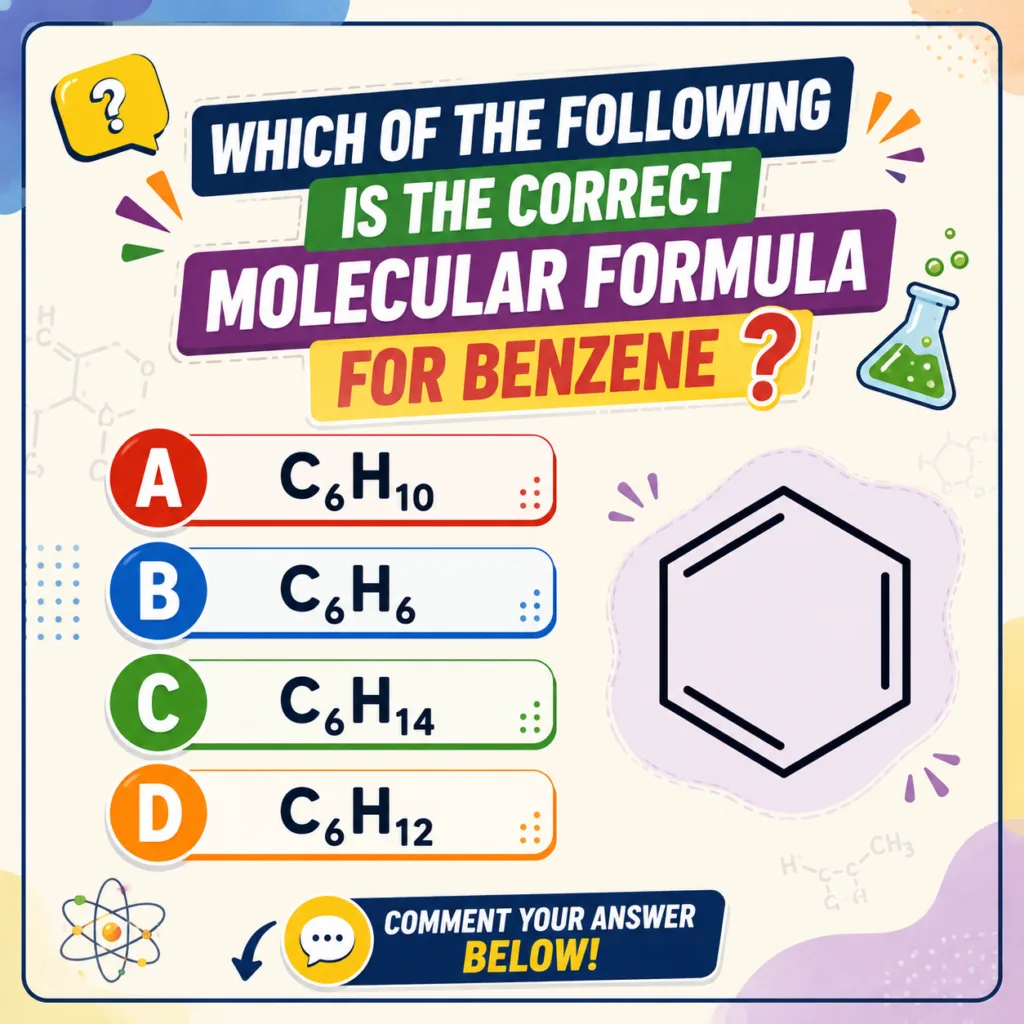
At first glance, all four formulas look similar—but only one represents benzene, one of the most important compounds in organic chemistry.
Take a moment to think before scrolling. 👇
- A. C₆H₁₀
- B. C₆H₆
- C. C₆H₁₄
- D. C₆H₁₂
Many people confuse benzene with other six-carbon compounds like cyclohexane or hexane. The trick is remembering that benzene is an aromatic hydrocarbon, meaning it has a unique ring structure with alternating double bonds.
This special arrangement gives benzene exceptional stability and a molecular formula different from many other six-carbon molecules.
✅ The Correct Answer: B. C₆H₆
Benzene consists of:
- 6 carbon atoms (C)
- 6 hydrogen atoms (H)
Its molecular formula is:
C₆H₆
The six carbon atoms form a hexagonal ring with alternating double bonds (often represented as a hexagon with a circle inside), making benzene the simplest aromatic hydrocarbon.
Why the others are incorrect:
- A. C₆H₁₀ – Represents other unsaturated hydrocarbons, not benzene.
- C. C₆H₁₄ – This is hexane, a straight-chain alkane.
- D. C₆H₁₂ – Commonly represents cyclohexane or other alkenes, but not benzene.
🎉 Did you get it right? If you answered B, congratulations—you know your organic chemistry! Keep challenging yourself with more science quizzes to sharpen your knowledge. 🧠⚗️