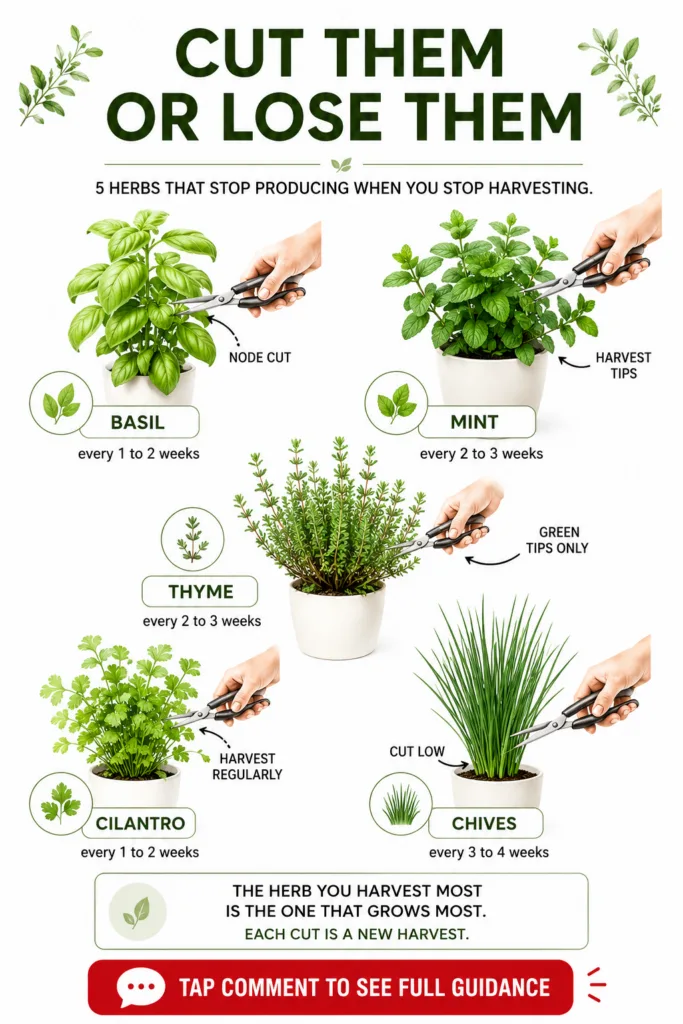
Have you ever noticed that one of your favorite herbs suddenly stopped growing, became woody, or started flowering too early?
The problem might not be your soil or fertilizer—it could be that you’re not harvesting often enough.
Many herbs actually become healthier, bushier, and more productive when they’re trimmed regularly. Every time you harvest correctly, you’re encouraging the plant to produce fresh new growth instead of slowing down.
Here are five herbs that love regular harvesting.
🌿 1. Basil
Harvest every 1–2 weeks
Basil grows best when you cut just above a leaf node. This encourages the plant to branch into two new stems instead of one.
Best Tip:
- Never remove more than one-third of the plant at once.
- Pinch off flower buds as soon as they appear.
- Regular harvesting creates a fuller, bushier basil plant.
🌱 2. Mint
Harvest every 2–3 weeks
Mint is one of the fastest-growing herbs in the garden. If left untouched, stems become long and leggy while older leaves lose their fresh flavor.
Best Tip:
- Cut the top few inches of healthy stems.
- Harvest before the plant flowers for the strongest flavor.
- Frequent trimming keeps mint compact and produces plenty of tender new leaves.
🌿 3. Thyme
Harvest every 2–3 weeks
Thyme can become woody over time if you only harvest occasionally.
Best Tip:
- Snip soft green stems rather than thick brown woody branches.
- Leave enough green growth for quick recovery.
- Regular pruning encourages dense, flavorful new shoots.
🍃 4. Cilantro
Harvest every 1–2 weeks
Cilantro grows quickly but also bolts quickly in warm weather.
Harvesting young leaves often helps delay flowering and keeps fresh leaves coming for longer.
Best Tip:
- Pick the outer stems first.
- Allow the center to continue growing.
- Harvest before flower stalks begin to form.
🌱 5. Chives
Harvest every 3–4 weeks
Unlike many herbs, chives respond well to a low haircut.
Best Tip:
- Cut leaves about 1–2 inches (2–5 cm) above the soil.
- New leaves quickly grow back from the base.
- Regular harvesting keeps the plant tender and productive.
🌼 Why Does Harvesting Help?
Plants naturally respond to pruning by producing new shoots.
Instead of putting energy into flowers or aging stems, they redirect that energy into fresh leafy growth—the part we actually want to harvest.
In many herbs, regular cutting can lead to:
- 🌱 More branches
- 🌿 More leaves
- 💚 Healthier plants
- ✂️ Longer harvesting season
🌞 Bonus Tips for Bigger Harvests
✔ Harvest in the morning after the dew dries.
✔ Use clean, sharp scissors to avoid damaging stems.
✔ Water after harvesting to help plants recover faster.
✔ Never remove more than one-third of the plant at one time.
✔ Remove flower buds early if you’re growing herbs mainly for leaves.
🌿 The Secret Every Gardener Learns
The biggest mistake isn’t harvesting too much—it’s waiting too long.
Regular harvesting tells your herbs to keep producing fresh growth. Leave them untouched for weeks, and many will shift their energy into flowering and seed production instead.
So don’t be afraid to snip a few stems.
The herb you harvest the most is often the one that grows the most. 🌱✂️