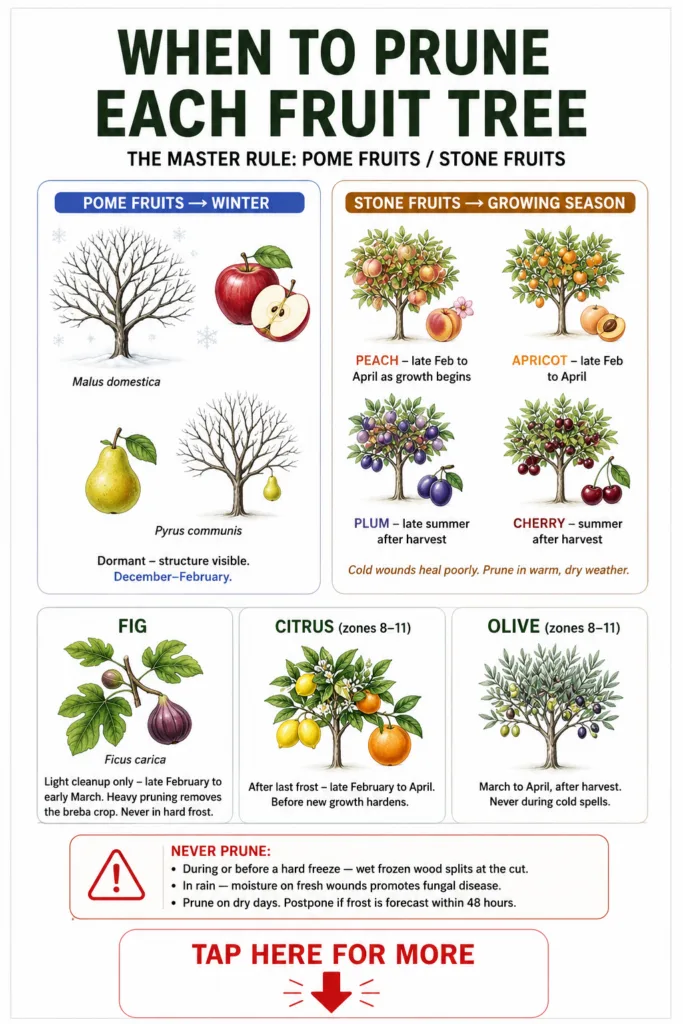
Pruning is one of the most important jobs in fruit tree care. Done at the right time, it improves sunlight penetration, increases air circulation, encourages healthy new growth, and often leads to larger, better-quality fruit.
However, not all fruit trees should be pruned at the same time. Different species respond differently to pruning, and choosing the wrong season can reduce harvests or increase the risk of disease.
Here’s a complete guide to pruning the most common fruit trees.
🍎 Pome Fruits (Apple & Pear)
Best Time to Prune
Winter (December–February) while the tree is dormant.
Trees include:
- Apple (Malus domestica)
- Pear (Pyrus communis)
During dormancy, the tree has dropped its leaves, making the branch structure easy to see. Winter pruning also stimulates vigorous new growth in spring.
How to Prune
Start by removing:
- Dead branches
- Broken branches
- Diseased wood
- Branches rubbing against each other
- Water sprouts (fast-growing vertical shoots)
- Suckers growing from the base
Then shape the canopy by opening the center so sunlight reaches every branch.
Aim for:
- Strong scaffold branches
- Good airflow
- Even spacing
- Balanced tree shape
Avoid removing more than 25–30% of the canopy in a single year.
🍑 Peach Trees
Best Time
Late winter to early spring, just before buds begin to open.
Unlike apples, peaches produce fruit on one-year-old wood, so annual pruning is essential.
How to Prune
Maintain an open-center (vase) shape.
Remove:
- Branches growing toward the center
- Old fruiting wood
- Weak shoots
- Crossing branches
Keep young, vigorous shoots because they will produce next season’s fruit.
Peach trees often require heavier annual pruning than other fruit trees.
🍑 Apricot Trees
Best Time
Late February through April, depending on your climate.
Apricots are sensitive to fungal diseases, especially in wet weather.
How to Prune
Only prune during:
- Warm weather
- Dry days
- Low humidity
Remove:
- Dead branches
- Crowded growth
- Vertical shoots
Avoid making unnecessary cuts.
🍒 Plum Trees
Best Time
Late summer immediately after harvest.
Avoid winter pruning whenever possible because fresh cuts are more susceptible to fungal infections.
How to Prune
Focus on:
- Removing damaged limbs
- Improving airflow
- Reducing excessive height
- Keeping the canopy balanced
Plums generally require lighter pruning than peaches.
🍒 Cherry Trees
Best Time
Immediately after harvesting fruit during summer.
Summer pruning reduces the risk of bacterial canker and silver leaf disease.
How to Prune
Remove:
- Dead wood
- Weak branches
- Crossing limbs
- Water sprouts
Maintain a light, open canopy rather than heavily reducing the tree.
🌿 Fig Trees
Best Time
Late February to early March.
Fig trees don’t need aggressive pruning.
How to Prune
Only remove:
- Dead wood
- Damaged branches
- Crowded growth
Avoid heavy pruning because it can remove the developing breba crop (the early fig harvest).
🍋 Citrus Trees (Lemon, Orange, Lime)
Best Time
After the last frost, usually late February through April.
Never prune during freezing temperatures.
How to Prune
Remove:
- Dead wood
- Weak branches
- Branches touching the ground
- Water sprouts
- Suckers below the graft
Keep the canopy open enough for sunlight while preserving healthy foliage.
Citrus trees usually require only light maintenance pruning.
🫒 Olive Trees
Best Time
March through April, or immediately after harvest in warm climates.
Avoid pruning during cold weather.
How to Prune
Olives naturally become dense.
Thin out:
- Interior branches
- Crossing limbs
- Suckers
- Vertical shoots
Maintain an open canopy that allows sunlight to reach the center of the tree.
This improves both fruit production and disease resistance.
⚠️ When You Should NEVER Prune
Avoid pruning under these conditions:
❌ During freezing temperatures
Frozen wood becomes brittle and wounds heal slowly.
❌ Just before a hard frost
Fresh pruning cuts are vulnerable to cold damage.
❌ During rainy weather
Moisture encourages fungal diseases and bacterial infections to enter fresh cuts.
❌ During extremely hot weather
Heavy pruning during heat waves can stress the tree and increase sunburn on exposed branches.
✂️ Essential Pruning Tips
No matter what fruit tree you’re pruning:
- Use sharp, sanitized pruning tools.
- Make clean cuts just outside the branch collar.
- Remove dead or diseased wood first.
- Avoid leaving long stubs.
- Disinfect tools between diseased trees.
- Never remove more than one-third of the canopy in a single season unless you’re performing a major restoration.
🌱 Final Thoughts
Pruning isn’t just about making a tree look tidy—it’s about encouraging healthy growth, maximizing fruit production, and preventing disease. Timing matters just as much as technique.
As a simple rule of thumb:
- 🍎 Apple & Pear: Prune in winter while dormant.
- 🍑 Peach & Apricot: Prune in late winter or early spring as growth begins (only in dry weather for apricots).
- 🍒 Plum & Cherry: Prune in summer after harvest.
- 🌿 Fig: Light pruning in late winter.
- 🍋 Citrus: Prune after the last frost.
- 🫒 Olive: Prune in early spring or after harvest.
With the right timing and careful cuts, your fruit trees will stay healthier, produce higher-quality fruit, and remain productive for years to come.