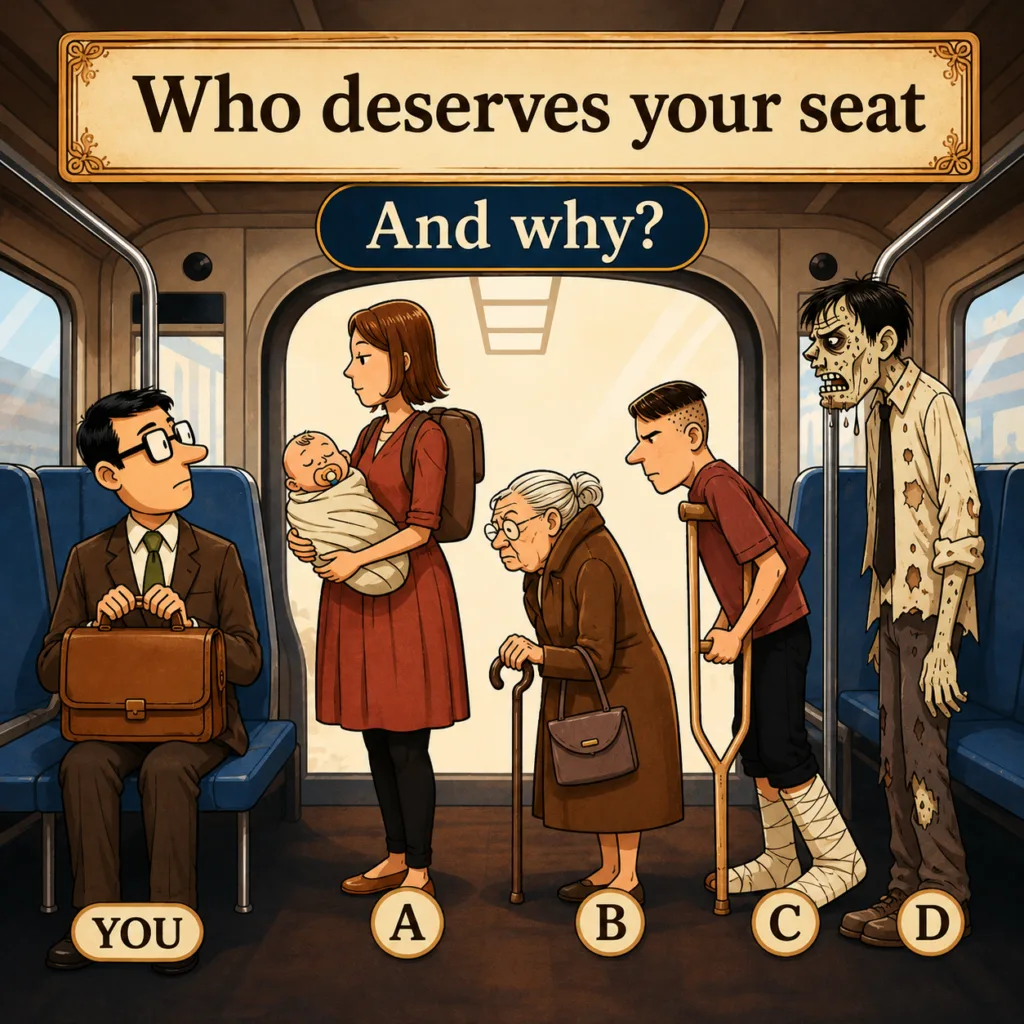
Would you give up your seat?
At first glance, this puzzle seems easy. But once you look closer, every person standing has a reason why they might deserve the seat.
So… who should you choose?
Let’s examine each option carefully.
The Situation
You’re sitting on a crowded subway.
Four people are standing in front of you:
A. A mother carrying a sleeping baby
B. An elderly woman using a cane
C. A young man with an injured leg using crutches
D. A very sick-looking man
There isn’t one universally “correct” answer—but there is one that many people consider the strongest choice.
Option A — The Mother
A mother carrying a sleeping baby is doing two jobs at once.
She has to:
- Support the baby’s weight
- Keep the child safe if the train suddenly stops
- Maintain her own balance
A sudden movement could easily wake the baby or even cause an accident.
She certainly deserves consideration.
Option B — The Elderly Woman
The elderly woman is walking with a cane.
Older adults generally have:
- Less balance
- Slower reactions
- A higher risk of falling
Even a small jolt on public transportation could cause a serious injury.
Giving up your seat to an elderly passenger is considered a common courtesy in many countries.
Option C — The Injured Passenger
This passenger is using crutches.
That tells us he likely cannot put full weight on one leg.
Standing on a moving train would require constant effort and could worsen his injury.
He also has a higher risk of losing balance.
Option D — The Sick Man
The last passenger appears seriously ill.
If he is genuinely unwell, he may be weak, dizzy, or struggling to stand.
However, unlike the other passengers, we cannot be certain of his condition based only on appearance.
So Who Deserves the Seat?
Many people immediately choose B, the elderly woman.
Here’s why:
- She has reduced mobility.
- She faces a high risk of falling.
- A fall could result in severe injuries such as a broken hip.
- Public transportation etiquette in many places gives priority to elderly passengers.
For these reasons, B is often considered the intended answer to this puzzle.
But There Isn’t Only One Right Answer
This puzzle is designed to start a discussion rather than test a single “correct” answer.
Many people would also reasonably choose:
- A, because protecting an infant is important.
- C, because standing on crutches is physically demanding.
- D, if he truly appears dangerously ill.
The “best” decision can depend on the situation and who seems to need help the most.
Final Answer
✅ Most versions of this puzzle expect Answer B — the elderly woman.
She is the most vulnerable to losing balance and suffering a serious injury if the train suddenly moves.
The Real Lesson
The puzzle isn’t really about finding a perfect answer—it’s about empathy.
Sometimes the right choice is simply noticing who needs help the most in that moment. Public kindness often begins with paying attention to the people around us.
Who would you choose: A, B, C, or D? Share your answer and explain your reasoning!