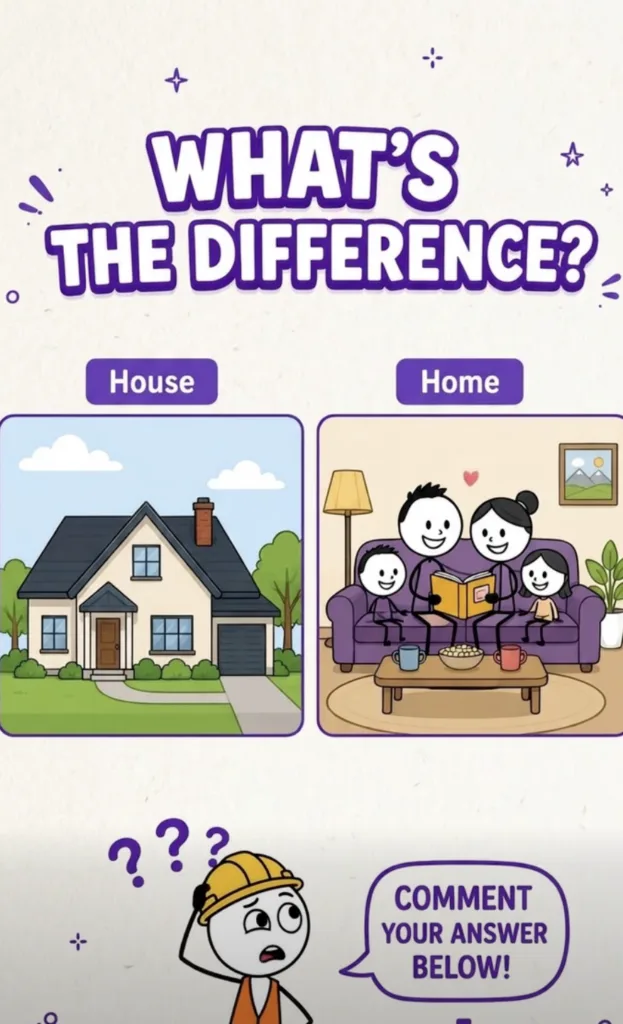
At first glance, house and home seem to mean the same thing. Many English learners use them interchangeably, but native speakers use them in different situations.
Let’s make it simple.
🏠 What Is a House?
A house is a physical building.
It’s the structure made of walls, windows, doors, and a roof where people live.
Examples:
- They bought a new house last year.
- That house has a beautiful garden.
- My house is on Oak Street.
Think of house as the building itself.
❤️ What Is a Home?
A home is much more than a building.
It’s the place where you feel comfortable, safe, loved, and connected with family.
A home can be:
- A house
- An apartment
- A small cabin
- Even a room—if it feels like home.
Examples:
- I can’t wait to go home after work.
- Home is where the heart is.
- Welcome home!
Here, the focus is on feelings, not the building.
The Easy Way to Remember
🏠 House = The Building
❤️ Home = The Feeling
A house is made of bricks.
A home is made of memories.
Quick Quiz
Which sentence sounds more natural?
A. I can’t wait to go back to my house after vacation.
B. I can’t wait to go back home after vacation.
✅ Correct answer: B
Because you’re talking about returning to the place where you feel comfortable—not the physical building.
Final Tip
Whenever you’re talking about an address, a building, or buying property, use house.
Whenever you’re talking about family, comfort, or the place you belong, use home.
It’s a small difference, but using the right word will make your English sound much more natural.
Did you get it right before reading the explanation? Let us know in the comments!