Healthy vegetables start with healthy soil. You can buy excellent seeds and water your garden carefully, but if the soil doesn’t provide the right balance of water, air, nutrients, and drainage, your plants may struggle.
The good news is that you don’t need to be a soil expert. Understanding four common soil types—loam, sandy, silty, and clay soil—can help you choose suitable crops and improve your harvest.
🌿 1. Loam Soil — The All-Around Garden Favorite
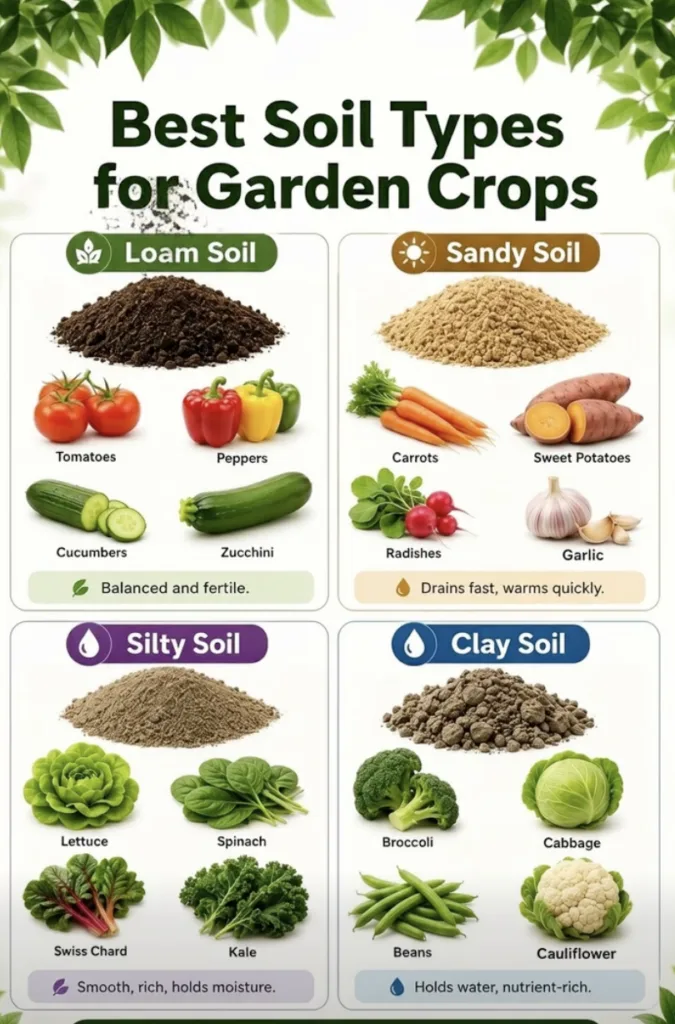
Loam is often considered one of the best soils for vegetable gardening because it contains a balanced mixture of sand, silt, clay, and organic matter.
It usually drains well while still holding enough moisture for plant roots.
Great crops for loam soil include:
- 🍅 Tomatoes
- 🫑 Peppers
- 🥒 Cucumbers
- 🌱 Zucchini
How to improve it
Even good loam benefits from adding compost or well-rotted organic matter each season. This helps replenish nutrients and supports beneficial soil organisms.
🥕 2. Sandy Soil — Excellent Drainage for Root Crops
Sandy soil has larger particles and drains very quickly. It also tends to warm up faster in spring, which can be useful for getting certain crops started.
Because the soil is loose, root vegetables can often develop more easily.
Crops that can perform well in sandy or sandy-loam conditions include:
- 🥕 Carrots
- 🍠 Sweet potatoes
- 🌱 Radishes
- 🧄 Garlic
The challenge with sandy soil
Fast drainage also means water and nutrients can disappear quickly.
Improve sandy soil by regularly adding:
Compost + aged manure + other organic matter
Mulching around your vegetables can also reduce moisture loss during hot weather.
🥬 3. Silty Soil — Moisture-Retaining and Fertile
Silty soil has fine particles and generally holds more water than sandy soil. When well managed, it can be fertile and productive.
Leafy vegetables often appreciate consistently moist, nutrient-rich soil.
Good choices can include:
- 🥬 Lettuce
- 🌿 Spinach
- 🌱 Swiss chard
- 🥬 Kale
Be careful with compaction
Avoid repeatedly walking over your growing beds, especially when the soil is wet. Compacted soil contains less air, making it harder for roots to grow.
Adding compost can help improve soil structure.
🥦 4. Clay Soil — Nutrient-Rich but Heavy
Clay soil contains very small particles. It can hold a lot of water and nutrients, but it may become dense, sticky, and poorly drained.
Some vegetables can grow successfully in improved clay soils, including:
- 🥦 Broccoli
- 🥬 Cabbage
- 🌱 Beans
- 🥦 Cauliflower
How to improve clay soil
One of the best long-term solutions is organic matter.
Add compost, leaf mold, or well-rotted organic material regularly. Raised beds can also help where drainage is a serious problem.
Avoid working heavy clay when it is extremely wet because this can damage its structure.
🧪 How Do You Know What Soil You Have?
Try this simple test.
Take a handful of slightly moist soil and squeeze it gently.
If it feels very gritty and falls apart easily, it probably contains a lot of sand. If it feels smooth or silky, it may contain more silt. If it feels sticky and can easily be shaped when wet, it probably contains a high percentage of clay.
For more accurate information, consider a proper soil test. A test can tell you about your soil’s pH and nutrient levels, which are just as important as its texture.
🌱 Remember: Soil Type Isn’t Everything
The crop suggestions above are useful starting points, but they aren’t strict rules.
For example, broccoli isn’t automatically going to thrive simply because your garden has clay soil. Drainage, soil pH, fertility, climate, sunlight, watering, and organic matter all matter too.
And gardeners can improve almost any soil over time.
The simplest habit?
🍂 Keep adding organic matter.
Compost improves water retention in sandy soils while helping heavy soils develop better structure and drainage.
🌻 Build Better Soil, Grow Better Food
Instead of trying to find “perfect” soil, learn what you already have and improve it season by season.
🌱 Loam: balanced and versatile
🏜️ Sandy: fast-draining and easy for roots to penetrate
💧 Silty: moisture-retentive and potentially fertile
🪨 Clay: nutrient-holding but often needs better structure and drainage
Your soil is the foundation of your entire garden. Take care of the soil, and the soil will take care of your plants. 🌱🍅🥕🥦
👇 What type of soil do you have in your garden? Comment below!