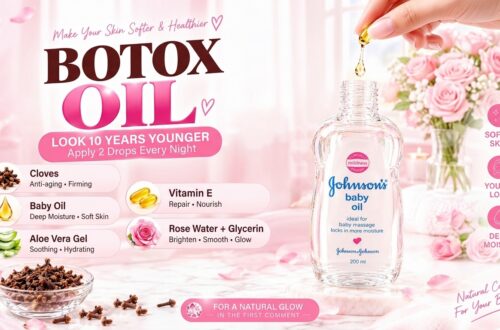
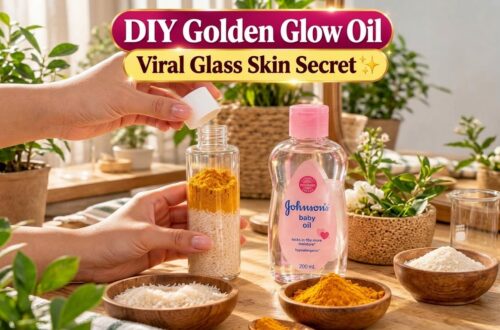
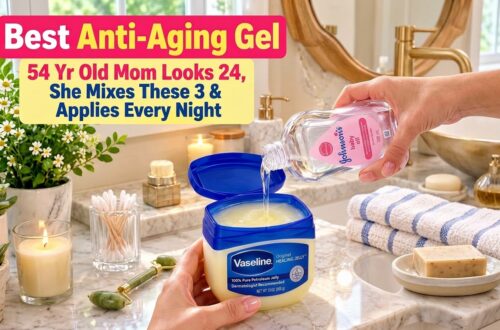
If you enjoy viral DIY beauty recipes, this Clove + Baby Oil + Petroleum Jelly Night Balm is certainly an unusual one. In the video, whole cloves and what appear to be small white cosmetic beads or granules are combined with baby oil and petroleum jelly, creating a rich mixture that is promoted as an “anti-aging cream.”
The video claims that a 56-year-old woman can look 25 by mixing these ingredients and applying them every night. That makes a strong social-media hook, but it shouldn’t be interpreted literally. This homemade mixture cannot reverse decades of aging.
A more realistic way to view it is as an occlusive nighttime balm designed to reduce moisture loss and leave dry skin feeling softer and smoother.
🌿 What Does the Video Use?
From the visible steps, the recipe appears to involve:
- Plain petroleum jelly
- Baby oil
- Whole cloves
- Small white beads or granules
The exact identity of the white granules cannot be reliably determined from the video alone.
That matters.
Never put an unidentified ingredient on your face simply because it appears in a viral video.
If you want to experiment with the general idea, it’s safer to simplify the recipe rather than guessing what those granules are.
🧴 Why Petroleum Jelly?
Petroleum jelly is an occlusive moisturizer.
Instead of directly adding lots of water to the skin, it forms a protective layer that helps slow moisture loss.
This can be especially useful for skin that feels:
- Dry
- Rough
- Flaky
- Tight
- Dehydrated
When dry skin retains more moisture, it often temporarily looks smoother, softer, and more supple.
💧 What Does Baby Oil Do?
Baby oil acts mainly as an emollient and occlusive ingredient.
Adding a small amount can make petroleum jelly softer and easier to spread.
Together, the basic effect is:
Baby Oil → Softens
Petroleum Jelly → Helps Seal Moisture In
This explains much of the glossy, moisturized appearance shown at the end of the video.
🌿 What About the Cloves?
Cloves contain aromatic compounds, particularly eugenol.
Although cloves are commonly featured in traditional DIY beauty recipes, they can also irritate sensitive skin.
This is especially important because facial skin can be more reactive than skin elsewhere on the body.
Using more cloves does not necessarily mean better results.
And concentrated clove essential oil should not be treated as interchangeable with whole cloves.
❓ What Are Those White Granules?
The video appears to show numerous small white granules mixed into both the baby oil and petroleum jelly.
However, their identity isn’t clear enough to recommend them.
Don’t assume they’re:
- Vitamin capsules
- Cosmetic wax
- Soap beads
- Supplements
- Powdered skincare ingredients
Without knowing exactly what they are, skip them.
A DIY facial recipe should never require guessing an ingredient.
🥣 A Safer Simplified Version
If you’re mainly interested in the moisturizing concept shown in the video, simplify it to:
- 1 teaspoon plain petroleum jelly
- 1–2 drops of baby oil
You could even use plain petroleum jelly by itself.
If your baby oil contains fragrance and your skin is sensitive, consider using a simple fragrance-free facial moisturizer instead.
🥄 Step 1 – Start With a Small Amount
Scoop approximately 1 teaspoon of petroleum jelly into a clean bowl.
Don’t modify an entire commercial jar.
Making a tiny amount lets you test how your skin reacts without wasting the original product.
💧 Step 2 – Add Baby Oil
Add only 1–2 drops of baby oil.
You don’t need much.
Too much oil can turn the mixture excessively greasy.
🌀 Step 3 – Mix Until Smooth
Stir the petroleum jelly and baby oil thoroughly.
The texture should gradually become:
Smooth → Creamy → Glossy → Easy to Spread
This recreates the basic balm consistency demonstrated in the video without introducing an unidentified ingredient.
🌿 Step 4 – Should You Add Cloves?
For facial skincare, I’d be cautious.
Whole cloves sitting inside an oily mixture don’t automatically make it more effective, and clove-derived compounds can irritate some people.
If your goal is simply softer, better-moisturized skin, the cloves aren’t necessary.
Keeping the recipe simple also makes it easier to identify the cause if irritation develops.
🧪 Step 5 – Patch Test First
Before applying any DIY mixture to your entire face, perform a patch test.
Apply a tiny amount to a limited area and monitor it.
Stop if you experience:
- Burning
- Itching
- Redness
- Swelling
- Rash
- Persistent irritation
Discomfort isn’t evidence that the treatment is “working.”
🌙 Step 6 – Apply at Night
The video recommends nighttime application, which makes sense for a heavy occlusive balm.
Start with clean skin.
Apply your normal moisturizer first.
Then add a very thin layer of the balm.
A simple routine is:
Cleanse → Moisturizer → Thin Occlusive Layer
🤏 How Much Should You Apply?
Very little.
You don’t need the thick amount often demonstrated in social-media videos.
Start with approximately a pea-sized amount or less for the areas that need it.
Focus mainly on dry patches.
👁️ Avoid Sensitive Areas
Keep homemade mixtures away from:
- Eyes and eyelids
- Inside the nose
- Broken skin
- Active rashes
- Irritated areas
If your skin is already inflamed, avoid experimenting with new DIY ingredients until it has recovered.
✨ What Results Are Realistic?
The main realistic benefit is moisture retention.
Dry skin may temporarily appear:
Softer → Smoother → Plumper → More Radiant
Fine lines caused or emphasized by dehydration may also become somewhat less noticeable.
These effects can make the complexion look refreshed.
But they aren’t equivalent to reversing biological aging.
❌ Can It Really Make 56 Look 25?
No DIY balm can reliably produce that transformation.
Visible aging involves complex changes in:
- Collagen
- Elastin
- Pigmentation
- Skin thickness
- Facial fat
- Bone structure
- Muscle activity
- Lifetime sun exposure
- Genetics
Lighting, makeup, filters, and camera processing can also dramatically change how old someone appears in a short video.
💉 Is This “Natural Botox”?
No.
Botox works by temporarily reducing activity in targeted facial muscles after being administered by a qualified medical professional.
Petroleum jelly and baby oil primarily work on the skin’s surface.
They don’t reproduce Botox’s mechanism.
So:
Moisturizing skin ≠ Botox
Temporarily smoother-looking skin ≠ wrinkle removal
☀️ What Matters More for Long-Term Skin Aging?
If your goal is maintaining healthier-looking skin over time, daily sun protection is one of the most important habits.
A simple routine could be:
Morning:
Gentle Cleanser → Moisturizer → Broad-Spectrum SPF 30+
Night:
Gentle Cleanser → Moisturizer → Optional Thin Occlusive Layer
Consistency with a basic routine generally makes more sense than constantly experimenting with viral mixtures.
⚠️ Who Should Be Extra Careful?
Be cautious with DIY facial recipes if you have:
- Sensitive skin
- Rosacea
- Eczema
- Dermatitis
- Active acne irritation
- Broken skin
- Known fragrance sensitivity
- Known clove sensitivity
Baby oil can also contain fragrance, so check the ingredient list.
🧼 Don’t Make a Huge Batch
The video mixes ingredients directly into large commercial containers because it creates an eye-catching visual.
At home, a better approach is:
Scoop a small amount → Mix separately → Patch test → Use sparingly
Avoid adding unknown ingredients to an entire jar of skincare.
🌿 Do You Actually Need Three Ingredients?
Probably not.
For the basic moisture-sealing effect, a much simpler approach is:
Cleanse → Moisturizer → Thin Layer of Plain Petroleum Jelly
This provides the primary occlusive benefit without introducing cloves, fragrance, or unidentified granules.
✨ Final Thoughts
This viral Clove + Baby Oil + Petroleum Jelly “Anti-Aging Cream” is best viewed as a social-media DIY moisturizing idea rather than a miracle age-reversal treatment.
The useful principle underneath the trend is:
Moisturize → Seal In Moisture → Reduce Dryness → Skin May Look Softer & Smoother
The video’s unidentified white granules should not be copied unless you know exactly what they are, and cloves aren’t necessary to obtain the basic moisturizing effect.
If you want to experiment, keep the formula simple, make only a tiny amount, patch test first, and use a very thin layer.
Would you try this overnight beauty balm? Comment “GLOW” below and save this guide for later! 🌿✨👇