That black-and-white portrait challenged many history buffs, didn’t it?
Identifying U.S. Presidents from their younger days can be surprisingly tricky, especially when all the options became giants of American politics.
The crisp suit and youthful determination in his eyes hint at a future leader, but which one?
Did you lock in your choice for who this ambitious young man would become?
It’s time to uncover the truth behind the historic face!
The correct answer is A — John F. Kennedy. 🇺🇸
If you chose John F. Kennedy, you successfully recognized one of America’s most iconic and influential presidents during his formative years. Even with the familiar name, this particular photograph captures him long before he became the charismatic leader we remember from the White House, making it a truly challenging guess!
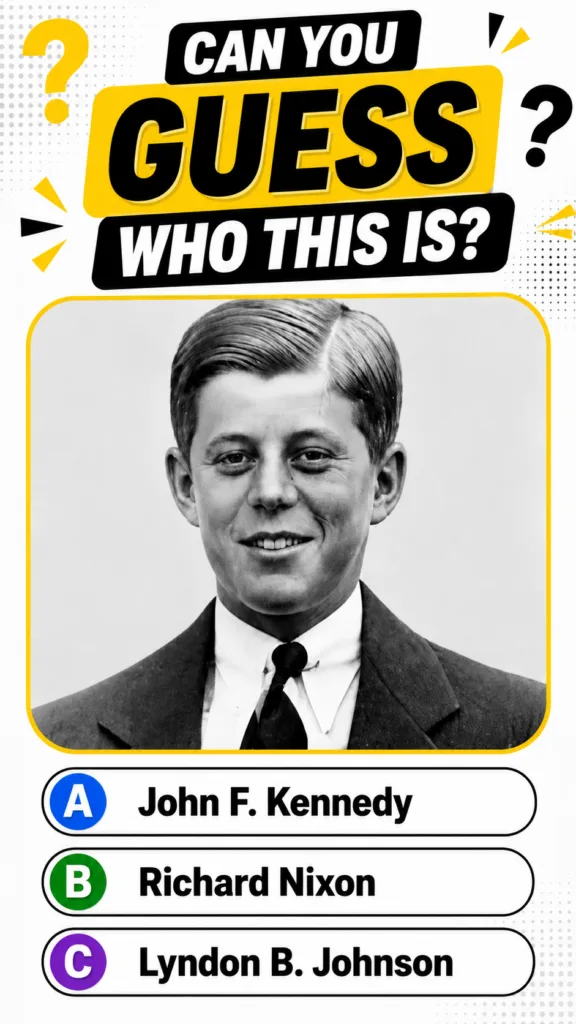 The young man who would become the 35th President of the United States.
Before History Knew His Name
Born into one of America’s most prominent political families on May 29, 1917, John Fitzgerald Kennedy was the second of nine children to Joseph P. Kennedy Sr. and Rose Fitzgerald Kennedy. From an early age, JFK, or “Jack” as he was known, was steeped in an environment of high expectations and public service. However, his early life was also marked by frequent health struggles, which would continue throughout his adulthood.
He attended a series of prestigious schools, including Canterbury School and Choate School, before enrolling at Harvard University. During his time at Harvard, he studied international affairs, and his senior thesis, focusing on why Britain was unprepared for World War II, later became a bestselling book titled “Why England Slept.” His experiences and observations during this period began to shape his worldview and political leanings.
World War II profoundly impacted Kennedy. He joined the U.S. Navy and, despite his health issues, distinguished himself with bravery, notably as commander of a PT boat (PT-109) in the Pacific. When his boat was rammed by a Japanese destroyer, he heroically led his surviving crew to safety, an act for which he was decorated. This experience not only forged his reputation as a war hero but also deepened his sense of duty and sacrifice.
The Path to the White House
Kennedy’s political career began unexpectedly after his elder brother, Joe Jr., who was slated for a political future, was killed during the war. With the family’s encouragement, John F. Kennedy stepped into the void, running for and winning a seat in the U.S. House of Representatives for Massachusetts’ 11th congressional district in 1946. He served three terms, focusing on issues like veteran benefits and labor rights, gradually building his political platform and public profile.
In 1952, he successfully ran for the U.S. Senate, defeating incumbent Henry Cabot Lodge Jr. His Senate years were marked by strong legislative activity and a growing national presence. He married Jacqueline Lee Bouvier in 1953, and their union became a symbol of American glamour and aspiration. During this time, Kennedy also continued to battle health issues, undergoing several surgeries.
His ambition was clear, and in 1960, he announced his candidacy for President of the United States. His youth, charisma, and articulate vision for a “New Frontier” captivated the nation. The televised debates against his Republican opponent, Richard Nixon (another option in the quiz!), played a crucial role in showcasing his poise and intellect, ultimately helping him secure a narrow victory and become the youngest man ever elected president at 43.
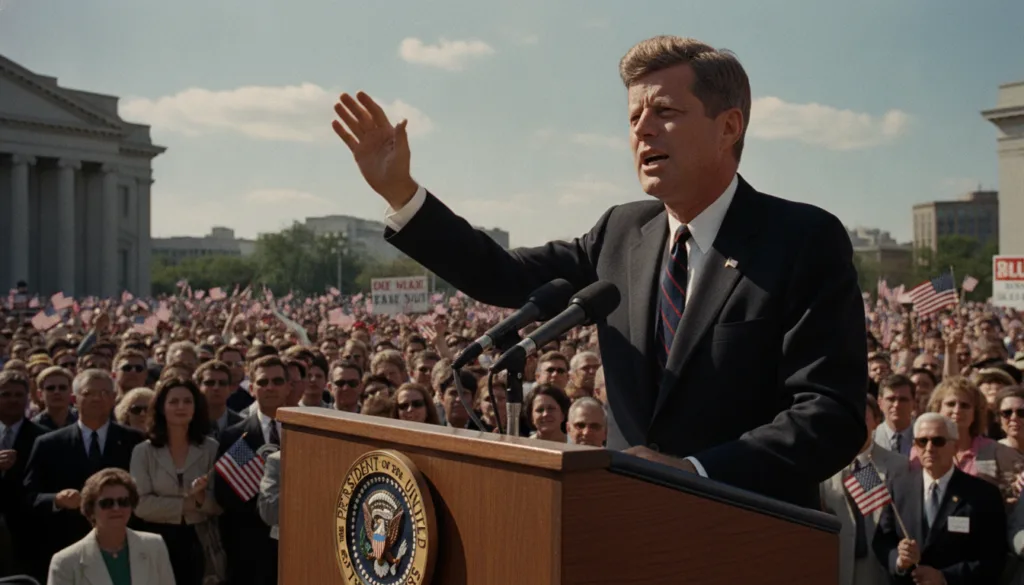 President Kennedy during a public address.
A Defining Presidency
President Kennedy’s thousand days in office, from January 1961 until his assassination in November 1963, were a period of intense challenge and significant progress. He faced numerous foreign policy crises, most notably the Bay of Pigs invasion and the Cuban Missile Crisis, bringing the world to the brink of nuclear war before a peaceful resolution was found. His handling of these events demonstrated a blend of caution and firm resolve.
Domestically, Kennedy championed his “New Frontier” programs, aimed at improving education, healthcare, and civil rights, though many of these faced congressional opposition. He also inspired a generation with his call to public service, famously stating in his inaugural address, “Ask not what your country can do for you – ask what you can do for your country.” His vision led to the creation of the Peace Corps, an initiative that sent American volunteers to assist developing nations.
Perhaps one of his most ambitious goals was to land a man on the moon before the end of the decade, galvanizing the American space program. Tragically, his presidency was cut short by his assassination in Dallas, Texas, leaving a profound impact on the nation and the world.
Why His Legacy Endures
Despite the brevity of his time in office, John F. Kennedy’s impact on American culture and politics remains immense. He inspired hope, ignited a sense of national purpose, and challenged Americans to strive for greatness. His youthful energy, eloquence, and vision for a better future captivated millions, both at home and abroad.
His administration’s efforts laid groundwork for crucial legislation in civil rights and social programs, while his approach to foreign policy helped navigate the tense Cold War era. Kennedy’s enduring appeal lies not just in what he achieved, but in the potential he represented, a promise of progress and change that continues to resonate today. So if you picked A, you were right — the young man in the photo was indeed John F. Kennedy.
Did You Get It Right? 👀
Did you recognize the unmistakable gaze of a future U.S. President in that vintage photograph? The options were certainly challenging, featuring other giants of the era like Richard Nixon and Lyndon B. Johnson.
Which clue, if any, helped you identify John F. Kennedy, or did the youthful image successfully stump you?