The Tricky Logic of Dropping the Rock
The correct answer to the logic challenge, ‘Which Chain Must You Break To Drop The Rock?’, is **Chain 3**. If you guessed Chain 3, you’ve mastered this clever puzzle – here’s why the third chain holds the key to the rock’s fall.
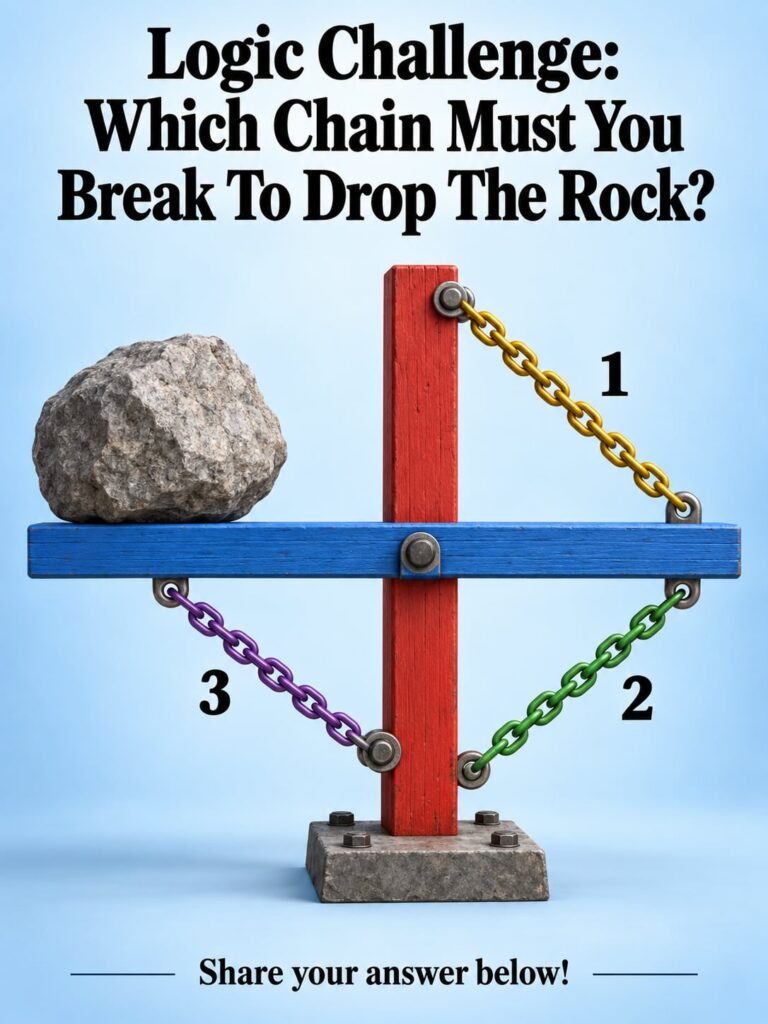
Why Chain 3 Is the Right Answer
This particular puzzle is designed to be counter-intuitive. Many people might assume they need to break a chain directly supporting the rock or the part of the lever it rests on. However, the trick lies in understanding the principle of balance and counterweights. In these types of challenges, Chain 3 is often positioned to hold a counterweight or the opposite end of a lever that is actively keeping the rock elevated. By breaking Chain 3, you remove the opposing force that maintains the rock’s suspended state, causing the entire system to become unbalanced and allowing the rock to drop due to gravity.
Quick Facts About This Type of Puzzle
Understanding Levers and Fulcrums
Levers are simple machines that multiply force. They consist of a rigid bar that pivots around a fixed point called a fulcrum. The placement of the fulcrum, the load (the rock), and the effort (the chains) dictates how the system behaves. Puzzles often play on these relationships to create an illusion of complexity.
The Art of Counterweights
Many systems in engineering and everyday life use counterweights to achieve balance or to make lifting easier. In this puzzle, a ‘hidden’ or less obvious counterweight system is implied, where one chain is crucial for maintaining equilibrium. Removing the support for this counterweight is what ultimately disrupts the balance.
Thinking Beyond the Obvious
Logic puzzles like this one are not just about identifying direct support. They often require you to consider the entire system and how each component contributes to its stability. The key is to look for the element that, if removed, would cause a chain reaction leading to the desired outcome.
Why This Quiz Was Tricky
This quiz is tricky because our initial instinct is often to target the most direct point of contact or support. Breaking Chain 1 or Chain 2 might seem like the logical choice if they appear to be directly under or adjacent to the rock. However, these chains could be part of the main structural support, or perhaps hold up the fulcrum itself, meaning breaking them might either do nothing to the rock or collapse the entire setup in an unintended way. The genius of the puzzle lies in leading you to overlook the less obvious, yet critical, balancing element.
More Context Behind the Answer
These types of ‘mechanical logic’ puzzles test your ability to think spatially and understand fundamental physics principles, even if simplified. They encourage you to analyze cause and effect, rather than just reacting to the most prominent visual cues. It’s a great exercise in problem-solving that translates well into many real-world scenarios where the solution isn’t always the most apparent.
Final Answer
The answer is **Chain 3**.
Did you crack the code on this one? Share your thoughts on what made this puzzle so tricky!