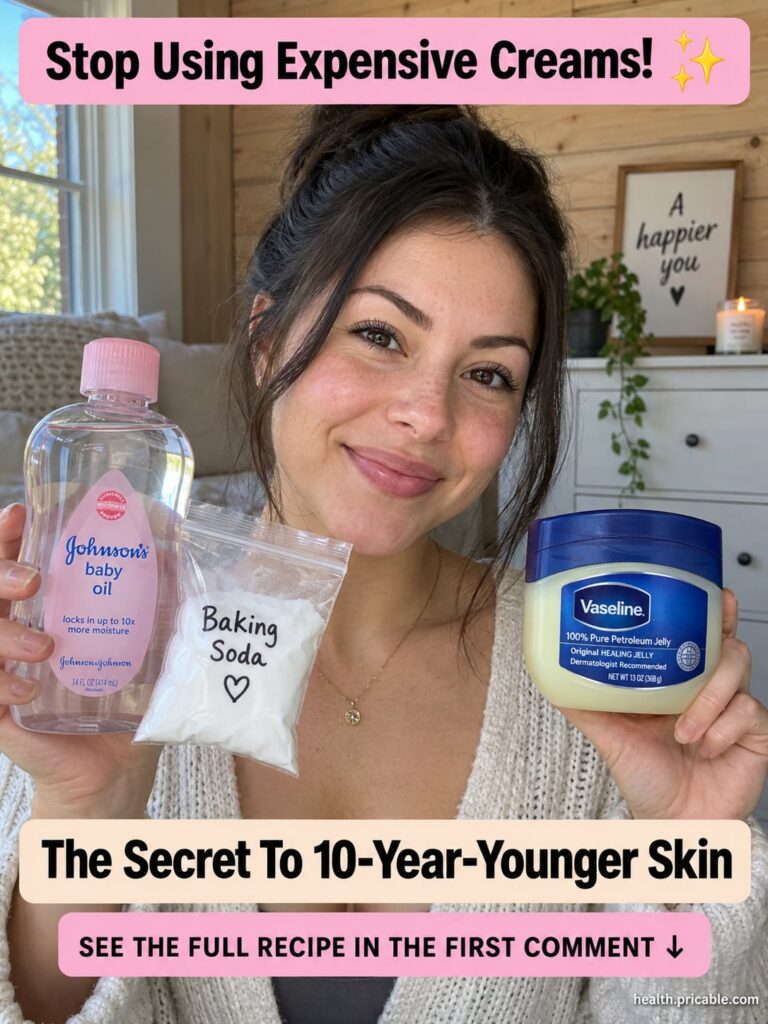
You’ve likely seen the buzz online: a seemingly simple beauty hack promising youthful, smooth skin using just three common household items. This viral trend, often shared as a secret passed down through generations, combines Vaseline, baby oil, and baking soda. While the allure of an easy, affordable anti-aging solution is strong, it’s crucial to understand exactly what this hack entails and its potential risks before trying it on your skin.
The Viral Hack Details
This hack is often presented as a ‘grandma’s secret’ for younger-looking skin, claiming to smooth wrinkles and provide a radiant glow. The method typically involves mixing the three ingredients to create a paste or cream-like consistency that is then applied to the face.
Prep time:
2 minutes
Best for:
Not recommended for any skin type due to high risk of irritation and damage.
Use type:
Topical paste/mask (as described in the viral hack)
Main ingredients:
- Vaseline (petroleum jelly)
- Baby Oil (mineral oil)
- Baking Soda (sodium bicarbonate)
Ingredients (as per the viral hack)
- 1 teaspoon Vaseline
- 1 teaspoon Baby Oil
- 1/2 teaspoon Baking Soda
How to Prepare the Viral Hack (Not Recommended for Use)
- Combine Ingredients: In a small, clean bowl, place 1 teaspoon of Vaseline and 1 teaspoon of baby oil.
- Add Baking Soda: Carefully add 1/2 teaspoon of baking soda to the mixture.
- Mix Thoroughly: Stir all ingredients together until a smooth, somewhat thick paste or cream forms. Ensure there are no lumps of baking soda.
How to Use the Viral Hack (Not Recommended for Use)
As per the viral trend, the suggested application is as follows:
- Cleanse Skin: Gently wash your face with a mild cleanser and pat dry.
- Apply the Mixture: Using clean fingertips, apply a thin layer of the prepared mixture to your face, avoiding the delicate eye area.
- Gentle Massage: Some versions of the hack suggest gently massaging the mixture into the skin in circular motions, particularly on areas with perceived wrinkles or rough texture.
- Leave On Briefly: The mixture is typically left on for 5-10 minutes.
- Rinse Off: Rinse your face thoroughly with lukewarm water, ensuring all traces of the mixture are removed.
- Pat Dry: Gently pat your skin dry with a soft, clean towel.
How Often the Viral Hack is Suggested to Be Used
The viral claims often suggest using this mixture 1-2 times a week for visible results. However, due to the significant risks, we strongly advise against frequent (or any) use. If you were to attempt this, even a single application can cause adverse reactions.
Why These Ingredients Are Used (and Why It’s Risky)
Vaseline (Petroleum Jelly)
Vaseline is an occlusive agent, meaning it forms a protective barrier on the skin to prevent moisture loss. This can make skin feel softer and appear smoother by trapping existing hydration. While Vaseline itself is generally considered safe and non-comedogenic (meaning it won’t clog pores for most people) when used alone, its heavy nature can be problematic when combined with other ingredients or used excessively, potentially contributing to a greasy feeling or trapping bacteria if the skin isn’t perfectly clean.
Baby Oil (Mineral Oil)
Similar to Vaseline, baby oil (which is typically mineral oil) is also an occlusive. It’s often used to moisturize and soften skin, creating a smooth feel. It’s known for being gentle and hypoallergenic. However, when combined with other ingredients in this hack, its occlusive properties can intensify the potential for pore clogging, especially if not thoroughly rinsed, which can exacerbate acne or milia for some individuals.
Baking Soda (Sodium Bicarbonate)
This is the most concerning ingredient in the mix for facial use. Baking soda is a strong alkaline substance with a pH of around 9.0. Healthy skin has a slightly acidic pH, typically between 4.5 and 5.5. Applying baking soda to the face can severely disrupt the skin’s natural acid mantle, leading to increased dryness, irritation, redness, sensitivity, and even damage to the skin barrier. This can make your skin more vulnerable to environmental damage and bacterial infections. It is also abrasive, and scrubbing with it can cause micro-tears in the skin.
What Results to Expect (and the Reality)
Anecdotal claims for this viral hack include skin looking

