Is A — Julie Andrews
Few movie characters have remained as beloved and recognizable as Mary Poppins. With her elegant hat, magical carpetbag, talking umbrella, and unforgettable ability to turn an ordinary day into an extraordinary adventure, Mary Poppins has enchanted generations of viewers. Even people who have not watched the entire film can often recognize the character immediately.
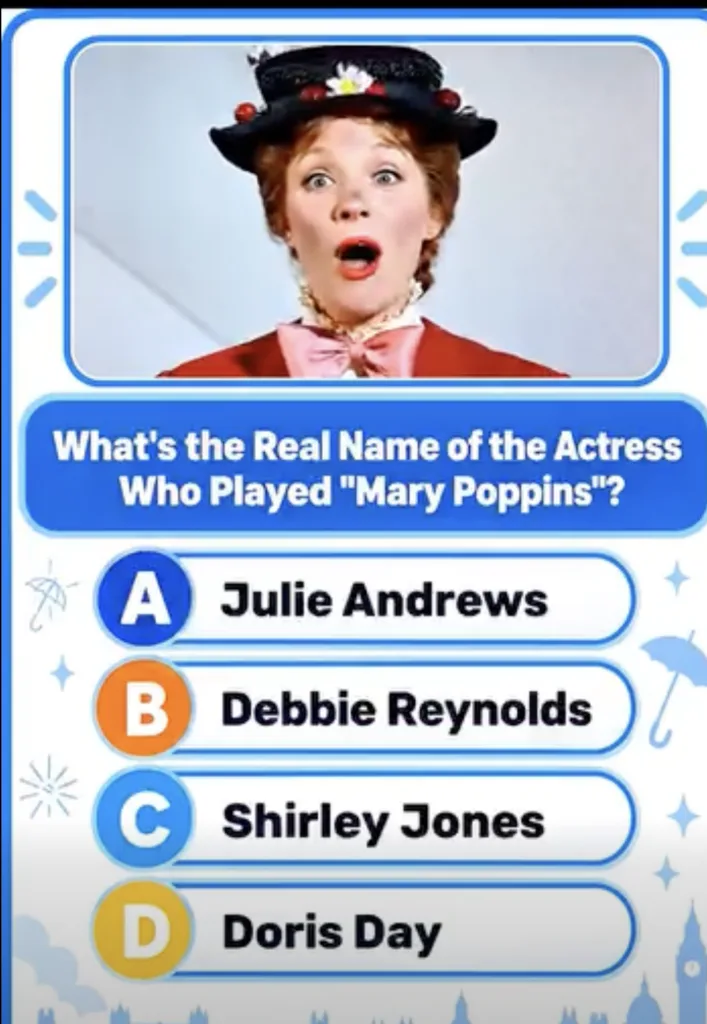
But do you know the real name of the actress who brought this magical nanny to life?
The choices were:
A. Julie Andrews
B. Debbie Reynolds
C. Shirley Jones
D. Doris Day
The correct answer is A. Julie Andrews.
Julie Andrews delivered one of the most iconic performances in the history of family entertainment when she played Mary Poppins in Walt Disney’s 1964 musical fantasy film. Her remarkable singing voice, graceful movements, warm personality, and playful sense of humor helped transform the character into a timeless cinematic legend.
However, the story behind this famous performance is even more fascinating than many fans realize. It was Julie Andrews’ first major film role, and it immediately earned her one of the highest honors in the entertainment industry. Let us look back at the actress, the movie, and the unforgettable legacy of Mary Poppins.
The Actress Behind the Magical Nanny
Julie Andrews was born Julia Elizabeth Wells on October 1, 1935, in Walton-on-Thames, England. From an early age, it became clear that she possessed an extraordinary singing voice. Her vocal range and natural ability allowed her to perform technically challenging songs while she was still very young.
Before becoming an international movie star, Andrews built her career on the stage. She performed in British variety shows and later moved into major theatrical productions. Her clear soprano voice, precise delivery, and graceful stage presence quickly attracted attention.
In 1954, Andrews made her Broadway debut in the musical The Boy Friend. Her performance introduced American audiences to her talent and opened the door to even greater opportunities.
She later became a Broadway sensation through roles such as Eliza Doolittle in My Fair Lady and Queen Guinevere in Camelot. These productions established Andrews as one of the most gifted musical theater performers of her generation.
By the early 1960s, she was already famous among theater audiences. However, she had not yet become a major Hollywood movie star. That would change dramatically when Walt Disney chose her to play Mary Poppins.
How Julie Andrews Became Mary Poppins
The character of Mary Poppins originated in a series of books written by Australian-British author P. L. Travers. The first book was published in 1934 and introduced readers to the mysterious nanny who arrives at the Banks family’s home in London.
Mary Poppins is strict but caring, serious but magical, and always in complete control of even the most unusual situations. Walt Disney believed the books could become a wonderful family film, but bringing the story to the screen was not easy.
Disney reportedly spent years trying to obtain permission from P. L. Travers to adapt her work. The author was highly protective of her characters and had strong opinions about how the story should be presented.
When the project finally moved forward, the filmmakers needed an actress who could handle every part of the demanding role. Mary Poppins had to sing beautifully, perform complicated choreography, deliver comedy, show emotional depth, and still maintain the character’s mysterious authority.
Julie Andrews seemed ideally suited for the role.
Walt Disney saw her performance in Camelot and recognized that she had the charm, talent, voice, and elegance required to portray Mary Poppins. Andrews was pregnant when Disney approached her, so the production was delayed until she was ready to begin filming.
That decision proved worthwhile. Once Andrews appeared on the screen, she seemed completely at home in the role.
A Practically Perfect Performance
Mary Poppins enters the Banks household in a most unusual way. She floats down from the sky with the help of her umbrella, arriving just when Jane and Michael Banks need a new nanny.
From her first appearance, Julie Andrews establishes the character’s fascinating personality. Mary is calm, confident, disciplined, and slightly mysterious. She rarely appears surprised, even when impossible things happen around her.
Andrews never plays Mary as a simple or overly sweet character. Her version of Mary Poppins is affectionate, but she is also firm. She expects the children to behave properly, clean their room, and follow instructions. At the same time, she introduces them to a world where imagination can transform even the most ordinary activity.
One of the performance’s greatest strengths is its balance. Mary Poppins could easily have become too strict or too sentimental. Andrews finds the perfect middle ground.
She delivers witty lines with a straight face, participates in magical adventures as though they are completely normal, and quietly guides the Banks family toward a deeper understanding of one another.
Her Mary does not demand praise or recognition. She arrives when she is needed, helps the family heal, and leaves when her work is complete.
This emotional restraint makes the final moments of the film especially powerful. The audience understands that Mary cares deeply for the children, even though she does not express her feelings in an obvious or dramatic way.
The Music That Made the Film Unforgettable
Julie Andrews’ magnificent singing voice is one of the main reasons the movie became such a classic. The film contains several songs that remain familiar decades after its original release.
“Supercalifragilisticexpialidocious” is probably the most famous. Its playful, almost impossible-to-pronounce title became part of popular culture and is still associated with joy, imagination, and childhood wonder.
“A Spoonful of Sugar” is another memorable song. Mary sings it while encouraging Jane and Michael to clean their nursery. The scene captures the film’s central idea that an unpleasant job can become enjoyable when approached with imagination and a positive attitude.
Then there is “Stay Awake,” a gentle lullaby in which Mary cleverly persuades the children to fall asleep by telling them not to do so. Andrews performs it with warmth and tenderness, revealing the softer side of Mary’s personality.
“Feed the Birds” provides one of the film’s most emotional moments. The song tells the story of an elderly woman who sells bags of crumbs for people to feed the pigeons near St. Paul’s Cathedral. Its message encourages compassion, kindness, and awareness of people whom society may overlook.
Andrews’ performance of the song is quiet and heartfelt. There is no need for elaborate choreography or comedy. Her voice carries the emotion of the scene and helps the audience understand the lesson Mary wants the children to learn.
The film’s music was written by brothers Richard M. Sherman and Robert B. Sherman. Their songs played an essential role in creating the movie’s unique atmosphere, but it was Julie Andrews’ voice and interpretation that gave many of those songs their lasting emotional power.
Julie Andrews and Dick Van Dyke
Another important element of the movie is the chemistry between Julie Andrews and Dick Van Dyke, who plays Bert.
Bert is a cheerful and imaginative man who works at several different jobs throughout the story. He appears as a street artist, a chimney sweep, and a one-man band performer. Most importantly, he is one of the few people who seems to understand Mary Poppins and her magical world.
The two characters share a warm, playful connection. Bert respects Mary, but he also gently teases her. Mary often pretends to disapprove of his behavior, yet the audience can see that she enjoys his company.
Their scenes together are filled with energy. During the animated adventure inside one of Bert’s chalk drawings, they sing, dance, and enjoy a colorful countryside outing. In another memorable sequence, Mary joins Bert and a group of chimney sweeps for an energetic rooftop dance.
Andrews’ polished style contrasts beautifully with Van Dyke’s lively physical comedy. Instead of competing with each other, their different performance styles complement one another.
Their partnership helps make the film feel both elegant and spontaneous. Mary brings discipline and mystery, while Bert brings humor and freedom. Together, they show Jane and Michael that life can be approached with both responsibility and imagination.
More Than a Story About a Nanny
At first glance, Mary Poppins may appear to be a simple story about two children and their magical nanny. However, the film is also