This enigmatic glance screams “golden age”! How well do you know the legends of classic Hollywood? We’ve got a brilliant brain-teaser for you today, featuring a true titan of cinema. This iconic figure from classic film left an indelible mark on the industry with his distinct vision and powerful presence.
Take a good look at the image below and let us know your best guess. Only true film buffs will know!
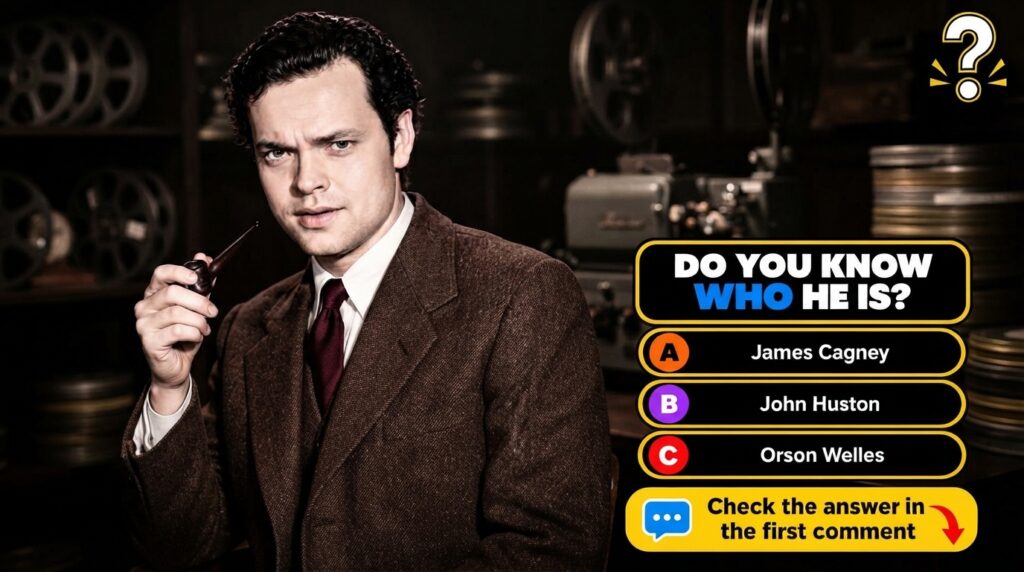
Here are your multiple-choice options for today’s challenge:
- A. James Cagney
- B. John Huston
- C. Orson Welles
- D. Humphrey Bogart
The Correct Answer: C. Orson Welles
If you chose C. Orson Welles, you got it right! This visionary artist was far more than just an actor; he was a groundbreaking director, writer, and producer who reshaped the landscape of cinema.
A Boy Wonder’s Beginnings
Born on May 6, 1915, in Kenosha, Wisconsin, Orson Welles demonstrated remarkable artistic talent from an early age, quickly earning a reputation as a prodigious talent. His career eventually stretched across theater, radio, film, and television, showcasing his diverse abilities.
Before becoming a major Hollywood filmmaker, Welles achieved national recognition through radio. In 1938, he directed and performed in a radio adaptation of H. G. Wells’ The War of the Worlds with the Mercury Theatre on the Air. The production was presented using realistic news-bulletin techniques, and some listeners who tuned in after the program had begun reportedly mistook portions of the fictional story for actual news, causing a sensation across the nation.
The Masterpiece: Citizen Kane
While his radio fame was significant, it was in Hollywood that Welles truly cemented his legendary status. At just 25 years old, he co-wrote, directed, and starred in Citizen Kane (1941), a film often cited as one of the greatest ever made. His role as Charles Foster Kane, a powerful and complex newspaper magnate, remains one of his most iconic performances.
The film was revolutionary for its time, introducing innovative narrative structures, deep-focus cinematography, and complex character studies that pushed the boundaries of filmmaking. It was a bold debut that immediately marked Welles as a cinematic genius.
A Distinctive Vision
Welles’s directorial style was characterized by its ambitious visual flair, non-linear storytelling, and a masterful use of light and shadow, often drawing comparisons to German Expressionism. He was known for his powerful, booming voice and commanding presence, both on screen and behind the camera. His approach to filmmaking earned him the status of an auteur, a director whose personal creative vision is evident in their body of work.
Legacy in Film History
Despite facing creative struggles and studio interference throughout his career, Orson Welles’s influence on cinema is undeniable. Films like The Magnificent Ambersons (1942), The Lady from Shanghai (1947), and Touch of Evil (1958) continued to showcase his unique artistry and innovative techniques. He remains a towering figure, revered by filmmakers and cinephiles alike for his audacious vision and profound contributions to the art of storytelling.
Did You Get It Right?
How did you do on today’s quiz? Was Orson Welles immediately recognizable, or did you have to think a little harder? Let us know in the comments if you knew this classic figure!
🎬 Final Answer: C. Orson Welles

