Are you looking to enhance your fitness journey, boost your workout performance, and safeguard against injuries? The secret often lies not in complex routines, but in mastering foundational strength. Focusing on core stability and fundamental body movements can create a robust base for all your physical activities.
A strong core isn’t just about visible abs; it’s about the deep muscles that stabilize your spine and pelvis, connecting your upper and lower body. This connection is vital for everyday movements, athletic performance, and maintaining good posture. By building this foundational strength, you equip your body to handle challenges more effectively and reduce the risk of strains and injuries.
This guide introduces 8 essential exercises designed to build a stronger core and improve overall body stability. These movements are perfect for beginners but valuable for anyone looking to refine their strength and balance. Remember, consistency in practice is often more beneficial than intense, sporadic workouts.
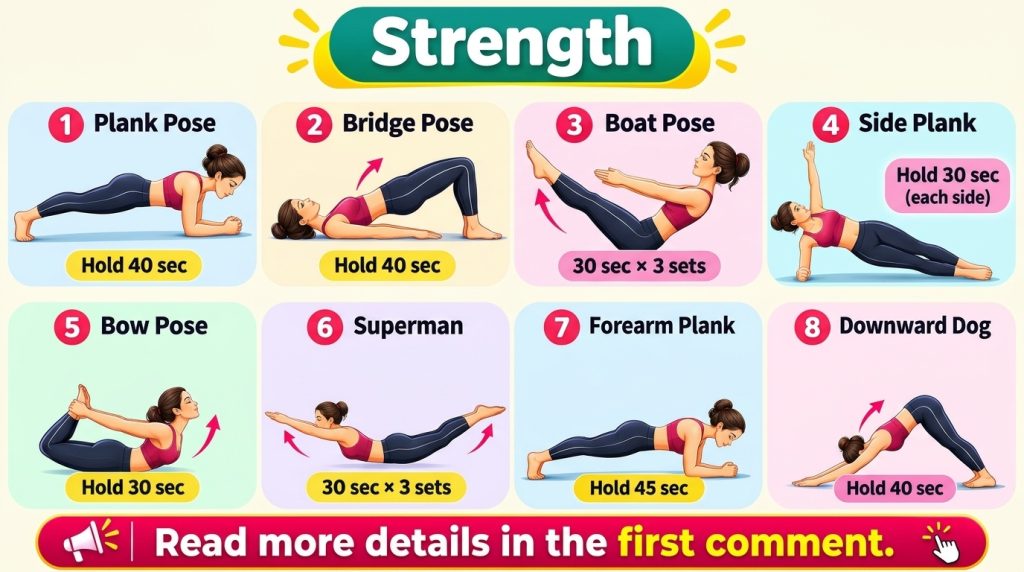
Your 8 Essential Strength Poses
Let’s dive into these foundational movements that can transform your body’s strength and balance.
1. Plank Pose
The plank is a cornerstone exercise for core strength. It engages your entire core, including your abdominals, obliques, and lower back, while also working your shoulders and glutes.
- How to Perform: Start in a push-up position, but support yourself on your forearms instead of your hands. Keep your body in a straight line from head to heels, engaging your core and glutes. Avoid letting your hips sag or rise too high.
- Benefits: Strengthens core, improves posture, enhances stability.
2. Bridge Pose
The bridge pose is excellent for strengthening your glutes, hamstrings, and lower back, which are all crucial for hip stability and power.
- How to Perform: Lie on your back with your knees bent and feet flat on the floor, hip-width apart. Your arms should be by your sides with palms down. Pressing through your heels, lift your hips off the floor until your body forms a straight line from your shoulders to your knees. Hold, then slowly lower.
- Benefits: Strengthens glutes and hamstrings, supports lower back health.
3. Squat
The squat is a fundamental movement pattern that strengthens your entire lower body, including quads, hamstrings, and glutes, while also improving hip mobility.
- How to Perform: Stand with feet shoulder-width apart, toes slightly pointed out. Keep your chest up and core engaged. Lower your hips as if sitting back into a chair, ensuring your knees track over your toes. Go as deep as comfortable, then push through your heels to return to the starting position.
- Benefits: Builds lower body strength, improves mobility, enhances functional movement.
4. Lunge
Lunges are fantastic for building unilateral (single-leg) strength, which is vital for balance and addressing muscle imbalances.
- How to Perform: Start standing with your feet hip-width apart. Step forward with one leg, lowering your hips until both knees are bent at approximately a 90-degree angle. Ensure your front knee is directly above your ankle and your back knee hovers just above the ground. Push off your front foot to return to the start. Alternate legs.
- Benefits: Strengthens legs and glutes, improves balance and coordination.
5. Push-up (Modified if Needed)
The push-up is a full-body exercise that primarily works your chest, shoulders, and triceps, while also demanding significant core stability.
- How to Perform: Start in a plank position with hands slightly wider than shoulder-width. Keep your body in a straight line. Lower your chest towards the floor by bending your elbows, then push back up. For modifications, you can perform push-ups on your knees or against an elevated surface.
- Benefits: Builds upper body strength, strengthens core.
6. Bird-Dog
The bird-dog is an excellent exercise for core stability, balance, and strengthening the lower back safely.
- How to Perform: Start on all fours, hands under shoulders and knees under hips. Engage your core. Slowly extend your right arm forward and your left leg straight back, keeping your hips level and core tight. Avoid arching your back. Return to the start and alternate sides.
- Benefits: Improves core stability, coordination, and strengthens back muscles.
7. Dead Bug
Despite its name, the dead bug is a highly effective core exercise that focuses on anti-extension, meaning it trains your core to resist arching your lower back.
- How to Perform: Lie on your back with your knees bent at 90 degrees directly over your hips, and arms extended towards the ceiling. Slowly lower your right arm towards the floor behind your head and your left leg towards the floor, keeping your lower back pressed into the mat. Return to the start and alternate.
- Benefits: Enhances core control, strengthens deep abdominal muscles, protects the lower back.
8. Superman
The superman exercise targets the muscles along your spine and your glutes, helping to improve posterior chain strength and combat the effects of prolonged sitting.
- How to Perform: Lie face down on the floor with your arms extended forward and legs straight. Engage your glutes and lower back to simultaneously lift your arms, chest, and legs off the floor a few inches. Hold briefly, then slowly lower.
- Benefits: Strengthens lower back, glutes, and shoulders, improves posture.
Consistency is Key for Lasting Results
Remember, building foundational strength is a journey, not a sprint. The real benefits come from consistent practice and gradual progression. Start with a manageable number of repetitions and hold times for each exercise, focusing on proper form over speed or intensity.
Incorporating these 8 essential poses into your routine a few times a week can significantly contribute to a stronger core, better body balance, and a more resilient body overall. Listen to your body, and don’t hesitate to modify exercises as needed. Your commitment to these basic movements will lay a powerful foundation for all your wellness goals!
Disclaimer: This content is purely educational and for reference purposes. It is not a substitute for professional medical advice, diagnosis, or treatment. Always consult with a qualified healthcare provider before starting any new exercise program or if you have any questions about a medical condition.