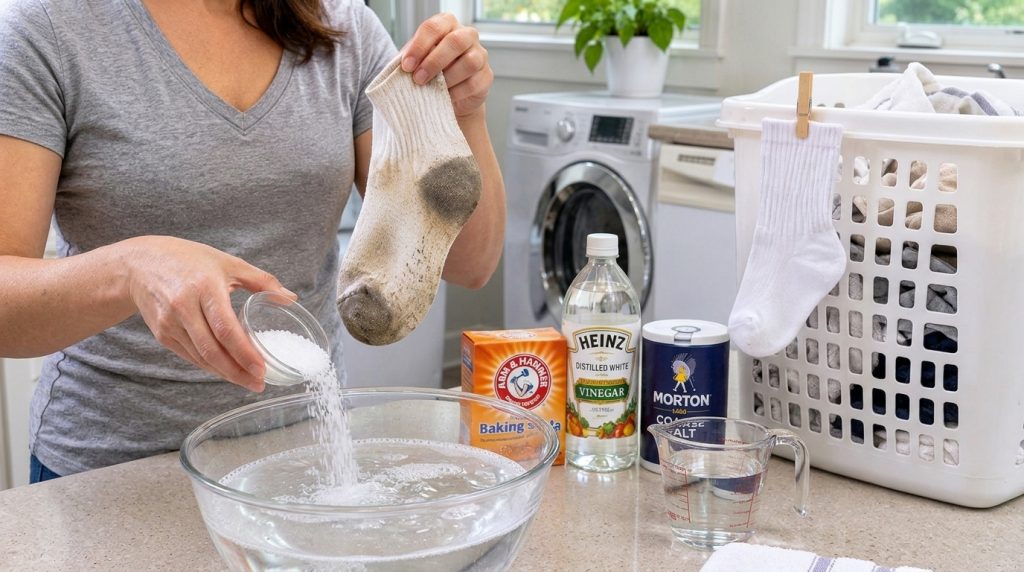
White socks lose their brightness fast. After a few washes they can turn dull, grayish, or faintly yellow, and grime along the heel and toe is hard to lift with detergent alone. Before you toss them or settle for off-white, try this simple overnight soak using pantry staples you probably already have on hand.
What You’ll Need
Ingredients
- Baking soda, about 2 tablespoons
- Distilled white vinegar, about 1/4 cup
- Coarse salt, about 1 tablespoon
- Warm water, enough to fully submerge the socks in a bowl or basin
Tools
- A large bowl, basin, or clean bucket
- A small bowl for dissolving the baking soda and salt
- A measuring spoon and measuring cup
- Laundry detergent, a small squeeze or your usual amount
- Rubber gloves, optional
Why This Soak Can Help
Each ingredient has a simple, practical role. Baking soda is mildly alkaline and helps loosen dirt and body oils. Distilled white vinegar is acidic and can help break down mineral deposits and residue that make whites look dull. Coarse salt adds gentle abrasion to help lift surface grime when the socks are rinsed and rubbed. Together, they work best as a pre-soak before a regular wash, not as a replacement for laundering.
How to Make It
- Fill your large bowl or basin with warm water. Warm water dissolves the ingredients more easily and loosens grime better than cold.
- In a small bowl, stir the baking soda and coarse salt into a few tablespoons of warm water until mostly dissolved. Pour this into the large bowl and stir well.
- Add the distilled white vinegar and stir again. You may see a little fizzing from the baking soda reacting with the vinegar. This is normal and harmless, but keep the bowl stable so it does not splash.
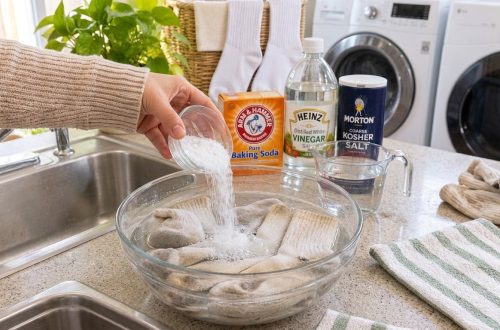
- Add the socks, pressing them under the surface so they are fully submerged. Make sure there is enough liquid to cover them.
How to Use It
- Let the socks soak for about 1 to 2 hours. For heavily stained pairs, you can leave them overnight, though check that the water stays cool or room temperature rather than hot.
- Remove the socks and gently rub any stubborn spots, such as the heel or toe, between your fingers. You can also add a small amount of detergent directly to those areas.
- Wash the socks in your washing machine on a warm or hot cycle with your regular laundry detergent, using the longest setting appropriate for the fabric.
- Check the socks before drying. If stains remain, repeat the soak. Heat from a dryer can set stains, so air drying is the safer choice until you are sure they are clean.
What to Expect
This soak can help freshen socks, reduce dinginess, and lift light to moderate grime. Results vary depending on how old the socks are, the type of fabric, and how deeply the stains are set. Heavily yellowed or long-set stains may only partly improve, and some older elastic or worn fibers will not look new again. Think of this as a helpful refresh rather than a guaranteed restoration.
Helpful Tips
- Sort your whites from colors before soaking. Vinegar and baking soda are generally fine for white cotton, but colored socks may fade or bleed.
- Use distilled white vinegar rather than dark or flavored vinegars, which can leave color or odor behind.
- Wash the socks in a mesh laundry bag to reduce tangling and protect them during the wash cycle.
- Keep the soak to a day at most. Longer soaks offer little extra benefit and can weaken fibers over time.
Important Notes and Safety
- Never mix vinegar with chlorine bleach. Combining them can release harmful fumes. If you use bleach on your whites, rinse all items thoroughly between treatments and do not combine the two products in the same container.
- Do a quick test on a hidden area or a less visible sock if the fabric is delicate, specialty, or blended with synthetic fibers.
- Rinse socks well after soaking so no salt or vinegar residue remains on the fabric.
- Store vinegar and baking soda in their original containers, away from children and pets.