At first glance, this puzzle looks impossible.
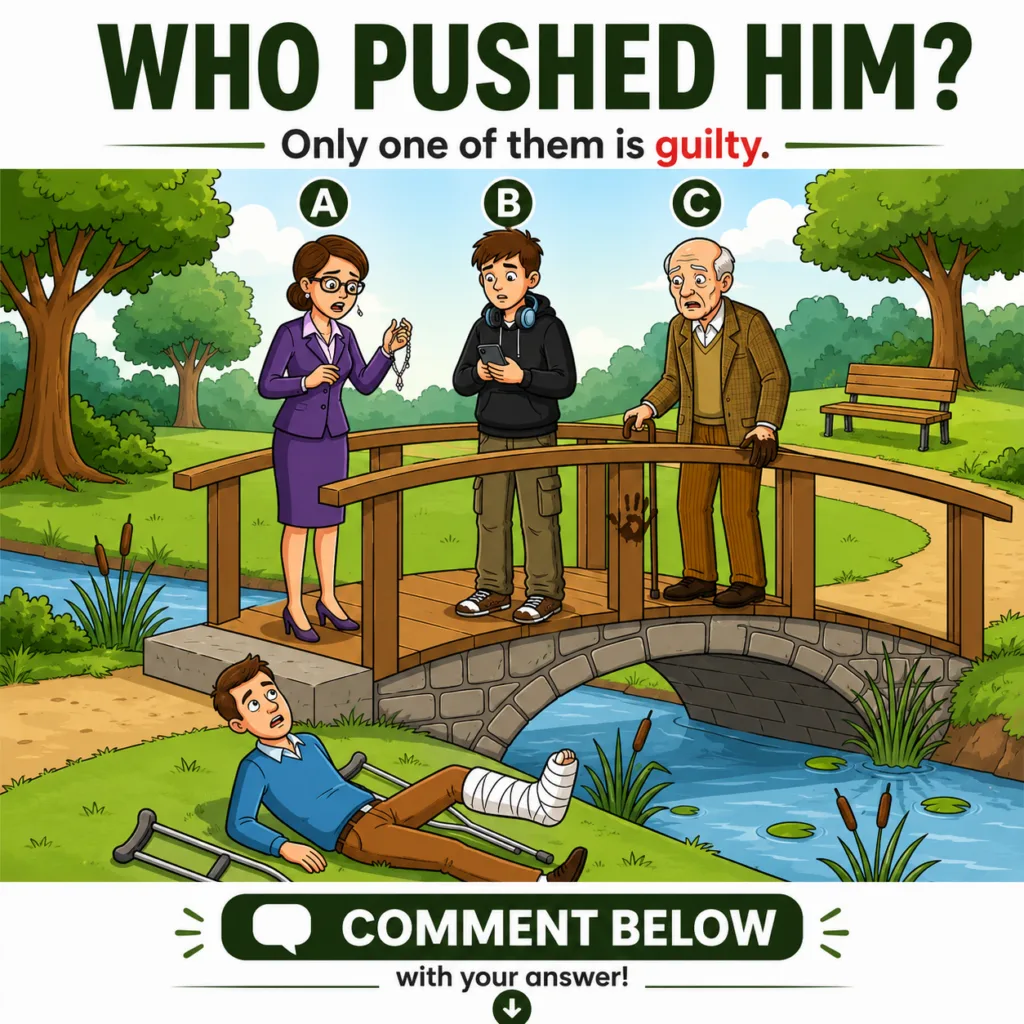
Three people were standing on the bridge:
- A – A woman holding a necklace.
- B – A young man looking at his phone.
- C – An elderly man with a cane.
A man is lying injured below the bridge with a broken leg.
The question is: Who pushed him?
Take a closer look…
Most people immediately suspect B, the young man, because he looks nervous and distracted.
Others think A may have argued with the victim because she appears upset.
But the real clue isn’t their expressions.
It’s on the bridge itself.
The Key Evidence
Look carefully at the wooden railing near Person C.
You’ll notice a clear handprint on the outside of the railing.
If someone had been pushed over the bridge, the victim would naturally try to grab the railing to stop themselves from falling.
That handprint shows exactly where the victim lost balance.
Now ask yourself:
Who was standing closest to that spot?
✅ Person C.
Why Not A?
A is standing farther away.
She is holding a necklace and appears surprised.
There is no evidence connecting her to the point where the victim went over the railing.
Why Not B?
B is focused on his phone.
Although many people think he’s acting suspiciously, there is no physical clue linking him to the fall.
His location is also farther from the handprint than C’s.
Why C Is the Best Answer
The elderly man stands directly beside the handprint.
Many people assume he couldn’t push someone because he uses a cane.
But appearance can be misleading.
The puzzle asks who could have pushed the victim—not who looks strongest.
The physical evidence points to the location, not the age of the suspect.
✅ Answer: C
The handprint on the railing is the hidden clue.
It indicates the victim grabbed the rail while falling, and Person C was standing closest to that exact spot.
Final Thought
This puzzle is a great reminder that solving mysteries isn’t about guessing based on appearances.
The best detectives focus on evidence, not assumptions.
Did you solve it correctly before reading the explanation? 👀