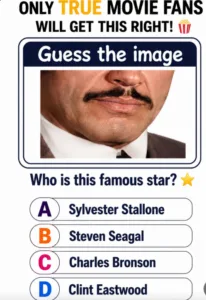
If you guessed C — Charles Bronson, you got it right! 👏
The mysterious mustache, rugged expression, and unmistakable screen presence belong to Charles Bronson, one of the most recognizable action stars of classic Hollywood. Long before modern action heroes dominated theaters, Bronson built a career playing tough, quiet characters who often let their actions speak louder than words.
Who Was Charles Bronson?
Charles Bronson was born Charles Dennis Buchinsky on November 3, 1921, in Ehrenfeld, Pennsylvania.
He grew up in a large working-class family in a Pennsylvania coal-mining community. His childhood was far removed from the glamorous Hollywood life he would later experience.
Before becoming an actor, Bronson worked in the coal mines, an experience that contributed to the rugged public image audiences would later associate with him.
From Military Service to Acting
During World War II, Bronson served in the United States Army Air Forces.
After the war, he became interested in acting and eventually moved into theater, television, and film. Early in his career, he appeared under his birth surname, Buchinsky, before adopting the professional name Charles Bronson during the 1950s.
His distinctive appearance made him particularly suited to Westerns, war movies, crime films, and action roles.
The Movies That Made Him Famous
Bronson spent years appearing in supporting roles before becoming an international star.
One of his best-known early films was The Magnificent Seven (1960), in which he appeared alongside actors including Yul Brynner and Steve McQueen.
He followed it with another classic ensemble film, The Great Escape (1963). Bronson played Flight Lieutenant Danny Velinski, nicknamed “The Tunnel King.”
Another major role came in Sergio Leone’s epic Western Once Upon a Time in the West (1968). Bronson portrayed the mysterious harmonica-playing gunfighter known simply as Harmonica.
The role became one of the defining performances of his career.
🔥 Becoming an Action-Movie Icon
Although Bronson had already achieved considerable success, the movie that permanently connected him with the vigilante-action genre was Death Wish (1974).
He played Paul Kersey, a New York architect who turns to vigilantism following a violent attack on his family.
The film was controversial but commercially successful and eventually produced several sequels starring Bronson.
During the 1970s and 1980s, his name became strongly associated with tough-guy action cinema.
What Made Charles Bronson Different?
Bronson didn’t usually portray the talkative, charismatic hero.
His characters were often quiet, serious, physically imposing, and emotionally restrained. A stare or subtle expression could communicate more than a long speech.
His weathered features and distinctive mustache also made him instantly recognizable.
That’s exactly why showing only the lower half of his face makes such a fun movie quiz. 👀
His Personal Life
Bronson was married three times.
His second wife was actress Jill Ireland, with whom he appeared in several films. They remained married until Ireland’s death from breast cancer in 1990.
Bronson later married Kim Weeks in 1998.
The Final Years
As Bronson grew older, his film appearances became less frequent. His final acting work came in the late 1990s.
Charles Bronson died on August 30, 2003, at the age of 81.
By then, he had accumulated a career spanning roughly five decades and had become an enduring symbol of a particular era of American action cinema.
🎥 So, What’s the Correct Answer?
The mystery celebrity is:
✅ C — CHARLES BRONSON
From The Magnificent Seven and The Great Escape to Once Upon a Time in the West and Death Wish, Bronson left behind a filmography that continues to introduce new generations to one of Hollywood’s classic tough guys.
👀 Did you recognize him from the mustache alone?
Comment A, B, C, or D with your original guess—and challenge another classic-movie fan to see if they can recognize him too! 🍿🎬