ACT 1: THE EMPTY KENNEL
Claire Whitmore adjusted the rearview mirror, not to check the gray Kentucky highway slipping away behind the Volvo, but to catch the reflection of the boy’s eyes. He wasn’t looking back at her. He hadn’t looked at her since they crossed the county line three hours ago. Nine-year-old Eli Turner sat perfectly straight against the pristine charcoal leather, his small spine rigid, his arms pulled completely inside the oversized sleeves of a faded navy wool sweater. He treated his hands like stolen property, tucking them deep into the cuffs whenever an adult turned to face him, as if hiding his fingers could make the rest of him invisible.
On the seat beside Claire, Daniel was typing a final, silent text message on his phone. His thumb moved with a practiced, rhythmic clicking—the sound of a man who measured his life in billable fifteen-minute increments and corporate land titles. Daniel’s knuckles were white against the steering wheel. He wasn’t angry; he was simply processing the day like a closing contract. For Daniel, the adoption was a series of filings, a linear sequence of state background checks, background clearances, and interstate compacts that would culminate in a Monday morning docket in Nashville. He believed in the paperwork. He trusted the seal of the court.
Claire, however, trusted nothing.
Her own body had taught her that lesson over seven years of white-walled fertility clinics, clinical failures, and silent ultrasound monitors. She still remembered the exact weight of the air in the reproductive health pavilion downtown—the sharp, sterile sting of pine-scented floor cleaner mixed with the bitter smell of the cheap coffee the nurses left in the waiting room. She remembered the blue plastic bins where she discarded her hormone syringes, her thighs map-marked with yellow and purple bruises from progesterone injections that had eventually turned her skin into something resembling old, dropped fruit. There had been three separate telephone calls from physicians whose voices were so perfectly metered in their sympathy that they sounded like funeral directors delivering a bill. Each time, they had used the word unviable. Each time, Claire had gone home to her beautifully designed, minimalist house in Belle Meade, stared at the twenty-foot ceilings and the custom Belgian linen sofas, and felt the terrifying, silent echo of her own empty rooms.
When they finally turned to the state database, her friends at the Nashville tennis club had whispered their warnings over glasses of white wine. “The older ones from the rural districts carry things you can’t see until the final papers are signed,” one had said, her eyes wide with a performative sort of pity. “The foster system teaches them how to mask their behavioral issues. They use silence as a weapon, Claire. If a child has been through four placements by the time he’s nine, there’s a reason. He’s testing your boundaries before you even get him across the state line.”
Claire had hated her for saying it, but today, with the wet coal dust and rotting oak leaves of Hollow Creek pressing against the car windows, the warning felt less like malice and more like a prediction. Eli hadn’t spoken since they left the courthouse. He hadn’t asked for a drink; he hadn’t asked to stop for a bathroom; he had simply accepted a turkey sandwich Claire bought him at a gas station, eating it without dropping a single crumb onto his knees, leaving the plastic wrapper folded into a perfect, tight square on the seat. It was a terrifying kind of goodness—the behavior of a child who knew that one wrong movement could cause an adult to put his clothes back into a blue plastic garbage bag and call the caseworker.
“We’re still on time for the five o’clock sign-off?” Daniel asked, his voice dropping into the low, smooth register he used when reassuring nervous city zoning boards.
“Yes,” Claire said, her fingers digging into the leather strap of her handbag until the seams groaned. “The regional worker said as long as we have the signed physical release from the local shelter volunteer placement, the transition phase is legally closed. We just need the local director to initial the community service log.”
She turned around in her seat, forcing a bright, maternal smile that felt stiff and theatrical against her teeth. “The bedroom is all painted, Eli. Remember the picture I showed you on the tablet? That soft sea-foam blue? I had the decorators finish the built-in shelves on Wednesday. There’s plenty of room for your books.”
Eli’s head turned slightly toward the glass. His reflection was thin, his hollow cheeks and dark, hyper-vigilant eyes making him look less like a child and more like a miniature sharecropper from an old black-and-white photograph. “I don’t have many books,” he whispered to the windowpane, his breath leaving a small, circular cloud of fog that vanished almost instantly.
“Then we’ll buy them,” Claire said quickly, her voice rising with an artificial lightness that tasted like copper. “Every single one you want. We can go to the big store downtown on Saturday morning.”
Eli didn’t answer. He simply pulled his sleeves further over his hands. Claire felt a cold, uncharitable knot of dread tighten in her stomach. She wanted to love him—she had prayed for this child until her knees were raw—but looking at his unreadable, gray profile, she felt an absolute failure of connection. He didn’t feel like a son; he felt like a tenant who had arrived with a temporary lease, watching her with eyes that already knew exactly how disappointment tasted.
The Hollow Creek Animal Rescue sat on the edge of an abandoned industrial road, squeezed between a rusted xưởng cưa and the sagging gray fences of the old rail yard. The building itself was a long, low-slung cinderblock shed that had originally been used by the county to store salt trucks during the winter mining seasons. The roof was corrugated tin, weathered to the color of dried liver, and the gravel parking lot was choked with dry briers and wind-blown plastic grocery bags that clung to the chain-link like dead skin.
When Claire stepped out of the Volvo, the air hit her like a cold, wet towel. It smelled of things that were perpetually damp—soaked dog fur, old pine-scented bleach that couldn’t quite mask the heavy stench of ammonia, and from a small oil-drum stove near the entrance, the bitter, acrid odor of burnt coffee.
Inside, the noise was an immediate, physical pressure. Forty dogs, housed in parallel rows of chain-link pens, barked with a frantic, rhythmic desperation that shook the thin drywall of the reception area. The floor was wet, coated in a thin film of gray water that reflected the harsh, white hum of the fluorescent tubes overhead.
A man was standing behind a high counter made of unpainted plywood. He was heavy-set, fiftyish, with a thick stomach that pushed against a grease-stained neon county vest. His name tag read VANCE, and he was balancing a cracked ceramic mug with a missing handle carefully as he typed with one finger into an ancient, beige computer monitor.
“The Whitmores?” Vance asked, not looking up from the screen. His voice had the gravelly, uninterested drone of a county employee who had three years left until his pension.
“Yes,” Daniel said, stepping forward and pulling his leather wallet from his breast pocket to produce his legal identification. “We’re here for the final signature on Eli Turner’s community service release. We have the state caseworker’s form right here.”
Vance finally looked up, his eyes small and wet behind a pair of cheap, wire-rimmed glasses. He looked past Daniel, his gaze landing squarely on Eli, who had stopped just inside the double doors, his back pressed hard against the rusted iron frame.
“Well, look at that,” Vance said, giving a short, wet bark of a laugh that wasn’t particularly friendly. “The city folks came and got you after all, Eli. Didn’t think you’d see the outside of this county before you turned eighteen, did you? You hit the jackpot, kid. Most of the boys from the Miller place end up working the night shift down at the truck stop.”
Eli didn’t move. His face remained flat, a mask of smooth, gray stone.
An older woman emerged from the back hallway, carrying a mop bucket that sloshed gray water over her rubber boots. She was small, sixty or so, with her gray hair pinned back by a plastic clip that had lost half its teeth. Her hands were red and swollen from the cold water, and she wore three separate cardigans layered over an old flannel shirt.
“Mabel,” Vance called out, jerking his chin toward the boy. “Look who’s back. The boy’s going to Nashville. Going to live in a mansion with a pool, probably.”
The woman, Mabel, stopped. She looked at Eli, then at Claire, and then her eyes immediately dropped to the wet floorboards. She didn’t smile. She didn’t say congratulations. She simply wiped her wet palms against her canvas apron and said, “He needs to sign the physical logbook in the back row if he’s officially turning in his volunteer badge. The state makes us keep the physical book for five years for the audit.”
“Go on back, Eli,” Claire said, her hand hovering an inch above the boy’s shoulder, still hesitant to make full physical contact. “We’ll wait here with the director.”
Eli didn’t look at her. He began to walk down the central corridor, his steps small and completely silent on the damp concrete. Claire, driven by a sudden, protective curiosity that she couldn’t quite name, followed him into the kennel row. Daniel stayed at the counter, already explaining to Vance the specific legal format required for the Tennessee court’s interstate compact compliance.
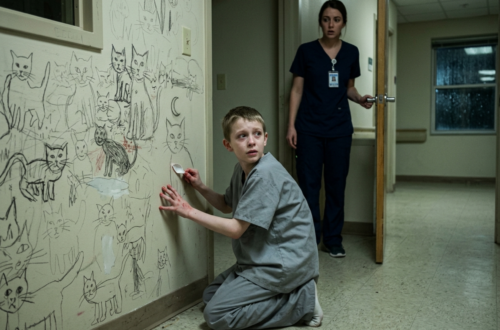
The kennel section was significantly colder than the front office. The floor was wet from a recent hosing, and the dogs—mostly coonhounds, pit mixes, and rib-thin strays found along the mountain roads—lunged against the wire gates. Eli walked past them without flinching. He didn’t flinch when a ninety-pound Rottweiler mix slammed its chest against the chain-link two inches from his face. He kept his eyes down, his feet moving with the precision of a soldier navigating a minefield.
He passed the old hound with the blind eye. He passed the three terrier puppies shivering on a single wet towel. Then, at the very end of the row, next to the emergency exit that led to the old rail line, he stopped dead in his tracks.
Kennel Number Four.
The gate was unlatched, swinging open an inch or two. Inside, there was no dog. There was only a concrete floor that had been scrubbed until the aggregate stone showed through like grey teeth, a rusty stainless-steel bowl that sat upside down in the corner, and a square patch of dark discoloration on the cinderblock wall where a nameplate had once been bolted into the mortar.
Eli stood before the empty space. His hands finally slid out of his sleeves, his small, dirt-embedded fingernails curling around the cold iron wire of the open gate.
“Eli?” Claire said, stepping into the damp air of the row. “Is this where you worked?”
The boy didn’t answer. He didn’t look at her. He just stared at the rusted latch.
“Come on, Eli,” she said, her voice dropping into the soothing, reasonable tone she used when a client became anxious about a furniture delivery delay. “Your dad has the papers ready up front. We have a very long drive ahead of us tonight.”
“He’s not here,” Eli said.
“Well, no,” Claire said, looking into the empty pen. “The other dogs are here, though. Do you want to say goodbye to the hound before we leave?”
“No,” Eli said. He didn’t raise his voice, but it had suddenly hardened into something cold, sharp, and crystalline. “Scout isn’t here.”
Vance appeared at the end of the aisle, his heavy leather boots clomping loudly against the concrete. He was carrying a blue plastic clipboard. “Everything’s signed up front, folks. Just need the boy to put his initials on the exit line and we can finally clear the books.”
“Where is Scout?” Eli asked, turning his head.
The question was so sudden that Vance actually tripped over his own boots, his face flushing a dark, blotchy red under the harsh fluorescent lights. He recovered quickly, slamming the clipboard against his thick thigh. “What did I tell you about that, kid? We don’t discuss the placement files with volunteers. It’s against county policy.”
“You said he was adopted,” Eli said, his eyes rising to meet Vance’s for the first time. The intensity in the nine-year-old’s gaze was unnatural; it lacked the deference children usually paid to men who weighed two hundred and fifty pounds.
“He was,” Vance said, his voice rising an octave, booming over the frantic barking of the nearby dogs. “A guy from the next county came in three weeks ago. Paid the fifty-dollar adoption fee, took the dog, signed the book. Case closed. Now get your coat on and get out of my hair.”
Claire watched the exchange, her interior designer’s eye catching the micro-movements that her husband would have missed. Vance wasn’t just annoyed; he was sweating profusely. A thin line of perspiration had formed along his hairline despite the fact that the temperature in the kennel row was barely fifty degrees. His fingers were white where he gripped the plastic clipboard.
“Eli,” Claire said gently, stepping between the boy and the director. “If Scout was adopted, that’s a good thing. It means he has a home now. Just like you do.”
“He didn’t get adopted,” Eli said. He didn’t move his eyes from Vance’s face. “The latch is broken.”
“What does the latch have to do with anything?” Claire asked, looking down at the rusted piece of iron that held the gate shut.
“Scout knew how to open it,” Eli said. His voice was very quiet now, almost a whisper against the background din of the shelter. “He’d hit it with his nose until it popped. That’s why we had to use the copper wire. We always wrapped the copper wire around the top bar three times so he couldn’t get out at night.”
He pointed down to the concrete floor just outside the pen.
“The wire is still there,” Eli said.
Claire looked down. In the narrow seam between two concrete slabs, a three-inch piece of bright, heavy-gauge copper wire lay twisted into a tight spiral. It hadn’t been unrolled; it had been cleanly cut. The copper ends were bright and shiny, completely unaffected by the damp air of the kennel. They had been severed with a pair of heavy wire cutters within the last forty-eight hours.
“So what?” Vance spat, stepping forward and grabbing Eli’s arm with a thick, hairy hand. “We cut the wires when we clean the pens. It’s county property. Now listen to me, you little—”
“Take your hand off him,” a new voice said.
Daniel had walked down the aisle, his briefcase in one hand, his cellphone in the other. His voice wasn’t loud, but it possessed that terrible, freezing weight that made junior associates at his firm instantly check their malpractice insurance.
Vance let go of Eli’s arm as if the boy’s skin had turned to hot lead. “Look, Mr. Whitmore, I’m just trying to get this over with. The kid is making a scene over a mutt that’s gone. We’ve got real work to do here.”
“Eli,” Daniel said, ignoring Vance entirely. He looked at the boy, then at the cut copper wire on the floor. “What are you telling us?”
Eli looked at Daniel, his face tight with a desperate, ancient grief that no nine-year-old should have known how to carry. “The man who owned Scout didn’t leave him. And Scout didn’t get adopted. They took him because of what was in the leather.”
Before the boy could answer, Mabel Carter let out a sharp, choked sob from the shadow of the back storage room. The cracked mug she had been holding slipped from her soapy fingers and shattered violently against the concrete, sending a puddle of cold, black coffee spreading toward their shoes like old oil.
Mabel looked up, her face completely pale, her eyes fixed on Eli. “Was the dog’s name Scout?” she whispered, her voice shaking uncontrollably.
Eli looked at her, his grip tightening on the iron bars of the empty cage.
“Scout wasn’t adopted,” Eli said.
ACT 2: THE MAN WHO FED THE FORGOTTEN BOY
The office of the animal rescue smelled of Vance’s cheap menthol cigarettes and the greasy, burnt crust of an old ham biscuit someone had left on the space heater. Claire sat on an orange plastic chair that rattled every time a heavy logging truck rumbled past the window on Highway 119. Eli stood beside her knee, his spine perfectly vertical, his head tilted slightly as if he were listening to a frequency that nobody else in the room could hear.
Daniel stood over the unpainted plywood counter, his long, manicured fingers turning the yellowed pages of the county ledger. His eyes were small, contracted behind his reading glasses. Claire knew that look—it was the same expression he wore when he discovered an intentional error in an adversary’s land title dispute. The room had gone cold. Outside, the rain was beginning to turn into a thick, gray sleet that tapped against the glass like handfuls of birdshot.
“The entry is here,” Daniel said, his voice dropping into that flat, legal tone that always made Claire feel as if she were being cross-examined in her own kitchen. “November fourteenth. Thomas Grady. Signed with a cheap black felt pen. The address listed is four-twelve Mill Creek Road.”
Daniel pulled out his phone, his thumb moving across the glass as he accessed the digital county land maps his firm used for timber contracts. After ten seconds, his jaw tightened. “There is no four-twelve Mill Creek Road, Vance. That entire ridge was cleared by the state highway department three years ago during the bypass expansion. It’s an empty limestone rock face. Nobody has lived there since the winter of twenty-twenty-three.”
Vance didn’t look up from his monitor. He was typing with one finger, his thick neck red above his vest. “I told you, people write down whatever they want when they’re ridding themselves of an animal. They don’t want the county tracking ’em down for the twelve-dollar license fee or checking their fences. It ain’t my job to run a background check on every hill-jack who comes in here to clear out a senior béc-giê mix.”
“The signature is copied,” Eli said from the corner.
Daniel turned his head slowly, looking down at the nine-year-old boy. “What do you mean, buddy?”
Eli reached into the pocket of his sweater and pulled out his hands. For the first time, Claire saw his fingers clearly—they were short, his fingernails bitten down to the pink meat, but they were remarkably steady. He didn’t have the tremulous shake she had seen in other foster children at the regional assessment center.
“Ray showed me how the county clerks do it,” Eli said, his voice level and flat, as if he were reading a list of engine parts from an old manual. “He had a light box in his shed made out of an old truck window and a fluorescent bulb. He said if the ink stays the exact same thickness from the start of the letter to the tail, it’s a tracing. A real man’s hand presses down harder when he draws his first initial because that’s where the blood hits the paper first. This name… the ‘T’ and the ‘G’ are too smooth. A dead man wrote that name twenty years ago, and someone else drew it onto the page with a light box.”
Vance’s hand stopped on his keyboard. He didn’t turn around, but Claire could see the muscles in his back go rigid beneath his flannel shirt.
“Who taught you that, Eli?” Claire asked, her voice dropping into a whisper. She felt an involuntary shiver pass through her shoulders—not from the draft under the door, but from the absolute, chilling certainty in the boy’s tone.
“Ray,” Eli said simply.
In Eli’s memory, the world didn’t have the clean, white edges of Claire’s Nashville house. It was the color of yellow clay, wet sumac bushes, and the gray grease that pooled around the wheels of the coal cars in the sorting yard. It was the second week of his temporary placement at the Miller home—a gray, split-level house that sat on the edge of the old rail spur where six foster children slept on twin mattresses laid out on the concrete basement floor. The Millers weren’t mean, Eli remembered; they were just tired. They kept a large, blue plastic tub of generic cornflakes on the kitchen counter, but by Tuesday morning, the milk was always gone, replaced by a pitcher of tap water that smelled of iron rust and laundry detergent.
Eli had gone down to the rail line because the noise in the basement—the older boys fighting over a broken video game controller—made a sharp, white pain start behind his left ear. He had been sitting on an overturned oil drum near the abandoned concrete water tower when the senior shepherd mix had come out of the briers.
The dog hadn’t barked. It had simply walked up to Eli, its nose wet and cold against the boy’s bare ankle, and sat down with a heavy, dry sigh. Its fur was black along the spine and the color of wet oak leaves along its belly, and its ears were notched with small, circular scars from old brier cuts.
“That’s Scout,” a voice had said from the shadow of the concrete tower.
Ray Bell had stepped out into the low afternoon light. He was sixty-seven, though Eli thought he looked like an old cedar fence post that had been left in a swamp—his skin was the color of bark, his beard a gray tangle that smelled of pipe tobacco, peppermint drops, and woodsmoke. He was wearing an old army utility jacket with the sleeves cut off at the elbows, and his boots were wrapped in heavy green garden twine to keep the rubber soles from flopping against the ballast stones.
“He don’t bite unless you’re holding a county clip,” Ray had said, sitting down on a piece of timber beside the boy. He didn’t ask Eli who his mother was or why his sweater was missing three buttons on the front. Instead, he reached into his canvas rucksack and pulled out a small, rectangular biscuit tin that had once held English shortbread.
Inside the tin were three cold lard biscuits and a plastic jar of blackberry jam he’d bought from the church ladies down at the crossroads. He didn’t hand the food to Eli like a charity worker delivering a handout. He laid the tin between them on the timber, took one biscuit for himself, and left the rest within the boy’s reach.
“A dog don’t know how to tell a lie, Eli,” Ray had told him that first afternoon, his thick thumb flaking a bit of dry crust into Scout’s waiting mouth. “A man will tell you he loves you while he’s looking over your shoulder to see if your house is worth burning for the insurance money. The town councilmen, the state lawyers—they’ve got mouths full of clean teeth and crooked words. But a dog… a dog’s face is just a mirror for his belly. If he’s sour, his ears are low. If he’s true, his tail’s level. You can build a whole town out of lies, boy, but you can’t get a dog to walk through the front door of it if the floorboards are rotten.”
Over the next six weeks, the old tool shed by the rail spur became the only place where Eli’s shoulders didn’t tighten when an adult spoke. Ray had been a dog handler in the army during the Vietnam era—the 4th Infantry Division, he’d told Eli, showing him an old brass crest that had lost its pin. He kept his silver medal with the blue ribbon wrapped in an oily piece of flannel under his cot, right next to a stack of old railroad maps that were so crisp they split along the folds like dry corn husks.
Ray didn’t talk about the war, but he showed Eli how to groom an animal using an old iron currycomb he’d found in the creek bed.
“You don’t pull,” Ray would whisper, his hand—thick-skinned and scarred from old iron work—guiding Eli’s smaller fingers over Scout’s ribs. “A dog’s skin is loose because he needs room to turn around inside his own hide when a bear’s got him by the shoulder. You brush with the grain, smooth and long, like you’re trying to draw sweet water out of a dry well. If your hand is steady, the dog’s blood stays cool. If your hand shakes, he thinks the woods are on fire.”
They spent hours repairing the cedar fence that ran along the old rail easement. Ray showed Eli how to braid heavy hemp rope into three-strand leads, using an old iron spike to separate the fibers until the hemp smelled of grease and river water.
“The town’s going to turn its back on this valley, Eli,” Ray had said one evening, the sky behind the ridge turning the color of an old bruise. He had been sitting on his cot, his thumb running over the heavy leather lining of Scout’s collar. “The mayor’s office has been clearing out the old widows down by the creek. Telling ’em their wells are foul, then buying the acreage for three cents on the dollar through some corporate name registered in Frankfort. They think because a man sleeps out here with the weeds, he don’t know how to read a plat map. They think because you’re a child, your memory don’t hold ink.”
He had whistle-called Scout to his knee, his thumbs hooking into the double brass buckles of the heavy leather band around the dog’s neck.
“If they take me out of here, Eli, it’ll be because they put me in the dirt under the track,” Ray had said, his voice dropping below the rumble of the coal train passing on the main line. “But they won’t find the papers. I sewed ’em where no clerk’s going to look. If they take the dog, boy, you look for the leather. You tell someone who ain’t from this county. You find a person who don’t owe the bank any favors.”
Inside the shelter office, the space heater gave a loud, metallic clink as it cycled off.
“The town says he was drunk,” Claire said, her voice sounding small and brittle against the room’s corners. She looked down at her own manicured nails, feeling a sudden, terrible weight of self-correction. For months, she had read Eli’s state files—the pages that noted his ‘unresponsive behaviors’ and ‘flat affect’—and she had agreed with the caseworkers. She had thought the boy was simply damaged by the system, a silent, complicated problem to be managed through private therapy sessions in Nashville.
She had been tempted—more times than she would ever admit to Daniel—to call the agency and cancel the placement. Just three nights ago, while looking at the sea-foam blue paint drying in the empty bedroom, she had sat on the floor and wept, her chest aching with the old, hollow grief of her failed pregnancies. “We’re bringing a stranger into this house,” she had whispered to the empty room. “A boy who looks at me like I’m a guard at a detention center. He’s going to destroy us, Daniel. He’s going to look at everything I’ve built and see right through it.”
But looking at Eli now—seeing the absolute, iron-like precision of his memory, the way he stood by her knee like a small soldier guarding a collapsed trench—she realized she had been completely, shamefully wrong. He wasn’t hoang tưởng. He wasn’t manipulating them to stay in Kentucky. He was simply the only person in the entire county who hadn’t agreed to forget the old man under the water tower.
Daniel stepped back from the plywood counter, closing the canvas ledger with a heavy, wet thud that made Vance jump in his chair.
“Vance,” Daniel said, his voice dropping into that freezing, courtroom register that always made junior associates at his firm check their insurance policies. “My firm represents three of the primary lenders for the Hollow Creek Luxury Ridge project. I know exactly how many millions of dollars are currently tied up in the clearing titles for the old rail spur. If this signature is a tracing—and I am quite certain it is—then this adoption entry is a fraudulent instrument under state law.”
Vance finally turned around. His face was gray, his eyes wide and wet behind his glasses. “Look, Mr. Whitmore… I didn’t have nothing to do with Ray Bell. The boy from the road department brought the book in. He said the old man had skipped town on a freight train to Florida and left the dog behind. He gave me five hundred dollars in cash to clear the cage and forget the name. I’ve got three guys working here who haven’t seen a county paycheck since September! What was I supposed to do? Let the dogs starve because some old rummy wouldn’t sign a piece of corporate paper?”
Claire felt a cold fist close around her throat. She looked down at Eli. The boy had reached into his pocket and pulled out his piece of copper wire—the one he’d found in the concrete seam outside Kennel Number Four. He was twisting it around his small index finger, over and over, until the skin turned a dark, bloodless white.
“Daniel,” Claire said, her voice shaking as she stood up from the orange chair. “We aren’t going to Nashville tonight.”
Daniel looked at her, his glasses slipping slightly down his nose. “Claire, the caseworker is waiting at the regional office.”
“Let her wait,” Claire said, her eyes fixed on the gray sleet outside the window. She reached down and took Eli’s hand, her fingers closing over his short, bitten nails for the first time with an absolute, defensive force. “We’re going to find Ray’s dog.”
ACT 3: THE DOG THEY WEREN’T SUPPOSED TO FIND
The road up to the old mill was nothing more than a logging track that had been cleared during the mining boom and then left to the briers. The Volvo’s all-wheel-drive system groaned as Daniel pushed the car through six inches of yellow clay that oozed up from the ruts like cold lard.
Nobody spoke. The silence in the car was no longer the compliance of an adoption placement; it was the tense, vibrating quiet of three people who had agreed to go down into a well without a rope. Claire kept her eyes on the side mirror, watching the reflection of the limestone ridge slip away into the gray sương mù. She knew what the townspeople thought—she had heard the whispers in the diner where they stopped for gas. The locals wanted the resort. They needed the three hundred seasonal jobs; they needed the tax revenue to repair the school roofs; they believed that Ray Bell was just an old, stubborn relic who was blocking progress because his brain had been ruined by the jungle and cheap gin.
“The old bastard was crazy,” the gas station attendant had muttered into his jacket collar when Daniel asked for directions to the mill. “Spent forty years talking to that dog like it was a person. Blocked the clearing crew for six months with some fake railroad paper he’d drew up himself. The city folks think it’s real romantic to live in a shed with the rats, but the rest of us have bills to pay.”
The audience of Hollow Creek had collectively decided that Ray Bell was an acceptable price to pay for a golf course. They had turned him into a ghost before he was even dead, crossing his name out of the ledger because his dirt was worth forty million dollars to a Frankfort development group.
The Miller grist mill was a three-story shell of gray timber, its roof partially caved in by a fallen pine tree. Beside the mill stood a long, low structure made of corrugated iron and pressure-treated posts—a series of hunting dog runs where six black-and-tan coonhounds were lunging against the wire gates, their long ears flopping as they bayed at the sound of the car’s engine.
Daniel stopped the car fifty yards away, leaving the headlights on. He reached into the glove compartment and pulled out his heavy, black iron flashlight.
“Stay here,” he told Claire.
“No,” Eli said, already pulling the door handle.
Before Claire could reach out to grab his sweater, the boy had slipped out into the sleet. He walked toward the iron pens, his feet finding the high ground between the mud puddles with that same eerie, practiced familiarity he had shown at the rail yard.
The hunting runs smelled of old lard, cedar shavings, and the sour, rotting stench of deer carcass. The coonhounds were frantic, their jaws slavering against the chain-link. But at the very end of the row, in a separate enclosure that had been reinforced with heavy plywood sheets to block the wind, there was no sound.
Eli stopped before the plywood wall. He didn’t call out. He didn’t use a dog’s name. He just reached out his hand and tapped three times against the wood—a rhythmic, distinct knock: tap-tap… tap.
From inside the dark box, there was a low, dry scrape—the sound of a heavy body dragging itself through dry straw. Then, a long, black muzzle appeared through the narrow gap between the plywood and the mud. The nose was gray with age, the skin around the nostrils scarred by old brier cuts.
The dog inhaled deeply, his chest heaving under his scarred coat. Then, he let out a tiny whine—a small, broken sound that sounded like wood splitting under ice.
“Scout,” Eli whispered.
Daniel swung the beam of the flashlight over the top of the pen. The gate was locked with a heavy brass padlock that had been greased to prevent freezing. Inside the pen, the senior shepherd mix was lying on his side. His left hind leg was swollen to twice its normal size, bound clumsily with a piece of dirty burlap and green garden twine. He was so thin that his hip bones looked like two tent poles pushing against an old tarp.
“They broke his leg,” Claire said, her voice cracking as she reached the gate. She didn’t think about her leather gloves or her Nashville coat anymore; she dropped to her knees in the mud beside Eli, her hands gripping the cold iron wire. “Daniel, look at him. They left him here to starve.”
“They couldn’t kill him yet,” Daniel said, his eyes scanning the dog’s neck. “Look at the collar.”
Around Scout’s neck was a thick, three-inch band of heavy leather. It was an old military-style collar, the kind used for sentry dogs in the seventies, with double brass buckles and a heavy steel ring for a lead. The leather was scarred, oil-stained, and so old it had begun to crack along the edges like dry wood. But along the inner lining, where the leather met the dog’s throat, someone had recently added a thick, clumsy row of stitches using black fishing line.
“Billy Hollis didn’t want the dog,” Daniel said, his voice dropping into a hard, professional register. “He wanted what Ray sewed into that lining. But Scout wouldn’t let him get close enough to take it off. Look at his muzzle.”
The old shepherd’s teeth were visible through a tear in his lip. They were yellow, worn down to the bone, but they were sharp, and the fur around his jaws was stained with dried, dark blood that didn’t belong to an animal.
“He bit them,” Eli said, his voice holding a sudden, fierce pride. “Ray taught him to guard the throat. If you don’t know the word, you don’t touch the leather.”
A pair of headlights suddenly flared at the top of the ridge road.
The silver Ford pickup truck came down the logging track fast, its back end fishtailing through the mud before it slammed to a halt ten yards from Daniel’s Volvo. The driver’s side door flew open, and a young man in a camouflage jacket and mud-stained hip boots jumped out. He was holding a short, heavy iron crowbar in his right hand. It was Billy Hollis, the mayor’s nephew.
“What the hell do you think you’re doing on private property?” the young man shouted. His face was thin, pockmarked, with the watery, pale eyes of a boy who had spent his entire life relying on his family’s name to get out of speeding tickets.
Daniel didn’t move from the gate of the pen. He stood with the heavy maglite flashlight held loosely at his side, his long coat open, his posture as relaxed as if he were waiting for an elevator in the city.
“Mr. Hollis,” Daniel said, his voice echoing off the timber of the old mill. “My name is Daniel Whitmore. I am a senior partner at Whitmore & Finch in Nashville. I am currently representing Eli Turner and the estate of the late Raymond Bell. You are currently in possession of stolen property belonging to an estate under probate review, and you are using a county-registered vehicle to facilitate a felony theft.”
Billy Hollis stopped three paces away, his boots sinking into the yellow mud. He looked at Daniel’s coat, he looked at the Volvo, and then he looked at the black maglite in Daniel’s hand. His jaw tightened. “I don’t know who the hell Ray Bell is. That’s my hunting dog. I bought him off a guy in Hazard.”
“No,” Daniel said, stepping forward. He didn’t raise the flashlight, but he didn’t lower it either. “You took him from the county shelter on November fifteenth at the direction of your uncle, Mayor Frank Hollis. You used a fake name—Thomas Grady—in the official county registry, which constitutes forgery in the second degree. Each instance carries a penalty of up to five years in the state penitentiary. And since you used a municipal facility to execute the fraud, we’re looking at an official misconduct charge that will bring the state attorney general’s office into this hollow before noon tomorrow.”
Billy Hollis’s face went from red to a pale, greasy yellow. He looked past Daniel to Claire and Eli, who were still kneeling by the dog’s pen. “You city folks think you can come down here and tell us how to run our county? My uncle built this town! That resort is going to bring three hundred jobs into this valley!”
“Your uncle stole thirty acres of protected timberland from the county easement and used a forged land transfer to evict an elderly veteran who had a legal occupancy lease,” Daniel said, his voice rising for the first time, cutting through the sleet like an iron saw. “And when Ray Bell wouldn’t sign your piece of paper, you had him dumped by the rail line near Hazard and called it an accident.”
“That’s a lie!” Billy shouted, though his hand was shaking so badly he almost dropped the crowbar into the mud. “Ray was drunk! Everyone knows he was an old rummy!”
“He wasn’t drunk,” Eli said.
The boy stood up from the mud. He walked past Daniel, his small sneakers squelching in the dirt, until he was standing three feet from the mayor’s nephew. He didn’t look afraid. He looked at Billy Hollis with a cold, absolute certainty that made the older man take half a step back.
“Ray didn’t drink,” Eli said. “He told me that if you drink, your hands shake, and if your hands shake, the dog knows you’re afraid. His hands never shook. Not once. You’re the one who was drunk, Mr. Hollis. I saw you leave the back door of the office in September.”
He pointed to the silver truck.
“You have his tin box in the back of your cab,” Eli said. “I can smell the grease from here. You took his medal, but you couldn’t find the papers because Ray didn’t put them in the box. He knew you’d look there.”
Billy Hollis looked down at the nine-year-old child. For a second, the look on his face wasn’t anger; it was a pure, superstitious terror. He looked as if he were standing before a ghost that had come out of the woods to read his mail.
“Get out of here,” Billy whispered, his voice cracking as he backed toward his truck door. “Just take the damn dog and get the hell out of my hollow. If my uncle finds out you were up here—”
“Your uncle is already done, Billy,” Daniel said, pulling his cellphone from his pocket and showing the screen. The green indicator light showed that an audio recording had been running for twenty-six minutes. “I’ve been streaming this audio to our firm’s server since we turned off the main road. Every word you just said about your uncle and the dog is already three hundred miles away.”
Billy Hollis didn’t say another word. He jumped into the cab of the Ford, slammed the door, and threw the truck into reverse. The heavy tires spun in the mud, throwing a great curtain of yellow filth over the iron dog runs before the vehicle roared up the ridge road and vanished into the gray sleet.
Daniel turned to the pen, his flashlight reflecting off the brass lock. He didn’t have the key, but he brought the heavy iron maglite down against the locking pin with a single, shattering blow. The brass sheared off, the gate swung open, and Eli stepped into the straw.
“We have him,” Eli whispered, his hands disappearing inside his sweater as he wrapped his arms around Scout’s neck. “We have the witness.”
ACT 4: HOME
The living room of the Whitmore home in Nashville did not look like an interior design magazine that evening. The Belgian linen rug had been rolled up and shoved into the hallway, replaced by three layers of heavy blue tarpaulins. In the center of the room, under the soft light of a custom Italian chandelier, lay Scout.
The prominent Nashville veterinarian—a man who usually charged three hundred dollars an hour to treat pampered French bulldogs—was kneeling in his shirtsleeves, his medical bag open on the floorboards. He had spent two hours cleaning the old shepherd’s wounds, resetting the fractured hind leg with a lightweight fiberglass cast, and administering two liters of intravenous fluids.
“He’s tough,” the vet said, wiping his brow with the back of his hand as he stood up. “An animal half his age would have gone into renal failure from the dehydration alone. The leg will heal with a slight limp, but he’ll be able to walk. The real problem was the malnutrition. He’s lost forty percent of his body weight.”
Eli sat on the floor beside the dog’s head, his hand resting on the black fur behind Scout’s ears. The dog’s breathing was slow, deep, and regular now, his muzzle resting against the edge of Eli’s navy sweater.
Daniel stood by the fireplace, holding the old leather collar in his hands. He had used a scalpel from the vet’s kit to carefully slice through the heavy rows of fishing line that held the inner lining together.
“Look at this,” Daniel said to Claire.
The lining of the collar had been reinforced with a thin strip of flexible, zinc-plated steel—the kind used for strapping industrial crates. Beneath the steel, wrapped in three separate layers of oil-treated butcher paper to protect it from moisture and sweat, sat a micro-USB flash drive with a rugged, rubberized casing.
Daniel walked over to his desk, plugged the drive into his laptop, and waited for the file directory to load.
The screen flickered, and then a long list of digital folders filled the monitor. There were hundreds of high-resolution photographs of the old county land registry books—pages that had been ripped from the ledger binders before the office was renovated. There were scanned copies of original railroad occupancy deeds dating back to 1974, each one bearing the official, embossed seal of the state land office.
But the final folder contained something else: a series of audio files recorded on an old digital dictaphone that Ray Bell must have kept in his coat pocket.
Daniel clicked on the first file. The sound was thick with background noise—the roar of a river, the distant rumble of a freight train, and then the heavy, wet cough of an old man whose lungs had been ruined by tobacco and damp air.
“This is Raymond Bell,” the voice said. It was deep, gravelly, with that slow, deliberate cadence of the old mountain people. “The date is September twelfth. Mayor Hollis’s boy came back today with another piece of paper. He told me if I didn’t sign, they’d find an old vagrancy charge from ninety-six and put me in the county farm until the tractors were done. I told him I’ve got the original grant from the L&N line. I told him the timber rights on the north spur belong to the school district, not his uncle’s corporation. He didn’t like that. He said old men who sleep with dogs don’t have much say in what the dirt does.”
The recording clicked, and then another voice filled the room—a smoother, higher-toned voice that Claire instantly recognized from the local news broadcasts they had watched in the hotel. It was Mayor Frank Hollis.
“Listen to me, you old fool,” Hollis’s voice said through the laptop speakers. “Nobody cares about your piece of paper. The railroad went out of business thirty years ago. The county owns the easement now, and we’re building something here that will save this town from rot. If you think a bunch of state judges in Frankfort are going to stop a forty-million-dollar development project because an old crazy veteran wants to keep his tool shed, you’re stupider than the dog you live with.”
“The dog ain’t stupid,” Ray’s voice replied, perfectly calm. “He knows an egg-sucker when he smells one. And I ain’t signing your paper, Frank. I’ve already sent copies of the original plat maps to the legal aid office in Louisville. They’ll have ’em by Monday.”
“They won’t have ’em, Ray,” Hollis’s voice whispered, a cold, casual tone that made Claire’s blood turn to ice. “The postmaster in this town is my cousin. Nothing leaves this valley unless I say so.”
The audio cut off with a sharp, metallic click.
Daniel scrolled down to the bottom of the text folder. There was a single, small notepad file labeled: ELI.txt.
Claire leaned over his shoulder, her breath catching in her throat as the small, uneven lines of text appeared on the screen. Ray hadn’t typed it; he had dictated it to a state library volunteer who had helped him clear his records three months earlier.
*“Eli, if you’re reading this, it means the dog found you. I spent forty years thinking that every adult in this state was born with a crooked tongue, but then I met you down by the water tank. You didn’t ask me for my papers, and you didn’t look at my boots like they were a disease. You just sat there and let the dog put his head on your knee.
I told the library lady to save this file because I knew Frank’s boys were going to come for the shed. They think because I’m old, I don’t know how to leave a trail. But I’m leaving Scout to you, Eli. He knows your voice now. I trained him to follow your shift pattern at the Miller place. If they put me in the ground, you take the leather to someone who don’t live in the valley. You find a family that has enough light in their windows to read the maps. Don’t you let them tell you that you’re crazy, Eli. You’re the only true thing left in that whole county.”*
Claire looked away from the screen, her hand flying to her mouth as the tears finally broke through. She looked back at the floorboards where Eli was still sitting by Scout’s head. The nine-year-old child hadn’t moved. He was staring at the small indicator light on Daniel’s laptop, his face perfectly still, but his fingers were no longer hidden in his sleeves. He had reached out and wrapped his short, bitten fingers around Scout’s front paw, holding it with a fierce, quiet intensity that looked like a prayer.
I almost walked away from him, Claire thought, the guilt hitting her like a physical blow to the chest. I looked at his trauma markers and I thought he was a problem to be solved. But he wasn’t a problem. He was the only person in that entire town who had enough honor to keep a promise to a dead man.
She dropped down to the floorboards beside him, her linen trousers soaking up the oil from the tarpaulin, and she didn’t care. She reached out and laid her hand flat across Eli’s small, cold shoulder blade.
“Eli,” she whispered, her voice cracking under the weight of seven years of silence. “We’re going to stay. We’re going to finish the papers. We’re going to be your family.”
Eli didn’t look up, but his shoulder didn’t tighten under her hand this time. He let his head drop slightly until his forehead was resting against Scout’s graying muzzle, and for the first time since they had met him, Claire heard the low, jagged sound of a child’s sob.
The final adoption hearing for Eli Turner took place on a Friday morning in late February. It was a clear, crisp day, the sky the color of a new robin’s egg, the air holding that thin, sharp promise of early spring that makes the dirt smell of green things again.
The courtroom in Nashville was small, paneled in dark walnut, with a large window that looked out over the public square. The judge, an older woman with sharp blue eyes and a soft, grandmotherly smile, looked down from her bench at the small group gathered before her.
Claire sat with her hands folded in her lap, her husband beside her. Eli sat between them, wearing a new tweed jacket that Claire had spent three hours tailoring to fit his narrow shoulders. His hands were still tucked slightly into his sleeves, but his fingers were visible now—clean, the nails trimmed, his skin no longer holding that gray, ashen tint of the foster system.
Beside the boy’s chair, resting his large head against Eli’s shiny new leather shoes, lay Scout. The dog wore a special county-issued service animal vest that allowed him into the federal building—a concession Daniel had secured through a personal request to the administrative judge. His fiberglass cast had been removed, replaced by a neat, black brace that clicked rhythmically against the hardwood floor whenever he moved his tail.
“Mr. and Mrs. Whitmore,” the judge said, her voice echoing in the quiet room. “I have reviewed the supplemental report from the regional social worker, as well as the independent character evaluations from the federal investigators in Kentucky. I must say, in twenty-two years on this bench, I have rarely seen an adoption file that contains a federal criminal brief as an attachment.”
She looked down at Eli, her expression softening. “Eli, do you understand what this paperwork means today?”
Eli looked up at the bench. He didn’t look at Daniel or Claire for reassurance; he kept his eyes fixed on the judge’s face. “It means I don’t have to change my name again,” he said.
“That’s exactly what it means,” the judge said. “It means you have a mother and a father who will answer every question you ask, even when the answer is difficult. And it means you have a home that nobody can take away from you with a piece of paper.”
She picked up her heavy wooden gavel and brought it down against the block with a single, sharp crack. “The petition for adoption is granted,” she said. “Welcome to the family, Eli.”
An hour later, the Volvo pulled into the driveway of the Whitmore home in Belle Meade. The yard was greening up, the old oak trees dropping their brown winter caps to make room for the new buds.
Claire opened the back door of the car. Eli jumped out first, his small backpack held loosely by one strap. Scout followed him more slowly, his bad leg giving a little hitch as he dropped down to the asphalt, his nose immediately going to the grass to catch the scent of the neighbor’s cat.
The boy stopped at the edge of the lawn, looking up at the large, two-story house with its neat white shutters and its wide, stone porch. He stood there for a long time, his body perfectly still against the afternoon light.
Claire walked up behind him, her heart full of that old, terrifying love that had finally found its true destination. She didn’t hesitate this time; she reached down and slid her hand into Eli’s sleeve, her fingers finding his small, warm palm and wrapping around it tightly. The boy didn’t pull away. He looked up at her, his dark eyes clear, his mouth softening into a small, tentative line that was almost a smile.
“Is the room still blue?” he asked.
“It’s exactly the blue you wanted,” Claire whispered, her tears finally coming now, hot and fast against her cheeks. “And the bottom shelf is completely empty. It’s just waiting for your books.”
Eli looked back at Scout, who had trotted up beside him, his tail wagging in slow, lazy circles as he looked toward the front door.
The kennel row in Hollow Creek was a ghost now, its rusted bars sitting in a scrapyard by the river, its empty space filled with the yellow dirt of a new forest trail. But as the three of them walked up the stone steps together, their shadows long and mingled against the warm timber of the porch, Claire knew the truth that the old veteran had sewed into the leather.
The kennel was empty when Eli first refused to leave it.
By winter, it was empty again.
But this time, nobody had been taken from it.
Someone had finally been brought home.

![[FULL STORY: The Surgeon's Untouchable Ex-Wife]](https://health.pricable.com/wp-content/uploads/2026/06/Acts-of-kindness-05-75x75.jpeg)