PART 1 — THE FUNERAL
I never thought my grandfather’s funeral would feel like a public event, but that was exactly what it became.
By the time my father and I arrived at Saint Andrew’s Church, the parking lot was already full. Cars lined both sides of the road outside the iron gates, and two police officers were directing traffic near the entrance. I remember thinking it looked more like a political memorial than a family funeral. Men in dark suits stood near the steps, speaking quietly into phones, while women I had never seen before held folded programs against their chests as if they were afraid of dropping them.
My grandfather, Samuel Whitaker, had been an important man to many people.
To me, he had always just been Grandpa.
That was the strange part about that morning. Everyone else seemed to be mourning a version of him that belonged to newspapers, charity dinners, and company history books. They talked about him as if he had been carved out of marble years ago and placed somewhere above ordinary people. I kept remembering him in smaller ways. I remembered the peppermint candies he kept in his coat pocket, the way he cheated badly at cards, and how he always pretended not to hear my grandmother when she told him he had eaten enough dessert.
Inside the church, the air was warm and heavy.
The front rows had been reserved for family, but every other pew was already packed. Former employees stood along the walls because there were no seats left. A few city officials sat near the center aisle, trying to look solemn while still glancing around to see who else had come. I saw business partners, retired factory managers, neighbors from decades ago, and people whose names I only recognized because I had heard them on the evening news.
My father, Thomas Whitaker, walked beside me without saying much.
He had spoken very little since Grandpa died. Most of the arrangements had been handled by my uncle Richard and my grandmother, Eleanor, because Dad seemed to move through those days like a man underwater. He answered when people asked him questions, but his eyes always drifted away before the conversation ended. That morning, he kept one hand in his pocket and the other around the folded speech he had written the night before.
My grandmother was already seated in the first pew when we reached the front.
Eleanor Whitaker looked exactly the way people expected a widow to look, at least from a distance. She wore a black dress with long sleeves, pearl earrings, and the same wedding ring she had worn for nearly forty years. Her posture was straight, almost too straight, and her face looked pale beneath the soft light coming through the stained-glass windows. When I bent down to kiss her cheek, her skin felt cold, and she squeezed my hand for a second longer than usual.
“You’re here,” she whispered.
“Of course,” I said.
She nodded, but I don’t know if she really heard me.
I sat behind her with my father, my aunt Susan, and my cousins. The coffin stood at the front of the church, closed, polished, and covered with white flowers. I had seen Grandpa two days earlier at the private viewing, and I was grateful the coffin was closed now. He had looked peaceful, people kept saying that, but peaceful was not the word that came to my mind. He had looked absent.
The service began exactly at ten.
That would have pleased him, I remember thinking.
Grandpa hated lateness. He used to say being late was a small way of telling someone their time did not matter. When I was a teenager, I thought that sounded dramatic. At twenty-nine, sitting in that church while hundreds of people waited to honor him, I understood it a little better. A life could be measured in all kinds of ways, and maybe one of them was how carefully a person treated other people’s time.
The pastor spoke first.
He talked about grief, legacy, family, and the kind of faith that had to survive the questions no one could answer. His voice was gentle, and he knew our family well enough not to sound like he was reading from a template. He mentioned Grandpa’s donations to the church, but not too much. He said Samuel Whitaker had been a man of action, not display, and I saw several people nod as if that was exactly how they wanted to remember him.
Then my father stood.
I felt him take a breath beside me before he walked to the pulpit.
He unfolded his paper with both hands. For a moment, he simply stared down at the page, and I thought he had forgotten how to speak. My father was not a weak man. He had spent his life negotiating contracts, managing pressure, and arguing with people who would have intimidated most of us. But that morning, with his father’s coffin a few feet away, he looked younger than I had ever seen him.
“My father was a difficult man to summarize,” he began.
A few people smiled softly.
Dad smiled too, but it did not last.
“He built things,” he continued. “Factories, homes, careers, schools, opportunities. But if you asked him what mattered most, he never said the company. He never said money. He never even said his reputation, though God knows he had one. He said family.”
My grandmother lowered her head.
Dad paused long enough that I wondered whether he would continue.
He talked about growing up before the money, when the Whitakers lived in a small house with a leaking roof and one car that only started when it felt like cooperating. He told a story about Grandpa working twelve-hour shifts and still coming home to help him build a model airplane for a school project. The plane fell apart before the competition, Dad said, and Grandpa stayed up past midnight helping him glue the pieces back together. They lost anyway, but Grandpa took him out for ice cream afterward and said losing only mattered if you had been too afraid to try.
People laughed at that.
Then Dad’s voice cracked.
He looked down at the paper again, but I could tell he was no longer reading it.
“My father showed up,” he said. “That was his gift. If you needed him, he came. If you called, he answered. If you were his child, his grandchild, his friend, or someone he had taken responsibility for, you never had to wonder whether Samuel Whitaker would be there.”
He stopped there.
For a few seconds, the church was completely still.
Then he folded the paper and stepped down.
I watched my grandmother reach for his hand as he returned to the pew. He bent down and kissed the top of her head. She closed her eyes when he did it, and for a moment I felt embarrassed for witnessing something so private in a room full of people. That was what grief did. It made even ordinary tenderness feel exposed.
After my father, Uncle Richard spoke.
Richard had always been the polished one in the family. He knew how to stand, how to gesture, how to make his voice carry without sounding forced. He talked about Grandpa’s business life, the risks he took, the people he employed, and the decisions that made the Whitaker name known across the state. He kept his tone respectful, but even in a funeral speech, Richard could not help sounding like he was addressing a boardroom.
Aunt Susan followed him.
Her speech was shorter and softer. She spoke about Sunday dinners, about Grandpa sneaking toys to the grandchildren even after Eleanor told him not to spoil us, and about the way he cried quietly at every wedding in the family. I had forgotten that until she said it. Then I remembered seeing him at my cousin Rebecca’s wedding, standing near the back of the reception hall, wiping his eyes with a napkin and pretending he had allergies.
After the family, others came forward.
An old factory worker named Mr. Alvarez said Grandpa had kept the plant open during a year when every advisor told him to shut it down. A woman from a scholarship foundation said he had funded college tuition for students he never met. A former nurse from Mercy General said the pediatric wing would not exist without him. One man, whose name I missed, said Grandpa had paid for his wife’s cancer treatment anonymously and never allowed him to thank him in public.
Each story added weight to the room.
Not the loud kind of weight.
A quiet one.
By the time the last speaker returned to his seat, the air felt thick with gratitude and sorrow. I could hear people breathing, shifting, trying not to cry too loudly. Someone behind me kept opening and closing a tissue packet. Somewhere near the back, a child whispered a question and was gently shushed.
I remember feeling proud.
That is uncomfortable to admit now, but it is true. I sat there listening to stranger after stranger describe the goodness of Samuel Whitaker, and I felt proud that he had belonged to us. I thought about how rare it was to leave behind that many people who could honestly say you had helped them. I thought about how lucky I had been to know him not as a name on a building, but as the man who called me “kid” long after I had stopped being one.
The pastor returned to the front.
He placed both hands on the pulpit and looked toward the coffin.
“We will now offer the final prayer before proceeding to the burial,” he said.
That was when the doors opened.
At first, the sound was not dramatic.
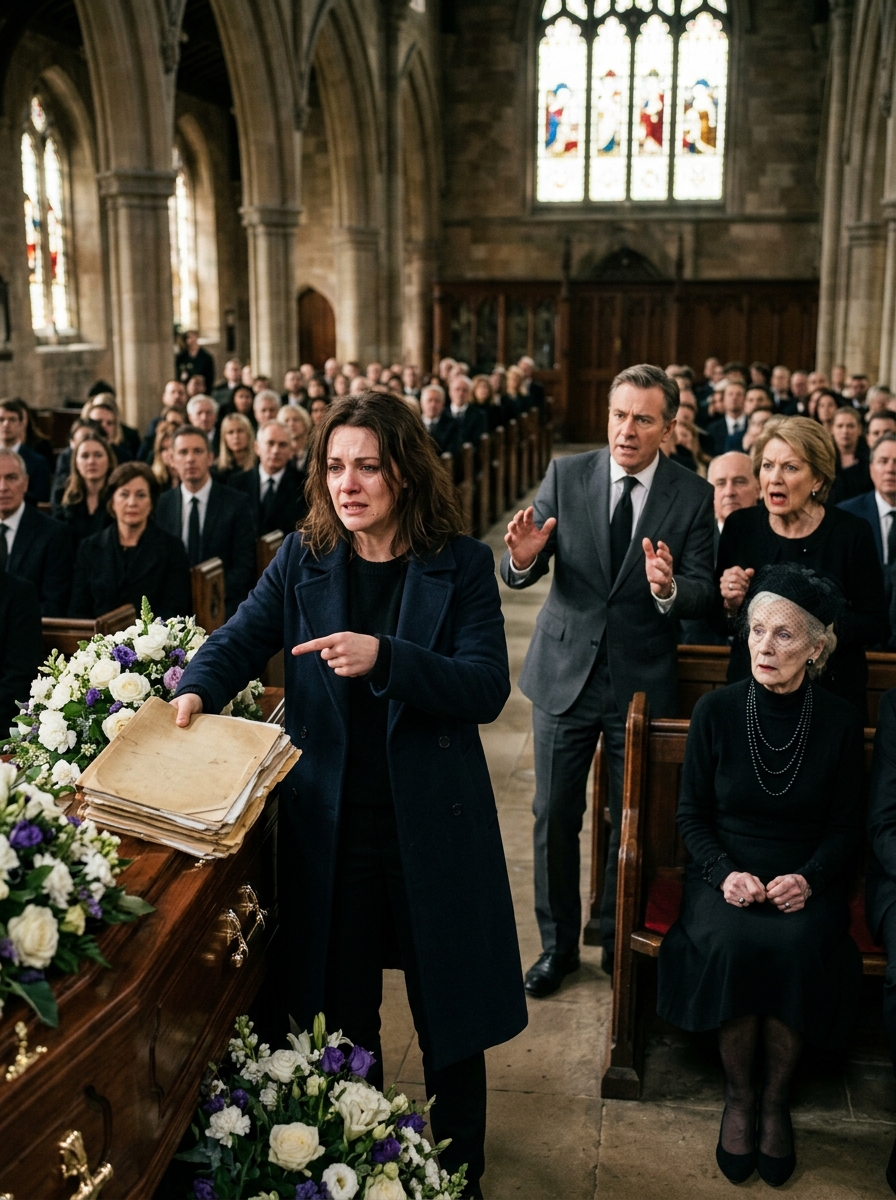
It was just the low creak of old wood moving against its frame. Still, in that silence, it cut through the room clearly enough that nearly everyone turned. I looked over my shoulder, expecting to see a late guest standing awkwardly at the back, embarrassed and unsure where to sit. Instead, I saw a woman I did not recognize.
She stood just inside the entrance.
She was not dressed poorly, but nothing about her looked planned for a funeral of this size. Her black coat was simple, her shoes were wet from the rain outside, and her hair had been pulled back in a way that made her face look sharper than it probably was. She held a worn folder against her chest with both arms. The folder was thick, yellowed at the edges, and stuffed with papers that looked as if they had been handled too many times.
No usher approached her.
Maybe everyone was too surprised.
The woman did not look around for an empty seat. She did not whisper an apology or lower her head in the embarrassed way people do when they arrive late. She simply began walking down the center aisle. Her steps were steady, but her face was not calm. Even from where I sat, I could see that her eyes were red.
People turned as she passed them.
A few leaned away slightly to let her through.
The pastor fell silent.
My father shifted beside me, and I felt the whole front row tense before anyone said a word. The woman kept walking until she reached the coffin. She stopped there and stared down at it, breathing hard through her nose. For a moment, she did nothing else, and the church seemed to hold itself still around her.
Then she placed the folder on top of the coffin.
Not gently.
Not violently either.
But hard enough for the sound to carry.
My father was on his feet before I fully understood what had happened.
“Excuse me,” he said.
The woman did not turn.
My uncle Richard stood next. Aunt Susan put a hand to her mouth. My grandmother remained seated, but her back had gone even straighter than before. I looked from the woman to the coffin and then to my father, trying to make sense of something that had no place in the morning we had been living through.
“You need to step away,” my father said.
The woman kept her hand on the folder.
“I listened,” she said.
Her voice was not loud, but it reached us because no one else made a sound.
My father frowned.
“What?”
“I listened to all of you,” she said. “For more than an hour, I sat back there and listened to people talk about him.”
Her voice trembled on the last word.
Someone near the aisle whispered that she should be removed. Another person asked if anyone knew who she was. I heard the word money, then the word scandal, though I could not tell who said either one. The woman seemed to hear it too, because her mouth tightened.
My father took one step toward her.
“This is my father’s funeral,” he said. “Whatever you think you’re doing, this is not the place.”
The woman finally looked at him.
I remember her expression better than I want to.
It was not the expression of someone looking for attention. It was not smug or theatrical or satisfied. She looked furious, yes, but beneath that fury was something raw and exhausted. She looked like someone who had carried a wound for so long that she no longer cared who saw it.
“Your father,” she repeated.
My father’s jaw tightened.
“Yes,” he said. “My father.”
She looked back at the coffin, and for a second I thought she might break down completely. Her hand slid over the top of the folder as if she were making sure it was still there. Then she laughed once, quietly and bitterly. It was not a laugh that belonged in a church.
My uncle Richard moved into the aisle.
“Thomas, don’t engage with her,” he said. “We’ll have security handle it.”
At the word security, the woman lifted her head.
“No,” she said.
A few people gasped, not because the word itself was shocking, but because of the way she said it. There was fear in it. There was anger too, but fear came first. She pulled the folder off the coffin and held it tightly against herself.
My father turned toward the back of the church.
“Can someone please escort her out?”
That was when the room truly began to change.
People started speaking over one another. Some told her to leave. Others asked what was happening. A man near the front said she should be ashamed of herself. Someone behind me muttered that every wealthy family attracted people like this, especially when inheritance was involved.
I believed that immediately.
I wish I could say I waited for the truth.
I didn’t.
I looked at her and saw an intruder. I saw a woman using grief as a stage. My grandfather was dead, my father was trying not to fall apart, and my grandmother looked like she had aged ten years in a week. Whatever this woman wanted, I hated her for choosing that moment.
The pastor stepped forward carefully.
“Ma’am,” he said, “perhaps we can speak privately outside.”
She shook her head.
“No. I have spent my whole life hearing things privately.”
Her eyes moved across the front pews.
She looked at my father, then Uncle Richard, then Aunt Susan, and finally my grandmother. When her gaze reached Eleanor, something flickered across her face. I did not understand it then. I thought it was disgust. Maybe it was. But there was recognition there too, though I had no idea how she could recognize a woman she had supposedly never met.
My grandmother spoke for the first time.
“Who are you?”
Her voice was quiet.
Too quiet.
The woman stared at her.
“My name is Claire Bennett,” she said.
The name meant nothing to me.
It seemed to mean nothing to my father either. He looked irritated, not alarmed. Uncle Richard made a small dismissive motion with one hand, as if a name without money attached to it could not possibly matter. Aunt Susan kept looking at the folder.
Claire swallowed.
“My father’s name was Daniel Bennett.”
Again, no one reacted.
Not at first.
Claire seemed to expect that. Maybe she had imagined this scene many times and knew we would not understand the name when she said it. She opened the folder with shaking hands and pulled out a stack of old papers. Some were folded, some copied, some marked with notes in the margins.
“My father died three months ago,” she said. “He died believing the man in that coffin had abandoned him.”
My father’s face changed.
Not because he believed her.
Because she had gone too far.
“Enough,” he said.
Claire raised her voice, but only slightly.
“No, it is not enough. I sat back there listening to all of you call him loyal. Loving. Devoted. A man who showed up for everyone.”
She turned toward the coffin again.
“My father waited his whole life for him to show up.”
The church went still.
Not silent exactly.
Still.
There is a difference.
Silence is what happens when no one speaks. Stillness is what happens when people are afraid to move because something in the room has shifted. I felt it then, though I did not know why. The accusation was outrageous, but Claire’s grief did not feel rehearsed.
My father stepped closer.
“You are lying.”
Claire looked at him, and her eyes filled again.
“I wish I was.”
That answer seemed to make him angrier.
“You come into this church, interrupt my father’s funeral, insult my family, and expect us to listen to some story about abandonment?”
Claire’s mouth opened, then closed.
For a moment, she seemed unable to speak.
Then she pointed at the coffin.
“You call him a wonderful father?”
No one answered.
She wiped her cheek with the back of her hand, but the tears kept coming anyway.
“The man in that coffin was a monster,” she said. “He abandoned my family for thirty years.”
The words landed badly.
There is no other way to describe it.
People reacted before they understood them. My aunt began crying openly. Uncle Richard shouted that she was insane. My father told her to get out, and this time his voice was loud enough to echo against the church ceiling. Even the pastor looked shaken, one hand still lifted as if he had meant to calm everyone but no longer knew where to begin.
Claire did not move.
She stood beside the coffin with the folder pressed to her chest and tears running down her face. She looked small suddenly, much smaller than she had when she entered. But she did not look sorry. That was what made people hate her even more.
I stood too.
I don’t remember deciding to.
My chair scraped lightly against the floor, and the sound made my grandmother turn her head. Her eyes met mine for a second. I expected to see confusion, or pain, or outrage. Instead, I saw something I could not name.
Then it was gone.
My father pointed toward the doors.
“Leave,” he said. “Now.”
Claire looked at him.
Then at my grandmother.
Then back at the coffin.
“I came here because my father never got to stand in front of him,” she said. “He never got to ask why. He never got to ask what he did wrong. So I’m asking for him.”
Her voice broke, but she forced the words out anyway.
“Why did Samuel Whitaker leave his own son to grow up with nothing?”
The church erupted around us.
But beneath the shouting, beneath the anger, beneath all the outrage that filled that beautiful old room, I heard something else.
I heard my grandmother take one sharp breath.
At the time, I thought it was grief.
I know better now.
And that was the moment, though none of us understood it yet, when my grandfather’s funeral stopped being a farewell and became the beginning of everything we had never been told.
PART 2 — THE LIFE MY FATHER NEVER DESERVED
For several seconds after Claire spoke, nobody seemed to know what to do.
The church was no longer quiet, but the noise felt scattered and directionless. People were talking over one another, asking questions, making accusations, and trying to understand what they had just heard. My father stood between Claire and the coffin as though he believed she might somehow damage my grandfather’s memory simply by remaining in the room.
“You need to leave,” he said again.
His voice was harder now.
Not louder.
Harder.
Claire didn’t move.
“I’ve spent thirty years listening to silence,” she replied. “You can listen to me for five minutes.”
“You don’t get to make demands here.”
“No?”
Her eyes were red, but her voice remained steady.
“My father spent his entire life paying for someone else’s choices. If this isn’t the place to tell that story, then tell me where it is.”
A murmur passed through the church.
Some people clearly wanted her removed immediately. Others looked uncomfortable enough that they were beginning to wonder whether there might be some truth buried beneath her accusations. Most simply looked confused.
I was one of them.
Five minutes earlier, I had hated her.
Now I wasn’t sure what I felt.
I still believed she was wrong. I still believed she was attacking a dead man who could no longer defend himself. But something about the way she spoke didn’t fit the image I had created in my head. She didn’t sound like someone trying to get money. She didn’t sound like someone enjoying attention.
She sounded tired.
Very tired.
The pastor stepped forward carefully.
“Miss Bennett,” he said, “perhaps if you explain why you’re here, we can avoid turning this into something even more painful.”
Claire looked at him.
Then she nodded once.
“Fine.”
She opened the folder again.
The papers inside were old. Some looked like photocopies made decades earlier. Others were originals stained by age and handling. Several had handwritten notes squeezed into the margins. It wasn’t the sort of folder someone assembled overnight.
It looked lived with.
As strange as that sounds.
“This is my father,” she said.
She held up a photograph.
A man stood beside an aging pickup truck. He looked to be in his late fifties. His shoulders were broad, but there was a tiredness in the way he stood. His clothes were clean but worn. Nothing about him suggested wealth, influence, or privilege.
Just work.
Years and years of work.
“His name was Daniel Bennett.”
Nobody spoke.
Claire glanced down at the photograph before continuing.
“He grew up in state care. He never knew who his parents were. The orphanage records listed almost nothing about his birth, and what little information existed was sealed or missing by the time he became an adult.”
My father crossed his arms.
“That doesn’t have anything to do with my father.”
Claire ignored him.
“When Daniel left the orphanage, he had one suitcase and less than two hundred dollars. That’s all. No family. No connections. No one waiting for him. Most people would probably tell you that’s a sad story, but my father never thought of it that way.”
She paused briefly.
“He used to say plenty of people start with nothing. The important thing is what happens next.”
Something in her expression softened.
For the first time since entering the church, she looked less angry and more sad.
“My father worked everywhere. Construction sites. Warehouses. Factories. Trucking companies. Roofing crews. Any place that needed someone willing to show up before sunrise and leave after dark.”
She smiled faintly.
“He was good at it too.”
The smile disappeared almost immediately.
“But every time life started getting better, something happened.”
I noticed several people exchange glances.
Even Claire seemed aware that the story was becoming harder to believe.
“My father wasn’t unlucky once or twice. He was unlucky constantly. Promotions disappeared. Job offers vanished. Loans were denied after being approved. Opportunities fell apart at the last second. For years he convinced himself it was coincidence.”
She looked down at the papers.
“Then it happened too many times.”
I shifted in my seat.
Maybe it was the way she told the story.
She wasn’t speaking dramatically. She wasn’t trying to build suspense. She sounded like someone repeating a conversation she had heard her entire life.
“My father met my mother when he was twenty-eight.”
Her voice softened again.
“Her name was Grace.”
The church remained still.
“My mother worked at a grocery store. She wasn’t rich. She wasn’t connected. She wasn’t anyone important. She just happened to smile at the right man on the right day.”
A few people lowered their eyes.
Even my father seemed less eager to interrupt.
“They got married six months later.”
Claire stopped speaking for a second.
When she continued, her voice was quieter.
“I don’t remember her. She died the night I was born.”
The room seemed to shrink.
No one interrupted grief when it sounded that genuine.
“She had complications during delivery. The doctors tried. That’s what everyone told me growing up. They tried. Maybe they did. I don’t know.”
Claire shrugged slightly.
“I only know my father walked into that hospital expecting to meet his daughter and walked out carrying both a newborn and a death certificate.”
The pastor lowered his head.
Several people in the church did the same.
“My father never remarried,” Claire continued. “A lot of people told him he should. They said he was still young. They said he deserved another chance at happiness.”
She laughed softly.
“He’d always answer the same way.”
Claire’s eyes moved toward the photograph.
“Maybe. But right now my daughter needs me more.”
Something about that line landed differently than the accusations had.
It sounded real.
Not polished.
Not dramatic.
Just real.
The kind of sentence a tired father might actually say.
“He raised me alone,” Claire said. “During the day he worked. At night he searched.”
“Searching for what?” someone asked from the back.
Claire looked toward the voice.
“For answers.”
She pulled another document from the folder.
“My father never stopped wondering where he came from. He wasn’t searching because he wanted money. He wasn’t searching because he expected some wealthy family to welcome him with open arms.”
Her eyes drifted briefly toward the Whitaker family.
“He just wanted to know why he existed.”
The church grew quieter.
I found myself listening despite everything.
Part of me didn’t want to.
Part of me wanted this woman removed so the funeral could continue. But another part had started noticing details that didn’t fit the story of a scammer. Scammers usually moved toward opportunity. Claire seemed to be moving toward pain.
And that difference mattered.
“He spent decades looking,” she said.
“Every lead vanished.”
She reached into the folder again.
“An investigator agreed to help him. Then quit.”
Another paper.
“A former employee at the orphanage agreed to meet him. Then disappeared.”
Another.
“A hospital clerk promised access to records. Then suddenly changed her mind.”
Another.
“A witness claimed to know something about his birth. Then stopped answering calls.”
The papers continued piling onto the coffin.
One after another.
Each one representing another dead end.
Another year.
Another failure.
“My father began to think someone was preventing him from finding the truth.”
A few people shifted uncomfortably.
I understood why.
The idea sounded ridiculous.
Conspiratorial.
Almost paranoid.
Claire seemed aware of that.
“He hated that thought,” she said quietly. “He didn’t want to believe it. Neither did I. We spent years convincing ourselves there had to be another explanation.”
She took a long breath.
“But every road ended the same way.”
My father finally spoke again.
“And eventually he decided Samuel Whitaker was responsible?”
Claire looked at him.
“No.”
The answer surprised everyone.
“My father didn’t blame Samuel at first.”
For the first time since she arrived, my father looked genuinely confused.
Claire continued.
“He blamed himself. Then bad luck. Then the system. Then whoever had hidden his records. Samuel Whitaker wasn’t even a name yet.”
She removed one final paper.
It was older than most of the others.
The edges had turned yellow.
“This changed everything.”
Nobody could see what was written on it from where we sat.
Claire stared at the document for several seconds before speaking again.
“Three years before he died, my father finally found a name connected to his birth.”
Her voice trembled.
“Samuel Whitaker.”
A wave of whispers moved through the church.
Not loud.
Not chaotic.
Just enough to remind everyone that we were sitting at Samuel Whitaker’s funeral while a stranger claimed he had another son.
“My father spent months verifying it,” Claire said. “He hired people he couldn’t afford. He traveled places he couldn’t afford to visit. He chased records and witnesses and old documents until there was almost nothing left to find.”
She swallowed.
“And eventually he became convinced.”
“Convinced of what?” Uncle Richard demanded.
Claire turned toward him.
“That Samuel Whitaker was his father.”
The room fell silent again.
This silence felt different.
Heavier.
More dangerous.
Claire looked toward the coffin.
Then toward the Whitaker family.
Then toward the hundreds of people who had spent the last hour celebrating my grandfather’s life.
“My father reached a conclusion.”
Her eyes filled with tears.
“He believed Samuel Whitaker knew he existed.”
Nobody moved.
Nobody spoke.
Claire’s voice dropped almost to a whisper.
“He believed Samuel Whitaker chose not to find him.”
The pain in those words felt old.
Older than Claire.
Older than the funeral.
Maybe older than Daniel himself.
“My father carried that belief for years,” she continued. “Every birthday. Every Christmas. Every Father’s Day. Every time life knocked him down and there was nobody there to help him stand back up.”
She closed her eyes briefly.
“He carried it until the day he died.”
I looked at the coffin.
Then at my grandmother.
Then back at Claire.
For the first time all morning, certainty began slipping away from me.
Not because I believed her.
Not yet.
But because I couldn’t stop wondering what kind of man spends thirty years searching for a father he claims abandoned him.
People chasing money don’t usually spend decades doing it.
People chasing answers do.
Claire wiped her eyes.
“My father died three months ago.”
The church remained silent.
“Before he died, he gave me these records. He told me there was only one thing he still wanted.”
She placed her hand on the folder.
“He wanted the truth.”
My father shook his head.
“You have no proof.”
Claire nodded slowly.
“I know.”
“Then why are you here?”
For a moment she looked down at the coffin.
When she spoke again, her voice sounded exhausted.
“Because my father isn’t.”
The answer hung in the air.
Nobody knew what to say.
Then, from the front row, a familiar voice finally broke the silence.
“She does have proof.”
Every head turned.
Harold Pierce, my grandfather’s attorney, slowly rose to his feet.
And for the first time since Claire entered the church, my grandmother looked afraid.
PART 3 — THE MAN WHO NEVER STOPPED SEARCHING
The silence that followed Harold Pierce’s words felt different from every other silence that afternoon.
Until that moment, the conflict inside the church had been relatively simple, at least in our minds. Claire Bennett claimed my grandfather had abandoned her father. My family insisted she was wrong. People had taken sides almost immediately because the story seemed to offer only two possibilities. Either Samuel Whitaker was the devoted father everyone believed him to be, or he was the man Claire had described. Harold’s sudden intervention destroyed that certainty.
For several seconds, nobody spoke.
I remember looking at my father first. His face had gone completely blank, which was somehow more unsettling than his anger had been. Throughout Claire’s accusations, he had remained confident that she was mistaken or lying. Now he seemed unsure what he was supposed to believe. Across the aisle, Uncle Richard looked equally confused. Even the pastor appeared caught between curiosity and concern.
“What do you mean she has proof?” my father finally asked.
Harold adjusted his glasses before answering. He wasn’t a dramatic man, and that made the moment feel more serious. If someone else had stood up and challenged my family, people might have dismissed it as speculation. Harold had worked with my grandfather for decades. He knew where every document was stored, handled every major legal matter, and spent more time with Samuel Whitaker than most relatives did.
“She has part of the truth,” Harold said.
The answer satisfied no one.
Claire frowned immediately. My father looked irritated. Several people in the congregation exchanged confused glances. For a moment I wondered whether Harold was trying to calm the situation without fully supporting either side, but the expression on his face suggested otherwise.
He stepped into the aisle and slowly approached the front of the church. In one hand he carried a worn leather briefcase I barely remembered seeing earlier that morning. Looking back now, I suspect he had anticipated something like this. Perhaps not Claire’s arrival specifically, but the possibility that secrets would surface once my grandfather was gone.
When Harold reached the front, he stopped beside the coffin and looked directly at Claire.
“Your father’s name was Daniel Bennett?” he asked.
Claire nodded.
“Yes.”
Harold lowered his eyes briefly.
The reaction lasted only a second, but it was impossible to miss. He looked genuinely saddened by the answer. It wasn’t the reaction of a lawyer evaluating evidence. It looked more like the reaction of a man hearing news he had feared for a long time.
“I’m sorry,” he said quietly.
Claire stared at him.
The apology seemed to catch her off guard. For the first time since entering the church, she looked uncertain. Her anger had carried her through the funeral like armor, but Harold’s sympathy appeared to create a crack in it.
“You knew him?” she asked.
Harold shook his head.
“No. I never met Daniel.”
Claire’s confusion deepened.
“Then why are you apologizing?”
Harold hesitated.
The pause wasn’t long, but it felt significant. He glanced toward the coffin before speaking again, as if reminding himself why he was there.
“Because Samuel talked about him for years.”
The church reacted immediately.
Not loudly at first. Most people simply shifted in their seats or whispered to the person beside them. The statement itself wasn’t dramatic, but its implications were enormous. If my grandfather had spoken about Daniel Bennett for years, then Claire’s accusation could not possibly be the entire story.
My father stood.
“No,” he said. “That’s impossible.”
Harold looked at him carefully.
“I wish it were.”
The answer hit harder than a direct argument would have.
My father opened his mouth to respond, then stopped. He looked like a man trying to fit together two pieces of information that refused to belong in the same picture. Across the room, Claire seemed equally lost. Whatever she expected from the Whitaker family, she clearly hadn’t expected someone to suggest that Samuel Whitaker had spent years talking about her father.
Harold set the briefcase on a nearby table and opened it.
Inside were several thick folders.
The sight alone changed the atmosphere.
These weren’t a few loose documents collected at the last minute. There were enough records to fill an entire shelf. Some folders were faded from age. Others had dates written across the front in black marker. Several appeared to have been opened and reopened so many times that the edges had started to fray.
“What is all this?” Uncle Richard asked.
Harold removed the first folder carefully.
“These are Samuel’s records.”
“Records of what?”
Harold looked around the room before answering.
“The search.”
The word hung in the air.
Nobody seemed to understand it immediately. I know I didn’t. When I heard the word search, I assumed he meant a business investigation or perhaps an attempt to verify Claire’s claims after learning about them. The truth turned out to be much larger than that.
Harold untied the string around the oldest folder and spread several documents across the table.
“Nearly thirty years ago,” he said, “Samuel learned that a woman he had known before his marriage may have given birth shortly before her death. At first the information was incomplete. There were rumors, conflicting reports, and almost no official records. But the possibility troubled him enough that he began investigating.”
The church had become completely silent again.
No one interrupted.
No one questioned him.
Everyone seemed to understand that we were approaching the center of something important.
Harold lifted an old report.
“This was the first inquiry.”
Then another.
“This was the second.”
Then another.
“And this was the third.”
One by one, the documents began telling a story that none of us expected.
There were letters sent to orphanages. Requests for sealed records. Notes from investigators. Travel receipts from towns nobody in our family had ever heard of. Some pages contained only a few handwritten lines. Others were dozens of pages long. Together they formed something larger than evidence. They formed a timeline.
A life spent searching.
I remember looking toward Claire.
She had stopped crying.
Not because she was calmer, but because she seemed unable to process what she was hearing. Her eyes moved from document to document as Harold continued explaining where each one came from and why it mattered. Several times she opened her mouth as if she wanted to challenge him, only to close it again before speaking.
The anger that brought her into the church was beginning to unravel.
“My grandfather searched for Daniel?” I asked before I could stop myself.
The question slipped out louder than I intended.
Harold turned toward me.
“Yes.”
The answer was simple.
Too simple.
Because nothing about the situation felt simple anymore.
“If that’s true,” my father said, “then why didn’t he find him?”
That question changed everything.
Until then, everyone had been focused on whether Samuel Whitaker knew Daniel existed. Suddenly a different mystery appeared. If my grandfather spent decades searching for his son, then how had both men managed to miss each other for so long?
Harold didn’t answer immediately.
Instead, he reached for another folder.
Unlike the others, this one was noticeably thinner.
And for the first time all afternoon, I saw genuine concern cross his face.
“This,” he said quietly, “is the part Samuel never fully understood.”
The room grew still again.
Harold opened the folder and removed a stack of financial records.
At first they looked unremarkable. Bank statements. Transfers. Routine paperwork. I couldn’t understand why they mattered until he began placing them beside the investigation reports.
A lead would appear.
Then a payment.
A witness would agree to cooperate.
Then a payment.
An investigator would get close to finding Daniel.
Then a payment.
Individually, none of the documents proved anything. Looking at a single transaction, you could easily dismiss it as coincidence. Looking at decades of transactions arranged beside decades of failed investigations was much harder.
The pattern revealed itself slowly.
Which somehow made it more disturbing.
My grandfather would get close to Daniel.
Something would happen.
A record would disappear. A witness would change their mind. An investigator would abandon the case. A meeting would be canceled. A trail would go cold.
Then the cycle would repeat.
The same thing happened too many times to ignore.
I remember glancing toward my grandmother for the first time since Harold opened the folders.
She had barely moved.
Most people in the church looked shocked, confused, or emotional. Eleanor Whitaker looked something else entirely. She sat perfectly still with her hands folded in her lap, staring at the documents as if she recognized them.
And perhaps she did.
Harold finally closed the last folder.
“Samuel never found proof,” he said. “That part is important. He suspected someone was interfering, but he never found evidence strong enough to make a direct accusation.”
The statement seemed to relieve a few people.
Only briefly.
Because Harold wasn’t finished.
He reached into the folder one final time and removed a handwritten note.
“However,” he continued, “he documented every obstacle he encountered. Every destroyed lead. Every withdrawn investigation. Every witness who suddenly disappeared.”
No one spoke.
The church felt almost frozen.
Harold looked toward the front pew.
Then he looked at my grandmother.
“The same name appeared repeatedly throughout those records.”
I felt my stomach tighten.
Beside me, my father slowly turned his head.
Across the room, Claire followed his gaze.
The movement spread through the church until nearly everyone was looking in the same direction.
Toward Eleanor Whitaker.
Harold’s voice remained calm.
He didn’t sound angry.
He didn’t sound triumphant.
If anything, he sounded sad.
“The name that appeared more often than any other,” he said quietly, “was Eleanor Whitaker.”
For the first time that afternoon, my grandmother didn’t look grieving.
She looked afraid.
PART 4 — THE WOMAN WHO STOLE THIRTY YEARS
For several seconds after Harold spoke my grandmother’s name, nobody in the church seemed capable of reacting. The accusation was so large, so completely at odds with everything we thought we knew, that people appeared to freeze rather than respond. I remember looking around the room and seeing the same expression repeated over and over again. Some people looked confused. Others looked skeptical. A few were already staring at my grandmother as if they had quietly reached a conclusion before anyone else.
My father was the first person to speak.
“Mom?”
The word sounded strange coming from him. He was a man who negotiated million-dollar contracts without hesitation, but at that moment he sounded like a frightened child. His eyes never left Eleanor’s face. I think he was waiting for her to laugh, shake her head, and explain how badly everyone had misunderstood the documents spread across the table.
Instead, she remained silent.
The longer she sat there without answering, the more uncomfortable the room became. People shifted in their seats. Several guests exchanged uncertain glances. Claire stood motionless beside the coffin, her folder pressed against her chest, while Harold waited near the table without saying another word. Looking back now, I think everyone instinctively understood the same thing. If my grandmother immediately denied the accusation, the conversation might still be salvaged. The fact that she couldn’t seemed more revealing than anything Harold had presented.
“Mom,” my father repeated, this time louder.
Eleanor finally lifted her head.
The expression on her face wasn’t anger. It wasn’t outrage either. What struck me most was how tired she looked. The woman sitting in that front pew no longer resembled the composed family matriarch I had known all my life. She looked like someone carrying a weight that had become too heavy to hold.
“No,” she said quietly.
I watched relief appear on my father’s face almost immediately. It lasted less than a second before disappearing again.
“No, it wasn’t like that.”
Harold frowned slightly.
“What wasn’t like that?”
Eleanor looked toward him, then toward Claire, and finally toward the coffin. For a moment she seemed unable to decide where to rest her eyes. When she finally spoke again, her voice sounded thin and fragile, as though every sentence required effort.
“I never wanted anyone hurt.”
The statement didn’t help her.
If anything, it made the room more uncomfortable. Nobody had accused her of wanting people hurt. They had accused her of spending three decades keeping a father and son apart. The distinction mattered, but not in the way she seemed to hope it would. Claire’s face tightened immediately, while several people in the audience exchanged looks that suggested they were already beginning to understand where this conversation was heading.
“My father spent his whole life believing he was unwanted,” Claire said.
Eleanor closed her eyes.
“I know.”
A ripple passed through the church.
The reaction wasn’t loud. It wasn’t dramatic. It was simply the collective realization that my grandmother had just acknowledged knowing something she should never have known. My father stared at her in disbelief. Even Uncle Richard, who had defended her instinctively throughout the afternoon, looked as though he had been caught off balance.
“You know?” my father asked.
His voice cracked on the second word.
“You knew?”
For several seconds Eleanor didn’t answer. Then she looked directly at Claire, and when she finally spoke, the confession came out with surprising simplicity.
“I knew Daniel existed.”
No one interrupted her.
No one needed to.
The room had become so quiet that I could hear the faint hum of the church’s air-conditioning system above us. Claire’s eyes filled with tears immediately, but she didn’t look surprised. If anything, she looked exhausted. It was the expression of someone who had spent years chasing a truth and had finally reached it only to discover it hurt exactly as much as she feared it would.
“Who was he?” Claire asked.
Eleanor swallowed before answering.
“He was Samuel’s son.”
The words seemed to settle over the church like dust.
For years, Claire’s father had fought to prove that claim. He had spent decades searching for evidence, only to die before hearing the confirmation himself. Now the truth sat in the middle of the church for everyone to see, and somehow it didn’t feel victorious. It felt tragic.
“I found out before Samuel did,” Eleanor continued. “That’s the part none of you understand.”
She clasped her hands together tightly before continuing. Her eyes drifted toward the coffin more than once, and each time it happened she seemed to struggle a little more.
“When I learned there was a child, I panicked. I wish I could tell you I made a careful decision or that I thought through the consequences. I didn’t. I was scared. I was younger than I am now, and I was terrified of losing the life I had built.”
She looked toward my father.
“You were still little then. Richard was little too. Everything I cared about seemed fragile.”
Then she looked at Claire.
“And your father became the thing I was afraid of.”
The confession hit harder than any denial could have.
Not because it was cruel.
Because it sounded human.
Selfish. Wrong. Destructive. But human.
That was what made it difficult to listen to.