![[FULL STORY] My Sister Moved Into Dad’s Bedroom Before He Died, Then Used My Caregiving Notebook To Call Me A Thief](https://health.pricable.com/wp-content/uploads/2026/06/Create_a_realistic_vertical_4_5_202606151538.jpeg)
PART 1 – THE SUITCASE IN THE HALL
My sister moved into our father’s bedroom on a Tuesday afternoon while I was still wearing the hospital bracelet they had given me in admitting.
I had not been admitted as a patient. I had been there for Dad, carrying his folder of medication lists, discharge instructions, hospice paperwork, and the tired little stack of insurance cards that never seemed to be enough for anyone behind a desk. By the time I pulled into the driveway, the late March sun was slipping behind the maple tree, and my hands smelled like sanitizer and vending-machine coffee. I remember sitting in the car for a few seconds after I turned off the engine, because the house looked too bright. Every downstairs light was on, including the dining room chandelier we never used because Dad said it made the room feel like a furniture store.
Then I saw Alyssa’s suitcase beside the front steps.
It was pale gray with gold zippers, the kind she rolled through airports when she posted photos from girls’ weekends in Scottsdale or work conferences where she wore white blazers and held champagne like she had invented being busy. It stood upright by the door as if it belonged there. As if it had been expected. As if the house had been waiting for her to arrive and take up the space I had been cleaning, lifting, documenting, and trying to keep gentle for months.
I got out with the hospital papers pressed against my ribs and opened the door to the sound of voices.
Aunt Carol was in the living room. So was Uncle Brian, my cousin Rachel, and Mrs. Donnelly from next door, who had known my father since I was in braces. They were sitting around like guests at a wake that had started early. Alyssa stood beside Dad’s recliner with her hand resting on the back of it, smiling that soft, practiced smile she used when she wanted people to think she was holding herself together for everyone else.
The blue medication notebook was on the side table beside her.
For eight months, that notebook had been mine and Dad’s lifeline. It was a cheap spiral notebook with a plastic cover the color of a summer sky, bought from the pharmacy clearance bin when I realized my phone notes were not enough. In it, I wrote every dose, every blood pressure reading, every time he refused soup, every time he ate half a banana, every call from the hospice pharmacy, every change in pain, mood, sleep, breathing. It was not pretty. It had coffee rings, bent corners, and smears where my pen had slid because I was writing with one hand while holding a pill cup in the other.
Alyssa had never opened it in front of me before.
“Megan,” she said, turning as if she had been waiting for an audience cue. “There you are.”
Everyone looked at me. I had been awake since 4:40 that morning because Dad had coughed himself into a panic before sunrise and Elena, his hospice nurse, had told me to bring him in for evaluation after his oxygen dipped. He had stabilized, but the doctor wanted a chest scan and lab work, and Dad had gripped my wrist before they took him down the hall. “Home,” he had whispered, rough and stubborn. “Don’t let her make it ugly.”
At the time, I thought he meant death.
“What’s going on?” I asked.
Alyssa’s eyes moved over the folder in my arms, then down to my shoes, which were damp from melted slush in the hospital parking lot. She looked polished in a camel sweater, dark jeans, and small gold hoops. Her hair was pulled into a low knot. I was wearing yesterday’s sweatshirt under my coat because Dad had thrown up on the clean one during the ambulance ride.
“I’m staying here now,” she said. “It’s time.”
Aunt Carol nodded like she had been briefed. “Your sister called us. She said things have gotten tense.”
“Tense?” I looked from one face to another. “Dad’s at the hospital. He’s stable. They’re adjusting his medication and sending him back tonight if his oxygen holds.”
“We know,” Alyssa said quickly. “That’s why we came. While he’s not here, we need to talk about what’s been happening.”
There was a small beat of silence, the kind that forms when people already believe they know what you did and are waiting for you to make it worse by defending yourself. I could feel my pulse in my wrists. I set the hospital folder on the entry table because my fingers had started to cramp around it.
“What do you think has been happening?” I asked.
Alyssa’s expression folded into pain so neatly I almost admired it. “You’ve isolated him, Meg.”
The words did not land at first. They hovered in the warm, overlit living room, too large and stupid to fit with the pill crusher on the kitchen counter, the waterproof pads stacked by the downstairs bathroom, the baby monitor receiver clipped to my waistband because Dad sometimes tried to stand when he forgot his legs were not steady. I laughed once, not because it was funny, but because my body reached for the wrong tool.
Alyssa flinched, and Aunt Carol put a hand to her chest.
“I’ve isolated him?” I said. “I left my job to take care of him because none of you could commit to more than Sunday visits and text messages.”
“That’s not fair,” Uncle Brian said, though he had not come by since Christmas Eve and had stayed for twenty-two minutes.
“What’s not fair is doing this while he’s at the hospital.”
Alyssa lifted the notebook from the side table. “We’re doing this because of what we found.”
My stomach tightened. Not because there was anything criminal in the notebook, but because there was so much private exhaustion in it. Dad’s constipation after morphine. His bad nights. His confusion when he woke from naps and called for my mother, who had been dead nine years. My own reminders to breathe before waking him for meds because if I came in anxious, he got anxious too.
She opened to a page marked with one of my sticky tabs.
“This is your handwriting, right?” she asked.
I stared at her. “Most of it is. Why?”
She turned the notebook toward Aunt Carol first, then Rachel, then Mrs. Donnelly, making sure I saw the procession. “No visitors before signing is settled,” she read. “That’s what Megan wrote. No visitors before signing is settled.”
The room went still around that sentence.
I knew the line. Or I knew part of it. I knew it the way you recognize a room in a dream and understand instantly that something has been moved. It had been from a Thursday entry, two weeks earlier, after Dad’s attorney called to reschedule because Dad was too nauseated to sit up and sign an updated medical directive. I had written down his words, then my response, then Elena’s recommendation that visitors wait until after Dad slept because too many people made him agitated.
But Alyssa held the page folded backward under her thumb, showing only the middle line.
“That is not what that says,” I said.
Alyssa’s voice trembled. “Megan, please don’t.”
That hurt more than the accusation. The little plea, performed softly in front of people who remembered us in Easter dresses and assumed older sisters did not lie because they had better posture. I stepped forward to take the notebook, but Uncle Brian stood from the couch.
“Maybe we should all keep calm,” he said.
The sentence landed on me like a hand.
I looked at him, then at Alyssa, then at the suitcase still visible through the open hall. It was not by the front door anymore. Someone had rolled it inside. It stood near the hallway that led to the main bedroom, Dad’s bedroom, the room where my mother’s old cedar chest still sat under the window and where Dad had slept alone for almost a decade before his illness forced us to move a recliner downstairs.
“You put your suitcase in Dad’s room?” I asked.
Alyssa sighed. “I need to be close to him.”
“He can’t climb the stairs.”
“That’s why I’ll be nearby to manage the household.”
“The household?” I repeated.
Aunt Carol looked uncomfortable. “Megan, honey, everyone appreciates what you’ve done. But sometimes when one person has been caregiving too long, they get possessive without meaning to.”
There it was. The softest possible word for stealing my life and then calling it suspicious. Possessive. As if I had hoarded Dad like jewelry. As if I had not begged Alyssa in January to take one weekend so I could sleep more than four hours, only for her to text back, I wish I could, but the team is underwater and Dad gets weird when I see him sick.
“He asked for me,” I said, and my voice came out quieter than I expected. “He asked me to handle his medication. He asked me to write things down.”
Alyssa closed the notebook with a careful hand. “Dad is scared of conflict. He says what people want to hear.”
“You haven’t been here enough to know what he says.”
Her face changed. Only for half a second. The gentle sadness peeled back, and something hot looked through. Then it was gone, covered by the expression everyone else believed.
“I’m here now,” she said. “And I’m not leaving him alone with this.”
No one asked me what “this” meant. No one asked why the notebook that had kept Dad alive long enough for them to visit him on good afternoons was suddenly evidence against me. They let Alyssa stand by his recliner with my blue notebook under her arm and her suitcase pointed toward his bedroom like a flag.
I wanted to scream. Instead, I picked up the hospital folder from the entry table.
“Elena will bring Dad home around eight if discharge stays on schedule,” I said. “He needs the downstairs bed made with clean sheets. He needs clear broth warmed, not microwaved hot. He needs the oxygen tubing checked because the cat keeps biting it near the kitchen corner. If you are here to help, help.”
The room absorbed my instructions with visible disappointment. They had expected guilt, panic, maybe tears. Not a list.
Alyssa smiled again. “Of course.”
I walked into the kitchen and found that someone had moved the pill organizer from the left side of the counter to the windowsill.
It was a small thing. So small that another person might have missed it or blamed the chaos of visitors. But caregiving teaches you the weight of small things. A water glass turned the wrong way can mean Dad tried to reach it and failed. A blanket on the floor can mean he slid in the night. A moved pill organizer can mean someone touched medication they did not understand.
I put the organizer back where it belonged and opened the blue notebook in Alyssa’s hands in my mind.
No visitors before signing is settled.
The line was ugly on its own. Cropped like that, it made me sound like exactly what she needed me to be: controlling, secretive, maybe greedy. I stood at the sink and looked out at the darkening backyard where Dad’s bird feeder swung empty from the old iron hook. My reflection in the window looked older than thirty-one.
Behind me, in the living room, Alyssa laughed softly at something Aunt Carol said.
That was when I understood that my sister had not come home to help Dad die peacefully.
She had come home to make sure everyone remembered me as the reason he hadn’t.
PART 2 – THE BLUE NOTEBOOK
Dad came home at 8:37 that night with Elena walking beside the transport chair and me carrying the oxygen paperwork behind them.
The house had been rearranged just enough to make me feel unwelcome in it. Alyssa had put flowers on the dining table, white tulips in a vase my mother used to save for Easter. She had lit a candle in the kitchen, which I blew out immediately because Dad’s lungs could not handle fragrance anymore. The downstairs bed had clean sheets, but the pillows were stacked upright like a hotel display, not angled the way he needed so he could breathe without fighting gravity.
Dad noticed before anyone said a word.
His eyes moved from the flowers to the candle smoke to Alyssa standing at the foot of the bed with both hands clasped. His face had thinned over the winter until every emotion showed quickly, like light under a door. He looked at my sister, then past her toward the hallway, where her suitcase was gone because she had carried it upstairs.
“Lyss,” he said.
She bent toward him with a bright, tender face. “Hi, Daddy.”
He closed his eyes.
To anyone else, it might have looked like relief. To me, it looked like retreat. He had been doing that more often, closing his eyes when he did not have the strength to refuse something out loud. I saw Elena notice it too. She was a compact woman in her fifties with silver threaded through her dark hair and a calm that did not waste itself on performance. She glanced at me, not dramatically, just enough to say she had seen what I had seen.
“We’ll settle him first,” Elena said. “One voice at a time, please.”
Alyssa stepped back, but her mouth tightened.
The next hour was all routine, and routine saved me. Dad’s pain medication at nine. Oxygen cannula adjusted. Warm broth. Half a cracker softened in soup because he wanted to chew something. Clean socks. Temperature. A record of the new antibiotic. I wrote in the blue notebook while Elena reviewed the discharge instructions, and every time my pen moved across the page, I could feel Alyssa watching.
Dad watched too.
He had always liked records. Before he got sick, he kept a notebook in the garage where he wrote down oil changes, furnace filters, lawn mower repairs, and the date he planted the hydrangeas along the fence. When Mom was alive, she teased him that he had a ledger for every nail in the house. He would grin and say, “Memory lies. Ink has manners.”
The blue notebook had been his idea before it became mine.
At first, back in August, I had resisted. I was still pretending caregiving was a temporary arrangement, something we would pass through like bad weather. Dad had been diagnosed in the spring, surgery had failed to get clean margins, and by summer the treatments were no longer buying enough time to justify what they cost his body. Alyssa organized a meal train for two weeks and made a shared calendar with color-coded tabs. She did not fill many of them herself, but everyone told her she was amazing for setting it up.
I moved into the small guest room because someone had to be there when Dad fell.
My life shrank to the radius of his needs. I learned the sound of his breathing through walls. I learned which mug made tea taste metallic to him and which old sweatshirt he wanted on bad days because it still smelled faintly of cedar from the closet. I learned that people praised caregiving most warmly when they did not have to watch it happen. They said things like, You’re an angel, and then changed the subject when I asked whether they could sit with him Thursday afternoon.
Alyssa’s visits were bright and brief. She brought expensive pastries Dad could not eat and sat where the light was good. She posted a photo once of her hand holding his, captioned Time is precious, and ignored my text asking if she had noticed he was too nauseated for company afterward. Dad loved her anyway, because parents can know a child is selfish and still lift their face toward them like a window toward sun.
That was part of the wound I did not like admitting.
I was the daughter who knew his medication schedule, and she was the daughter who could still make him shave before she arrived. I was the one who cleaned the commode, and she was the one he called “my beautiful girl” when she walked in smelling like perfume and outside life. I told myself it did not matter. Love was not a contest. Dying made people sentimental. But exhaustion has teeth, and sometimes it bit through my noblest thoughts.
After Dad fell asleep, Elena followed me into the kitchen. Alyssa had gone upstairs to “unpack and make calls,” though I heard drawers opening in Dad’s bedroom, and each sound made something in my shoulders climb higher.
“How are you holding up?” Elena asked.
I laughed under my breath. “Is there an answer that doesn’t get me reported to someone?”
She leaned against the counter, arms folded. “You can be tired without being unsafe.”
That sentence nearly undid me. Not because it was grand, but because it was accurate. I pressed both hands flat on the counter and stared at the pill organizer. Monday through Sunday. Morning, noon, evening, bedtime. Little plastic doors between Dad and pain.
“My family thinks I’m keeping people from him,” I said.
“I noticed some tension.”
“That is a polite word.”
“It’s a useful word until we need a sharper one.” Elena looked toward the hallway, then lowered her voice. “Your notes are excellent, Megan. They’ve helped us adjust his care quickly. Keep writing things down.”
I looked at her. “Even if they use it against me?”
“Especially then,” she said.
At the time, I thought she meant medication records. I did not yet understand that she was giving me the one piece of advice that would save me from disappearing inside Alyssa’s version of events.
The next morning, I found Dad’s checkbook on the desk in the den.
It had not been there the night before. I knew because I had searched the desk for stamps after dinner and the checkbook had been in the top drawer under the yellow envelopes. Now it sat beside the keyboard with a pen laid across it. The den smelled faintly of Alyssa’s lotion, something expensive and citrusy. I stood in the doorway with a laundry basket against my hip and felt a little click inside my mind, the kind a door makes when it locks.
I did not confront her.
Instead, I wrote it down.
March 22, 7:15 a.m. Checkbook moved from top drawer to desktop. A’s lotion scent in den. Dad asleep 10:40 p.m.-6:05 a.m. No authorized reason for checks out.
I wrote it on the left page of the blue notebook under the medication notes, small enough that a casual reader might skip it. Dad was still sleeping, his mouth open, the oxygen machine sighing beside him. I made coffee. I folded laundry. I put the checkbook back.
At 9:20, Alyssa came downstairs in leggings and one of Dad’s old college sweatshirts.
It bothered me more than it should have. The sweatshirt had been in his bedroom closet, and he wore it on cold evenings before he got too thin for it to hang right. On her, it looked styled. On him, it had looked like history.
“Morning,” she said.
“Morning.”
She glanced at the counter. “Where’s the checkbook?”
I turned from the sink. “Why?”
Her face stayed smooth, but her eyes sharpened. “Dad asked me to help with some bills.”
“He’s asleep.”
“Last night.”
“Last night he could barely stay awake through broth.”
Alyssa opened the refrigerator and took out the oat milk she had brought, though Dad drank whole milk and I drank black coffee. “You don’t have to interrogate every conversation I have with my own father.”
I dried my hands slowly. “What bills?”
She shut the refrigerator. “This is exactly what I mean.”
There it was again, the accusation shaped like hurt.
She did not need to prove anything to me in the kitchen. She only needed me to sound sharp enough that when she repeated the story later, people could imagine my tone. Megan demanded to know why I was helping Dad. Megan hides his financial things. Megan treats me like a stranger. Each sentence would have a clean little handle for relatives to grab.
So I said nothing.
Alyssa seemed almost disappointed. She poured coffee, added oat milk, and carried the mug into the living room without asking whether Dad needed anything. I watched her pass the blue notebook. Her gaze flicked to it, then away too fast.
Over the next four days, the house became a stage.
Relatives came more often now, not to help but to observe. Aunt Carol brought casseroles and looked at me sadly when I labeled them with dates. Rachel offered to sit with Dad, then spent the entire time asking him whether he was “getting enough say” in things while he tried to sleep. Uncle Brian came on Friday and asked where Dad kept “important papers,” because Alyssa had told him things were scattered and she was worried.
The papers were not scattered. They were in a fireproof box in the upstairs closet, where Dad had kept them for twenty years.
The problem was that Alyssa knew it.
I had never told her. Dad had never mentioned it in front of her while I was present. As far as I knew, the only people who knew about the box were Dad, me, and my mother before she died. Yet on Friday afternoon, while I was changing Dad’s bedding after his fever broke, I heard Alyssa tell Uncle Brian, “The fire box is probably in the closet, but Megan has the key.”
I froze with the fitted sheet halfway over the mattress.
Dad’s eyes opened. He looked at me, then toward the hall. His hand moved weakly on the blanket. At first I thought he wanted water, but then he tapped twice near his thigh, where the blue notebook usually rested when he was awake enough to review the day.
“Notebook?” I whispered.
He blinked once.
I brought it to him. His hands trembled too badly to write much anymore, but he still liked holding a pen. I gave him the thick black pen he preferred because it left darker lines than my blue ballpoints. He curled his fingers around it, stared at the page, and made a small frustrated sound. I thought he was trying to write a medication note. I thought he wanted to correct my record of his temperature or ask for more pain relief. His breath rasped.
“Later,” I said gently. “You can tell me later.”
His eyes filled with anger.
Not at me. That took me a second to understand. He was angry because his body had become a locked room and he was still inside it, hearing people discuss keys and closets and the daughter they trusted least because she was the one doing the work.
I guided the pen into his hand and held the notebook steady.
He wrote one word. It took him almost a minute.
Closet.
Then he underlined it so hard the pen tore the page.
PART 3 – CROPPED LINES
By Saturday, Alyssa had made herself useful in every visible way and useless in every way that mattered.
She answered the door before I could. She arranged flowers. She carried mugs to relatives and murmured updates in the hallway. She texted people after each visit, thanking them for supporting Dad, though I was the one who cleaned him, medicated him, and sat awake through the hours when pain turned him restless and mean. She started calling the main bedroom “my room,” then correcting herself with a small laugh if anyone heard.
Dad watched more than he spoke.
His voice had become unreliable. Some hours he could manage a sentence if we waited patiently. Other hours he communicated with blinks, fingers, or the stubborn set of his jaw. Alyssa treated this as confusion when it suited her and lucidity when she needed agreement. If he turned away from her, she said he was exhausted. If his hand twitched near hers, she said he wanted her close.
On Sunday afternoon, she brought him a document.
I was in the kitchen crushing pills into applesauce when I heard paper rustle. It was not the sound of a magazine or a hospice pamphlet. It was the dry, official sound of forms. I set down the spoon and walked to the living room.
Alyssa was sitting on the edge of Dad’s bed with a folder open in her lap. “It’s just housekeeping,” she said to him. Her voice had that sweet, patient note people use with children and the dying when they want obedience to sound like comfort. “You don’t want things messy for us, do you?”
Dad stared at the ceiling.
“What is that?” I asked.
Alyssa turned, startled, then recovered. “A list.”
“Of what?”
“Dad and I are talking privately.”
“He’s due for medication.”
“He’s due for dignity,” she snapped, and the word was so perfectly chosen for an audience that I knew she had been waiting to use it.
There was no audience, though. Only me, Dad, and the oxygen machine. Without witnesses, her polished sadness had less reason to stay polished. I walked closer, and she angled the folder toward herself.
Dad’s hand moved under the blanket.
It was a small movement. His index finger traced a shape against the sheet, almost nothing. A line down, then across. I looked at him. He did it again. Down, across. At first I did not understand. Then I saw his eyes flick toward the side table.
Notebook.
I picked up the blue notebook. Alyssa’s gaze hardened.
“What are you doing?” she asked.
“Writing down his medication.”
“He hasn’t taken it yet.”
“I also write down changes in behavior.”
Her laugh was quiet and ugly. “You mean evidence.”
I looked at her then, really looked. My sister, who had once taught me how to curl my hair with a flat iron before freshman homecoming. My sister, who cried harder than I did at Mom’s funeral and then let me handle the thank-you cards because she said grief made her hands shake. My sister, who could make people feel chosen for ten minutes and abandoned for ten years. I had spent most of my life trying to earn the version of her that appeared in flashes.
“What do you need him to sign?” I asked.
Alyssa stood, folder pressed to her side. “I need him to be protected.”
“From me?”
“If that’s what this has become.”
Dad made a sound. Not a word, but close. His face twisted with effort. I stepped toward him, and Alyssa moved at the same time, both of us reaching, both of us daughters, neither of us innocent of wanting him to choose us in some old, buried way.
“Elena is coming tomorrow,” I said. “Anything important can wait until she evaluates him.”
Alyssa’s eyes flashed. “A nurse does not decide our family business.”
“No,” I said. “Dad does. When he can speak without being pressured.”
She stared at me, breathing through her nose. Then she smiled. “You’re making this very clear.”
I did not know then that she had recorded only that last sentence on her phone, starting after she had hidden the folder behind her back. I did not know she would send it to Aunt Carol with the message, Megan says Dad can only make decisions if her hospice nurse approves. I did not know ten relatives would hear a clipped audio file before dinner and decide I had finally shown my true face.
I only knew Dad relaxed when she left the room.
The family meeting happened two days later.
Alyssa called it a “care circle,” which made me want to walk into the backyard and scream into Dad’s empty bird feeder. She scheduled it for Wednesday at six, when she knew Elena would have finished her regular visit and when she thought I would be too tired to object. By then, Dad was sleeping nearly twenty hours a day. His pain was controlled, but his wakeful periods were thinner and stranger. Sometimes he asked for my mother. Sometimes he asked whether the garage door was closed. Sometimes he looked at Alyssa and seemed to know exactly what room he was in.
I did not want the meeting, but I agreed because refusing would become another exhibit.
Everyone gathered in the dining room. Aunt Carol sat with a legal pad. Uncle Brian stood near the china cabinet. Rachel had her phone face down in front of her but kept touching it like a pulse. Mrs. Donnelly came too, which embarrassed me until I realized Alyssa had invited her because neighbors made things feel public without making them official. Elena was not there. Dad was asleep in the living room, the baby monitor on the table between us like a small black witness.
Alyssa placed the blue notebook in the center of the dining table.
I felt something cold move through me.
“This isn’t easy,” she began.
I looked at the notebook instead of her face. It was closed, elastic band wrapped around it. My handwriting lived inside it. Dad’s days lived inside it. So did the small notes I had started keeping after the checkbook moved, after she mentioned the fire box, after Dad wrote closet so hard the page tore. I had not told Alyssa that. I had not told anyone.
“I think we need to be honest about Dad’s fear,” she said.
Aunt Carol’s pen hovered.
“What fear?” I asked.
Alyssa swallowed. Her eyes shone. “He’s afraid of Megan changing the will.”
The room shifted around me. It was not loud. No one gasped. No one called me a thief. But bodies leaned back. Eyes dropped. Aunt Carol’s pen touched paper. Uncle Brian looked at me as if I had become something he should have noticed earlier.
I sat very still.
“That is not true,” I said.
Alyssa opened the notebook. “Dad told me he felt trapped. He said every time he asked about papers, Megan got angry or changed the subject. And then I found this.”
She held up her phone first. On the screen was a photo of the notebook page, cropped tightly around one line.
No visitors before signing is settled.
It looked awful. Even to me, knowing the full page, it looked awful. The handwriting was mine. The words were real. The photo did not show the lines above it: Dad nauseated, attorney rescheduled, no signing today. It did not show the lines below it: Dad said no visitors before signing is settled? Clarified: he means no visitors asking about signing; wants rest. Elena agrees limit stimulation before sleep.
Alyssa slid a printed copy across the table.
I did not touch it.
“This is why I moved in,” she said. “I couldn’t ignore it. I think Megan has been blocking visits until Dad signs something that benefits her.”
“That’s disgusting,” I said.
Rachel looked wounded on Alyssa’s behalf. “Meg.”
“No,” I said, and my voice rose despite every promise I had made myself. “No, you don’t get to crop my caregiving notes and call me a thief.”
Alyssa’s tears spilled over at exactly the right time. “I didn’t want to do this.”
“You did all of this.”
“I found Dad’s checkbook hidden.”
“It was in his desk.”
“You had the fire box key.”
“Because Dad gave it to me.”
“You refused to let me speak to him alone.”
“Because you brought him papers when he was medicated.”
Aunt Carol made a small distressed sound. Uncle Brian said my name in warning. Rachel picked up her phone. The room had become exactly what Alyssa needed: me sharp, her wounded, everyone else uncomfortable enough to prefer the person who sounded calmer.
Then the baby monitor crackled.
At first it was only static. Then Dad coughed, a wet, tearing sound that pulled me out of the chair before anyone else moved. I went to him, and for a few minutes the meeting vanished because his body needed what it needed. I lifted him, adjusted pillows, checked oxygen, wiped his mouth, gave the breakthrough dose Elena had approved. His skin was hot and papery. His fingers clutched mine with surprising strength.
“Stay,” he whispered.
“I’m here,” I said.
His eyes moved toward the dining room.
“I’m here,” I repeated, because I did not know whether he meant stay with him or stay steady.
When I returned to the dining room, Alyssa had the notebook open in front of her.
My chair was slightly angled away from the table. The printed crop sat near my place like a verdict. Everyone looked freshly solemn, as though they had used my absence to agree that my caregiving was touching but suspect, my exhaustion understandable but dangerous.
Alyssa closed the notebook when she saw me.
That was her mistake.
It was not the big one, not yet. But it was the moment I stopped trying to convince her to be decent and started thinking like Dad had taught me. Memory lies. Ink has manners. I looked at the elastic band, the bent cover, the little corner of a yellow sticky tab peeking from the side, and I realized something simple.
Alyssa had read only what she thought could hurt me.
She had not understood the notebook as a whole.
PART 4 – INK HAS MANNERS
The next morning, I made a copy of every page in the blue notebook.
I did it at the library while Alyssa stayed with Dad and Aunt Carol sat in the living room, officially to help, unofficially to make sure I did not continue being alone with him. Leaving him hurt. Even with Elena scheduled to arrive in an hour, even with Dad asleep when I kissed his forehead, it felt like stepping off a curb into traffic. But I needed the notebook duplicated before Alyssa realized what else was inside it.
I took photos first in the car, page by page, hands shaking over the steering wheel.
Then I went inside and used the copier near the reference desk. The machine hummed and flashed while retirees checked email and a toddler argued with his mother about dinosaur books. It felt obscene, making copies of Dad’s decline under fluorescent lights for ten cents a page. Pain level 6. Ate four spoonfuls oatmeal. Asked for Mom. A accessed den 7:15. Dad agitated after discussion of fire box. Closet.
I copied everything.
When I came home, Elena’s car was in the driveway. Alyssa’s suitcase was visible through the upstairs window because she had left the curtains open in Dad’s bedroom. I sat for a moment with the copied pages in a manila envelope on my lap and let myself feel the full shape of my anger. It was no longer hot. Hot anger had made me sound guilty. This was colder, steadier, and sadder.
Inside, Dad was awake.
Elena stood beside him, checking his pulse. Alyssa sat in the armchair with her legs crossed, scrolling on her phone. Aunt Carol was in the kitchen washing dishes that were already clean. The house had started to feel like a museum exhibit about care, with everyone admiring the artifacts and no one willing to touch the work.
Dad’s eyes found mine.
“Library,” I said softly, because he hated not knowing where I had gone.
His brow twitched. Maybe approval. Maybe pain. With Dad now, every expression had to be interpreted carefully, and I had learned not to pretend certainty when I only had hope.
Elena finished her check and asked Alyssa and Aunt Carol to give us a few minutes. Alyssa hesitated.
“I’d like to stay,” she said.
“I need to assess him without extra stimulation,” Elena replied.
It was said kindly, but it was not a request. Alyssa left with a tight smile. Aunt Carol followed her, drying her hands on a towel.
When the room was quiet, Elena leaned close to Dad. “Paul, I’m going to ask you a few questions. If yes, blink once. If no, blink twice. Do you understand?”
One blink.
“Are you comfortable right now?”
One blink after a pause.
“Do you feel safe with Megan?”
His eyes filled before he blinked once.
I turned away, because if I cried, Alyssa would somehow find a way to make it evidence.
Elena waited. She did not rush him, did not fill the silence with comfort he had not asked for. “Do you feel pressured by anyone in the house?”
Dad closed his eyes. For a moment, I thought he had slipped away into sleep. Then he opened them and blinked once.
Elena’s face did not change. “Is the pressure about papers or the house?”
One blink.
My hands went cold.
“Is Megan pressuring you?”
Two blinks. Then, after visible effort, two more.
I covered my mouth.
Elena put a hand on Dad’s shoulder. “Is Alyssa pressuring you?”
Dad stared at her. One blink.
From the kitchen, a cabinet closed too loudly.
Elena looked toward the doorway, then back at Dad. “Do you want me to document this conversation in my visit notes?”
One blink.
That was all. No dramatic speech. No sudden burst of strength. Just a dying man using the small power left in his eyelids to tell the truth. Elena wrote it down on her tablet, professional and calm, and I stood beside the bed with grief pressing so hard against my ribs that I could barely breathe.
Dad’s hand moved toward the notebook.
I placed it on the blanket. He tapped the cover, then looked at me. The black pen lay on the side table. I gave it to him.
This time, I did not think he was trying to write medication notes.
He opened to the page with the torn underline beneath closet. Beneath it, on the next line, he had written something the night before while I thought he was doodling through pain. The letters were shaky and uneven, black ink crossing my blue notes.
A knows box.
I stared at the words.
Dad tapped the page again. His breathing quickened with frustration. I leaned closer.
“How?” I whispered.
His eyes shifted toward the stairs.
I thought of Alyssa upstairs in his bedroom. Alyssa in his sweatshirt. Alyssa knowing the fire box was in the closet. Alyssa moving into the only room where she could search without looking like she was searching.
“You think she found it?” I asked.
He blinked once.
Elena saw the page. She did not touch it. “Megan,” she said quietly, “take a clear photo of that.”
I did.
After Elena left, the house changed again. Not visibly. Alyssa still moved through rooms with the same smooth authority. Aunt Carol still spoke to me in a gentle voice that made me feel like a cracked dish. But I was no longer only reacting. I started tracking everything with a discipline that felt almost like prayer.
If Alyssa asked Dad a question, I wrote the time. If she came downstairs from his bedroom, I checked whether the closet door was fully closed. If Uncle Brian repeated a detail he should not know, I wrote down who had told him. I did not hide the fact that I was writing. I let them see the pen in my hand until the notebook became, in their minds, part of my controlling behavior.
That was useful.
Alyssa began performing for it. She would say, “Dad, do you want me here?” in a voice loud enough for me to record in ink, then smile when his sedated blink came slowly. She would ask, “Are you worried about Megan being angry?” after a coughing spell, when any answer would be meaningless. She wanted me to write down things that could be cropped later. She wanted the notebook to keep betraying me.
So I wrote with context.
March 28, 2:10 p.m. A asked, “Are you worried about Megan being angry?” immediately after coughing spell and rescue dose. Dad eyes closed, no reliable response. A told C he “confirmed fear” at 2:16.
March 28, 4:35 p.m. A upstairs in main bedroom 32 minutes while Dad asleep. Closet door open afterward. Fire box shifted left on shelf. Key still on my ring. Dad later pointed upstairs and tapped notebook.
March 29, 11:05 a.m. Uncle B says A told him Dad wants “girls to be equal in house.” Dad has not discussed house with me today. Last clear statement to Elena: pressure from A re papers/house.
I also watched Dad’s gestures.
There was a rhythm to his communication when he was lucid. He blinked quickly when annoyed. He pressed his thumb against my palm when he wanted me to wait. He tapped the notebook when something mattered. Alyssa did not know these rhythms because she had not spent the nights learning them. She interpreted him like a person reading subtitles in a language she barely knew, and she mistook confidence for fluency.
On Thursday evening, Dad woke more alert than he had been in days.
A rainstorm had moved in, tapping the windows and darkening the living room. Alyssa had gone to pick up takeout because Aunt Carol told her she needed air and Alyssa accepted sympathy better than help. For twenty minutes, it was just me and Dad, the way it had been before the house filled with watchers.
I gave him water from the sponge swab. “Better?”
He blinked once.
The notebook lay open beside him. I was recording his fluid intake when he moved his hand over mine. Not a tap. A hold. Weak, but intentional.
“You okay?” I asked.
His mouth worked. I leaned close.
“Not,” he whispered.
“Not what?”
His face twisted. He tried again. “Not… hers.”
I went still.
He looked toward the ceiling, then toward the stairs. Not hers. The bedroom? The house? The story? All of it? I wanted to ask ten questions, but his breath was already thinning from the effort.
“The house?” I asked.
One blink.
“You don’t want her taking the house?”
One blink, fierce.
I swallowed. “Dad, I don’t care about the house. I care about you.”
His eyes filled with a kind of exhausted impatience that was so familiar I almost laughed. He had given me that look when I was sixteen and claimed I did not care that a boy had not called. He knew when I was lying to sound noble.
“Home,” he whispered.
“I know.”
He squeezed my hand once, then looked at the notebook.
I wrote exactly what he had said. Not hers. House? one blink yes. M says cares about him, not house. Dad appears frustrated, squeezes hand, indicates notebook.
I did not write what I felt, which was that the house had suddenly become unbearable in a new way. Not because I wanted to own it, but because every room contained evidence of love that could be sold, twisted, or claimed by the person most willing to perform grief. The pencil marks on the pantry door where Dad measured our heights. The dent in the banister from when I dropped a suitcase coming home from college. Mom’s cedar chest. The recliner. The blue notebook.
When Alyssa came back with Thai food and red eyes from whatever version of the story she had told herself in the car, I was washing Dad’s cup.
She set the bags on the counter. “We need to talk about Friday.”
“What’s Friday?”
“The attorney is coming.”
My hand tightened around the cup. “What attorney?”
“Dad’s.”
“Dad’s attorney is Mr. Feld, and he said last week that he would not come until Elena confirmed Dad had a strong enough window.”
Alyssa smiled faintly. “This is someone else. For a second opinion.”
“A second opinion on his will?”
“A second opinion on whether you’ve been controlling access.”
I stared at her across the kitchen. Rain slid down the window behind her in crooked lines. She looked tired for the first time since she arrived, but not guilty. That was important. Alyssa believed she was fighting for something she deserved. She had built a story where my competence was manipulation, her absence was pain, and Dad’s property was proof of love delayed too long.
“No,” I said.
Her eyebrows lifted. “No?”
“No attorney comes into this house to pressure him.”
She stepped closer. “You don’t get to decide that.”
“You’re right. Dad does. Elena can assess him in the morning, and if he can clearly consent, fine.”
Alyssa laughed softly. “You really think a hospice nurse outranks family.”
“I think a dying man outranks everyone.”
For once, she had no immediate answer.
The next day, she did not bring the attorney. Instead, she brought everyone else.
PART 5 – THE FULL PAGE
They arrived after lunch, when Dad was in one of his thin, bright windows of awareness.
Aunt Carol came first with Rachel, then Uncle Brian, then two cousins I had not seen since Thanksgiving, then Mrs. Donnelly because apparently the neighborhood needed representation in my character trial. Alyssa had texted them that Dad wanted clarity before it was too late. She had also texted, though I only learned this later, that Megan may try to stop us from hearing him.
The living room filled with coats, murmurs, and the smell of wet wool.
Dad lay in the hospital bed near the window, propped with pillows, eyes open but tired. Elena stood beside the oxygen machine. I had called her that morning when Alyssa announced a “family clarity conversation,” and Elena had adjusted her schedule without promising anything beyond a visit. She was not there as my rescuer. She was there because Dad was her patient, and because lucidity mattered.
Alyssa hated that, but she hid it well.
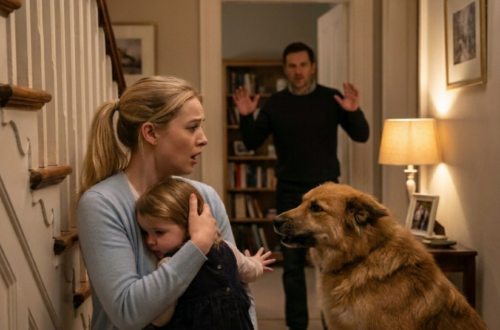
“This needs to be peaceful,” she said, standing near Dad’s recliner. The blue notebook sat on the side table between us. Her suitcase was visible in the hallway because she had brought it downstairs, maybe for laundry, maybe for theater. The scene must have looked exactly like a thumbnail: me in the doorway with hospital papers, Alyssa hosting relatives beside the notebook, the suitcase near the bedroom hall like proof she had sacrificed too.
I wondered how long she had been arranging rooms.
Dad’s eyes moved from person to person. He looked overwhelmed. I went to him and touched his shoulder.
“Too much?” I asked softly.
He did not blink. His gaze shifted to Alyssa, then to the notebook.
Alyssa took that as her cue. “Daddy, we’re all here because we love you. And because some of us are worried you haven’t been allowed to speak freely.”
Elena stepped forward. “Before this continues, I need to be clear. Paul is alert right now, but he is fragile. Questions need to be simple, neutral, and limited. If he shows distress, we stop.”
Alyssa’s smile tightened. “Of course.”
Aunt Carol dabbed her eyes. Uncle Brian crossed his arms. Rachel watched me with the wary sadness of someone who had already forgiven herself for believing the worst.
Alyssa picked up the blue notebook.
My pulse kicked once, hard.
“I know this is uncomfortable,” she said. “But we can’t ignore what Megan wrote. Dad’s been afraid she would change the will or keep people away until he signed papers. I found her own note saying no visitors before signing is settled.”
She opened to the page she had marked. This time, she did not use the cropped printout. She held the notebook itself, perhaps thinking the physical object made her accusation stronger. Perhaps thinking I would lunge for it and prove her point. Perhaps thinking no one would read beyond the line she had trained them to see.
“Read the full page,” I said.
My voice surprised me. It was calm.
Alyssa looked up. “What?”
“Read the full page.”
The room shifted. Aunt Carol lowered her tissue. Elena looked at me, then at Dad. Dad’s fingers moved against the blanket.
Alyssa gave a small laugh. “Megan, don’t perform.”
“You brought the notebook,” I said. “Read the entry.”
She looked down. For the first time, uncertainty crossed her face. It was brief, but I saw it. She had read enough to crop. She had not prepared to read context aloud in a room where people could hear dates, times, and Dad’s own clarifications.
“I can read it,” Elena said.
Alyssa held the notebook closer. “This is family.”
“It’s my handwriting,” I said. “And Dad’s medical recordkeeping. If you’re using it to accuse me, everyone gets the full page.”
Uncle Brian cleared his throat. “That seems fair.”
Alyssa shot him a look so quick most people missed it. I did not.
She began reading, her voice thinner than before. “March 16. Dad nauseated after morning meds. Attorney appointment rescheduled. No signing today. Dad upset by repeated questions about paperwork.”
She stopped.
“Keep going,” I said.
Her jaw tightened. “Dad said, quote, no visitors before signing is settled.”
Aunt Carol inhaled.
“Keep going,” Elena said gently.
Alyssa’s eyes moved over the next lines. Color rose in her cheeks. “Clarified after water and rest: he means no visitors asking about signing; wants quiet. Elena agrees limit stimulation before sleep.”
No one spoke.
The cropped sentence had been a blade. The full entry was a bandage pulled back to show who had made the wound.
Alyssa closed the notebook. “That doesn’t change the pattern.”
“You’re right,” I said.
I stepped forward, and this time no one blocked me. I did not take the notebook from her. I took the manila envelope from my hospital folder and placed it on the coffee table. Copies slid out in a neat stack.
“There is a pattern.”
Alyssa stared at the pages.
I turned to Aunt Carol first, because she had been the easiest for Alyssa to frighten and the hardest for me to stop loving. “You asked me yesterday whether I was too tired to see things clearly. I am tired. I’m exhausted in ways I don’t know how to explain. But I saw enough.”
Then I looked at Dad. His eyes were on me, wet and fierce.
I started with the checkbook. Not dramatically. Not with a speech. I read dates, times, and observations. Checkbook moved from top drawer to desk. Alyssa asked where it was before I told anyone it had been moved. Den smelled like her lotion. Dad asleep during the time she claimed he requested help with bills.
Alyssa laughed once. “This is obsessive.”
“It’s caregiving,” Elena said.
The room went quiet again.
I continued. Fire box mentioned by Alyssa to Uncle Brian before I had ever told her where it was. Closet door found open after she spent thirty-two minutes upstairs. Fire box shifted on shelf. Dad wrote closet in black pen and underlined it hard enough to tear the page.
I turned the copied page so they could see.
Aunt Carol leaned forward despite herself. The black ink looked different from mine, heavier and broken by tremor. Dad’s handwriting had once been square and orderly. Now it looked like it had crawled out of him on its hands and knees.
“That’s Paul’s writing,” Mrs. Donnelly whispered.
Alyssa’s face hardened. “He was confused.”
Elena looked at her. “He was frustrated. That is not the same thing.”
I turned another page.
A knows box.
The sentence sat there in black ink beneath my blue medication notes. Four words. No ornament. No accusation from me. Dad had written them himself.
Alyssa’s eyes filled again, but this time the tears did not know where to go.
“You coached him,” she said.
There it was, the only bridge left.
I had known she might say it. I had practiced hearing it without flinching. It still hurt. To be accused of using the man I had bathed and lifted and sung to when pain made him afraid of the dark, by the sister who had searched his room while wearing his sweatshirt, was a cruelty too intimate to answer quickly.
So I let the silence answer first.
Then Elena opened her tablet. “I need to add something. During my visit on March 27, I assessed Paul’s orientation and communication. He was able to answer yes and no reliably with blinks. I asked whether he felt safe with Megan. He indicated yes. I asked whether anyone was pressuring him about papers or the house. He indicated yes. I asked whether Megan was pressuring him. He indicated no twice. I asked whether Alyssa was pressuring him. He indicated yes.”
Alyssa turned white.
Aunt Carol whispered, “Alyssa?”
“She’s lying,” Alyssa said, but her voice broke on it.
Elena did not react. “My visit notes were entered that day.”
Rachel picked up the copied pages with shaking hands. “Why didn’t you tell us?” she asked me.
I almost laughed. Not because it was funny, but because the question was so human and so unfair. “I tried telling you smaller truths. No one wanted them.”
Dad made a sound from the bed.
Everyone turned.
His hand lifted, trembling, toward the notebook. Alyssa still held it. For a second, she looked as if she might refuse him in front of all of us. Then Uncle Brian reached out and took it from her, not roughly, but firmly enough that her fingers had to open.
He placed it on Dad’s blanket.
I gave Dad the black pen.
“No,” Alyssa said softly.
It was the first honest word she had said all day.
Dad’s hand shook so violently I had to steady the notebook, but I did not guide the pen. Elena watched closely. Everyone watched. Dad dragged the tip across the page in slow, broken strokes. It took a long time. Long enough for rain to start ticking against the window again. Long enough for Alyssa’s tears to dry on her cheeks.
When he finished, the words were barely legible.
Meg stayed. Lyss pushed.
No one moved.
Dad closed his eyes, exhausted, but his hand stayed on the notebook. I covered it with mine. In that moment, I did not feel victorious. I felt the terrible cost of being believed too late. The truth had entered the room, clear and undeniable, but it had not given Dad back his strength. It had not erased the nights I had spent wondering whether love counted if no one applauded it. It had not made my sister someone else.
Alyssa sat down as if her knees had failed.
Aunt Carol began crying for real then, not the delicate tears of discomfort but the messy grief of a woman understanding she had helped corner the wrong person. Uncle Brian took off his glasses and rubbed his face. Rachel whispered my name, but I could not look at her yet.
Elena touched Dad’s wrist. “He needs rest now.”
This time, everyone listened.
They left the room one by one. Alyssa stayed until Elena looked at her and said, “Now.” Then my sister stood. She did not apologize. Not then. Maybe she could not. Maybe apology would have required stepping out of the story where she was the worried daughter and into the one where she had become exactly what she claimed to fear.
At the doorway, she turned to me.
“You always make me look selfish,” she said.
I looked at her for a long moment. She was still beautiful. Still my sister. Still the person Dad had called his beautiful girl when he had enough breath to give names like gifts. I could see the child in her who had learned that being adored felt safer than being useful. I could see the adult who had mistaken inheritance for proof that she mattered.
“I didn’t make you look,” I said. “You did that part.”
She flinched as if I had slapped her, then walked away.
Dad died five days later, just before dawn.
It was quieter than I expected. His breathing changed around four, becoming spaced and shallow, and Elena came because I called her even though I knew what she would say. Alyssa was in the house but not in his room. After the meeting, she had moved out of Dad’s bedroom and into a hotel, then returned during the day with red eyes and careful silence. She sat with him sometimes. He let her. Dying did not make him less her father.
At 5:12, he opened his eyes.
I was holding his hand. Alyssa stood on the other side of the bed, arms wrapped around herself. Elena was near the foot, quiet as a shadow. The room smelled like clean sheets, oxygen plastic, and the lavender soap Dad had used for years before candles became too much for his lungs.
Dad looked at Alyssa first.
His fingers moved. I thought he wanted the notebook, but he shook his head faintly. Alyssa leaned closer, crying without sound.
“Daddy,” she whispered.
His mouth moved. We had to bend close to hear him.
“Be kind,” he breathed.
Alyssa covered her face.
Then he looked at me. His eyes were tired, but clear. For months, I had wanted him to say something that would make the work visible. Thank you. I saw you. You were enough. Something I could carry like a certificate through the rooms where my family doubted me. But Dad had never been good at ceremonial words. He fixed gutters. He logged oil changes. He showed love by noticing whether your tire tread was low.
His thumb pressed once against my palm.
Wait.
I waited.
He breathed in, barely. “Home,” he whispered.
“I know,” I said.
His eyes softened. A minute later, he was gone.
The house after death is not empty right away. It is too full. Full of medication that suddenly has no purpose. Full of cups and blankets and instruction sheets. Full of relatives speaking softly in doorways because volume feels disrespectful but silence feels worse. Full of the outline of the person in every place they are not.
For two days, I moved through it like someone underwater.
Alyssa did not challenge me again. Not directly. The truth in the notebook had changed the air, and even people who wanted forgiveness quickly understood they could not rush me into providing it. Aunt Carol apologized in the kitchen with both hands wrapped around a mug she had not drunk from. Uncle Brian said he should have asked more questions. Rachel cried and admitted she had shared Alyssa’s cropped photo with cousins because she thought she was protecting Dad.
I accepted their apologies the way you accept flowers at a funeral. Politely, with no promise that they can fix anything.
The will, when read weeks later, was not dramatic. Dad had not left everything to me. He had not disinherited Alyssa. He had done what he had apparently intended before illness sharpened everyone’s worst instincts: divided his savings equally, left Mom’s jewelry to be shared by agreement or sold if we could not agree, and placed the house in a trust that allowed me to live there for two years before deciding whether to buy Alyssa’s share or sell.
It was practical. Dad had always been practical.
Alyssa cried when she heard it, but not loudly. She looked smaller in the attorney’s conference room, dressed in black wool, her hair less perfect than usual. I wondered whether she was mourning Dad, the house, the version of herself she had wanted us to see, or all of it tangled together. When the attorney asked if there were questions, she shook her head.
Outside, in the parking lot, she stopped me.
“I thought you were going to take it,” she said.
I looked at the cars glittering under the cold sun. “I know.”
“Everyone always trusted you with the hard things.”
That sentence stayed with me because it was the closest she came to opening the real door. Not an apology. Not an excuse. A glimpse. In Alyssa’s mind, trust had become another inheritance I had received unfairly. She had not seen the cost of it, or she had seen it and still wanted the shine without the weight.
“I didn’t want the hard things,” I said.
She nodded, but I did not know whether she understood.
I kept the blue notebook.
For a while, I could not open it. I put it in Dad’s desk, top drawer, beneath the yellow envelopes where the checkbook had belonged. The house became quiet in stages. First the oxygen machine was picked up. Then the hospital bed. Then the casseroles stopped appearing. The dining room chandelier stayed off. I threw away the candle Alyssa had lit that first night and washed the vase before putting Mom’s tulips, silk ones from a storage bin, back in the cabinet.
Spring came slowly.
One morning in May, I sat in Dad’s recliner with coffee and opened the notebook from the beginning. The first pages were almost cheerful in their order. Dosage charts. Questions for the oncologist. Foods that sounded good. Dad wants chili when appetite returns, I had written in September, as if appetite were a neighbor who might stop by again.
As the pages went on, the handwriting changed. Mine got messier. Dad’s black notes appeared in the margins. Too sweet. Call plumber. Ask M sleep? That one undid me. In the middle of his pain, he had been worried that I was not sleeping. I pressed my hand to the page and cried harder than I had cried at the funeral.
Then I reached the final entry.
Meg stayed. Lyss pushed.
For weeks, I had thought of those words as proof. Evidence. The sentence that saved me from my sister’s accusation. But sitting alone in the quiet house, I saw something else in them. They were not only about blame. They were Dad doing what he had always done: making a record because memory lies, because grief edits, because families crop the parts that make them uncomfortable.
Ink has manners.
I did not need to beg anyone to understand anymore. Not Aunt Carol, not Rachel, not Uncle Brian, not even Alyssa. The truth of my care was not clean or saintly. I had been resentful. I had snapped. I had written bitter notes in my head that never made it to the page. I had wanted help and recognition and sleep. I had loved my father imperfectly, daily, practically, with alarms set for midnight and clean socks warmed in my hands.
That was enough.
Alyssa and I did not become close after that. Stories like ours do not always end with sisters holding hands over old wounds while sunlight pours through forgiving windows. She came by once in June to pick up a box of Dad’s college books and stood awkwardly in the hall where her suitcase had been. She looked toward the living room, toward the recliner, toward the side table where the notebook no longer sat.
“I’m sorry,” she said.
It was quiet. Unpolished. Late.
I believed that she meant it in that moment. I also knew meaning it did not erase what she had done. Both things could stand in the same room. Caregiving had taught me that too: love and anger, duty and resentment, truth and mercy, all breathing the same stale air at three in the morning.
“Thank you,” I said.
She waited, maybe for more. Forgiveness. Reassurance. A way back to being the older sister whose mistakes became everyone else’s lesson in compassion. I did not give it to her. I did not punish her either. I simply stood there, tired and steady, and let the silence remain honest.
After she left, I went upstairs to Dad’s bedroom.
For months, I had avoided it except to clean. The bed was made. The closet door was closed. Mom’s cedar chest sat under the window, dusty in the light. I opened the closet and saw the empty shelf where the fire box had been moved to the attorney’s office. Then I took Dad’s old college sweatshirt from the hanger where Alyssa had left it and held it against my face.
It smelled faintly of cedar and laundry soap.
I did not move into the main bedroom. I turned it into a quiet room instead, with Dad’s reading chair, Mom’s lamp, and the bird feeder visible through the window once I filled it again. Sometimes I sat there in the evenings and listened to the ordinary sounds of the house settling. Pipes. Wind. A neighbor’s dog. My own breathing, no longer synced to the baby monitor.
The blue notebook stayed in the desk downstairs.
Not hidden. Not displayed. Just kept.
When people visited, some of them still looked at me with that softened guilt, like they wanted me to absolve them so dinner could taste normal. I learned to let them carry their own discomfort. I had carried enough. If they mentioned how strong I had been, I said, “I was tired.” If they said Dad was lucky, I said, “He was loved.” If they said family gets complicated around death, I said nothing, because complication was too easy a word for what happened when one daughter tried to turn another daughter’s care into a crime.
By the end of summer, the hydrangeas along the fence bloomed blue.
Dad had planted them after Mom died because she had wanted color in the yard and he did not know what else to do with his hands. That year, they came in heavy and bright, leaning over the grass like they had been waiting for someone to notice. I cut a few stems and put them in the Easter vase on the dining table.
Then I turned on the chandelier.
The light filled the room without apology. It touched the polished wood, the old chairs, the faint scratch on the wall from Dad’s walker, the doorway where I had once stood with hospital papers while my sister held my notebook like a weapon. For a second, I could see all of it at once. The accusation. The fear. The ink. The final blink of truth.
I stood there until the room stopped feeling like a trial.
Then I sat down at the table, opened a fresh notebook, and wrote the date at the top of the first page. Not because I needed evidence. Not because anyone was coming to take the story from me. Because Dad was right about one thing, and I wanted to keep it in my own hand.
Memory lies.
Ink has manners.


![[FILL STORY] The Serpent in the Family Tree](https://health.pricable.com/wp-content/uploads/2026/06/tai-xuong-3-500x330.png)