The Magical Movie That Introduced a Generation to a Hidden World
Some movies begin with an explosion.
Some introduce their hero in the middle of an adventure.
This one begins with a boy who does not even know who he really is.
He lives under the stairs.
His relatives treat him as an inconvenience.
Then strange letters begin arriving.
And suddenly, everything changes.
An enormous man appears at the door.
The boy learns that his parents were not ordinary people.
He learns that magic is real.
And then comes the revelation that would become one of the most recognizable invitations in modern fantasy cinema:
he is going to Hogwarts.
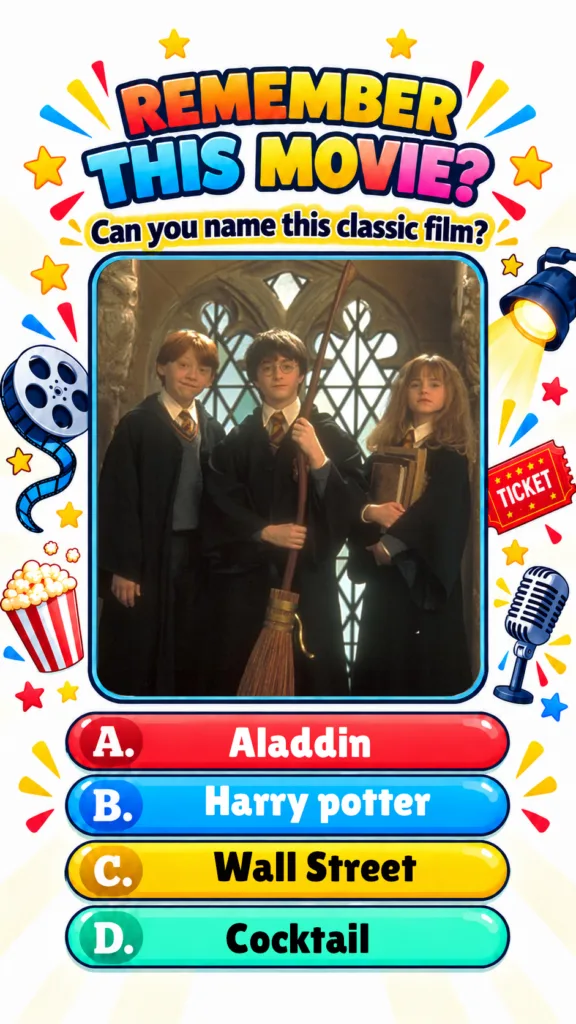
If you selected:
B — Harry Potter
you got it right.
More specifically, the image comes from the world introduced in:
Harry Potter and the Sorcerer’s Stone
released in the United States on November 16, 2001.
Outside the United States, the film is widely known as Harry Potter and the Philosopher’s Stone.
Directed by Chris Columbus, the movie introduced audiences to Daniel Radcliffe as Harry Potter, Rupert Grint as Ron Weasley and Emma Watson as Hermione Granger. It runs about 2 hours and 32 minutes and carries a PG rating. Rotten Tomatoes
For millions of viewers, this was the moment Hogwarts stopped existing only on the page.
It became a place they could see.
Before Hogwarts
Harry Potter begins the story living with the Dursleys.
They are his aunt, uncle and cousin.
And they have spent years hiding the truth from him.
Harry believes his parents died in an ordinary accident.
He does not know why strange things sometimes happen around him.
He does not understand why he feels so different.
Then the letters begin arriving.
At first, the Dursleys attempt to stop Harry from reading them.
More letters appear.
Then more.
Eventually, hiding the truth becomes impossible.
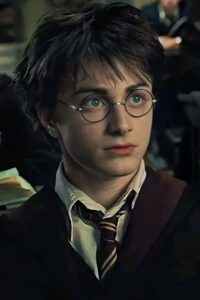
Hagrid Changes Everything
The person who finally explains Harry’s past is:
Rubeus Hagrid
played by Robbie Coltrane.
Hagrid tells Harry that he is:
a wizard.
Harry’s parents, James and Lily Potter, were magical too.
And Harry has been accepted into:
Hogwarts School of Witchcraft and Wizardry.
That information changes the entire meaning of Harry’s childhood.
The strange events were not accidents.
Harry belongs to a world he never knew existed.
Diagon Alley
One of the great pleasures of the first movie is watching Harry discover the magical world at the same time as the audience.
Hagrid takes him to:
Diagon Alley.
Suddenly we see:
wand shops,
owls,
robes,
magical banks,
books,
potions,
and witches and wizards moving through an entire hidden society.
The sequence is important because Chris Columbus does not rush through it.
Harry is allowed to stare.
And so are we.
That sense of discovery is one of the reasons the first movie still feels different from many of the darker sequels.
Ollivanders and the Wand
Then Harry visits:
Ollivanders.
The mysterious wandmaker helps him find the wand that chooses him.
The moment also introduces another piece of Harry’s past.
The wand that responds to Harry contains a connection to the wand used by the wizard responsible for killing his parents.
That name is:
Voldemort.
Even before Harry reaches Hogwarts, the movie begins connecting his future with the darkest event of his childhood.
Platform 9¾
Harry eventually arrives at King’s Cross Station.
There is only one problem.
His ticket says:
Platform 9¾.
There is no obvious platform by that number.
Then Harry notices the Weasley family.
He follows their example.
And runs directly toward what appears to be a solid barrier.
Instead of crashing into it, he passes through.
On the other side waits:
the Hogwarts Express.
For many fans, this remains one of the most nostalgic images in the entire series.
The red train.
The steam.
The luggage.
The owls.
And the feeling that an entirely different life is about to begin.
Harry Meets Ron
On the train, Harry meets:
Ron Weasley
played by Rupert Grint.
Ron comes from a large wizarding family.
Unlike Harry, magic is completely normal to him.
But Harry has something Ron does not:
fame.
Almost everyone in the magical world knows the name Harry Potter.
Harry himself is the person who understands his fame the least.
Their friendship begins almost immediately.
And it soon expands to include someone very different from either of them.
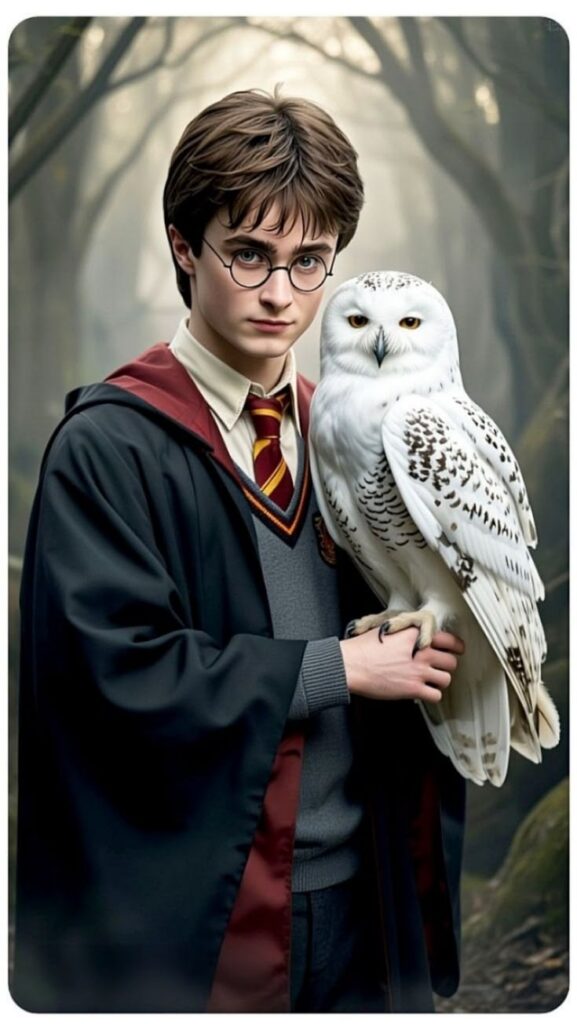
Hermione Granger
Emma Watson plays Hermione Granger.
When Hermione first appears, she seems:
confident,
highly intelligent,
extremely prepared,
and sometimes slightly irritating to the two boys.
She has read the books.
She knows the spells.
She knows the rules.
Harry and Ron mostly do not.
That contrast becomes an essential part of the trio.
Harry has instinct.
Ron understands wizarding culture.
Hermione has knowledge.
Together, they become much stronger than any of them would be individually.
The First Look at Hogwarts
Then comes the image that defined the entire franchise.
The first-year students cross the dark water in small boats.
They look upward.
And there it is:
Hogwarts.
Towers.
Windows.
Stone walls.
Lights glowing against the night sky.
For readers who had imagined the school for years, this was the moment the book world became physical.
And for people who had never read the novels, Hogwarts immediately became one of cinema’s most recognizable fantasy locations.
The Sorting Hat
Inside the Great Hall, the students are divided into four houses.
Gryffindor
Slytherin
Ravenclaw
Hufflepuff
Harry is nervous when the Sorting Hat considers where he belongs.
He desperately does not want:
Slytherin.
Instead, he becomes a member of:
Gryffindor.
Ron and Hermione join him there.
The foundation of the trio is complete.
Professor Dumbledore
The Hogwarts headmaster is:
Albus Dumbledore
played in the first films by Richard Harris.
Dumbledore immediately feels different from the other adults Harry has known.
He is powerful.
But gentle.
Mysterious.
And strangely aware that Harry’s arrival at Hogwarts may be part of something much larger.
He becomes one of the central figures in Harry’s life.
Professor McGonagall
Maggie Smith plays Professor Minerva McGonagall.
She is strict.
Disciplined.
And unmistakably authoritative.
But beneath that stern exterior is someone who cares deeply about her students.
Maggie Smith’s performance became one of the most recognizable adult characters throughout the series.
Professor Snape
Then there is:
Professor Severus Snape
played by Alan Rickman.
From Harry’s perspective, Snape seems immediately suspicious.
He watches Harry.
He speaks coldly.
And Harry becomes convinced that Snape may be connected to the strange events happening at Hogwarts.
One of the strengths of the first film is how effectively it encourages the audience to see the mystery through Harry’s limited understanding.
Things are not always what they appear to be.
Quidditch
Hogwarts also introduces Harry to:
Quidditch.
A sport played on flying broomsticks.
Harry quickly discovers that he has an exceptional natural ability to fly.
He becomes Gryffindor’s:
Seeker.
The Quidditch sequences were among the movie’s biggest visual challenges because they needed to make actors flying through a fantasy stadium believable to audiences in 2001.
But emotionally, Quidditch also gives Harry something important.
For perhaps the first time in his life, he discovers something he is naturally good at.
The Troll and the Birth of the Trio
Harry, Ron and Hermione do not instantly become inseparable friends.
The turning point is the encounter with a troll inside Hogwarts.
Harry and Ron realize Hermione is in danger.
They go after her.
What follows is chaotic, frightening and sometimes funny.
But afterward, Hermione protects the boys by taking responsibility for what happened.
From that point forward, the relationship changes.
The three children stop simply being classmates.
They become:
Harry, Ron and Hermione.
One of cinema’s most recognizable friendship groups is born.
The Mystery Inside Hogwarts
As the year continues, the trio becomes convinced that someone is attempting to steal a mysterious object hidden within Hogwarts.
That object is:
the Sorcerer’s Stone.
The Stone possesses extraordinary powers.
It can help produce the Elixir of Life.
Harry suspects Snape.
But the truth is more complicated.
The mystery eventually leads Harry, Ron and Hermione through a series of magical obstacles.
Each child contributes something different.
Hermione uses intelligence.
Ron uses strategy.
Harry ultimately has to continue alone.
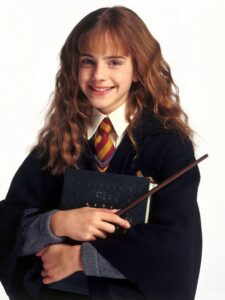
The Wizard Chess Sequence
Ron’s major moment arrives with:
Wizard Chess.
The pieces are life-sized.
And when they capture each other, they do not simply disappear.
They smash one another apart.
Ron realizes that winning requires sacrifice.
He deliberately allows himself to be taken so Harry can continue.
For a character often used for humor, the sequence shows his courage early in the franchise.
Hermione’s Strength
Hermione repeatedly proves that knowledge is not simply a school obsession.
It saves them.
Her ability to remember spells, understand magical problems and think logically allows the trio to continue through situations the boys could not solve alone.
The first movie establishes a pattern that continues throughout the series:
when everything goes wrong,
Harry and Ron frequently need Hermione.
The Truth Behind the Stone
Harry eventually discovers that the person involved is not Snape.
Instead, the real threat comes through:
Professor Quirrell
played by Ian Hart.
And behind him is something much darker:
Voldemort.
The villain who killed Harry’s parents is not fully gone.
The first movie therefore ends by showing that Harry’s story is only beginning.
He survived Voldemort once as a baby.
Now their paths have crossed again.
The Mirror of Erised
One of the most emotional elements of the movie has nothing to do with action.
Harry discovers:
the Mirror of Erised.
The mirror shows a person what they desire most deeply.
Harry looks into it.
And sees:
his parents.
For a child who never truly knew them, the image is overwhelming.
The sequence adds emotional depth to the fantasy.
Harry does not simply want:
magic,
power,
or fame.
He wants a family.
That desire sits underneath much of his character throughout the series.
Daniel Radcliffe as Harry Potter
When the movie arrived, Daniel Radcliffe was still a child.
Yet he had been given responsibility for carrying what Warner Bros. hoped could become a huge fantasy franchise.
Harry needed to feel:
ordinary enough for children to identify with,
but extraordinary enough to anchor the story.
Radcliffe’s performance in the first film is appropriately restrained.
Harry is discovering almost everything for the first time.
Much of the movie depends on his reactions.
A train.
A castle.
A moving staircase.
Ghosts.
Quidditch.
Magic.
Through Harry’s eyes, the audience enters the world.
Rupert Grint as Ron Weasley
Rupert Grint immediately brought humor to Ron.
But Ron is not simply comic relief.
He gives Harry something he has never really had before:
a normal friendship.
Harry is famous in the wizarding world.
Ron quickly stops treating him like a celebrity.
He becomes simply:
Harry’s friend.
That relationship becomes one of the emotional foundations of the entire franchise.
Emma Watson as Hermione
Emma Watson’s Hermione is immediately recognizable.
Precise speech.
Confidence.
Books.
Rules.
And an obvious belief that preparation can solve almost anything.
Yet over the course of the film, Hermione learns that friendship sometimes requires breaking those rules.
That development turns the character from the smartest student in the room into something much more important.
A loyal friend.
An Extraordinary Supporting Cast
The movie also surrounded its young actors with experienced British performers.
Among them were:
Richard Harris as Dumbledore, Maggie Smith as Professor McGonagall, Robbie Coltrane as Hagrid, Alan Rickman as Snape, Ian Hart as Quirrell, Julie Walters as Molly Weasley and John Hurt as Ollivander. Metacritic’s cast listing confirms the central trio and many of these major supporting roles. Metacritic
That experienced adult cast gave the fantasy world credibility around three very young leads.
John Williams and the Sound of Magic
Then there is the music.
Composer:
John Williams
created the score.
One melody in particular became inseparable from Harry Potter:
Hedwig’s Theme.
Even people who have not recently watched the films often recognize the first few notes.
The music suggests:
mystery,
wonder,
magic,
and something slightly unsettling.
The Academy nominated Williams’ score for an Oscar. Oscars
More than two decades later, that theme still instantly signals:
Harry Potter.
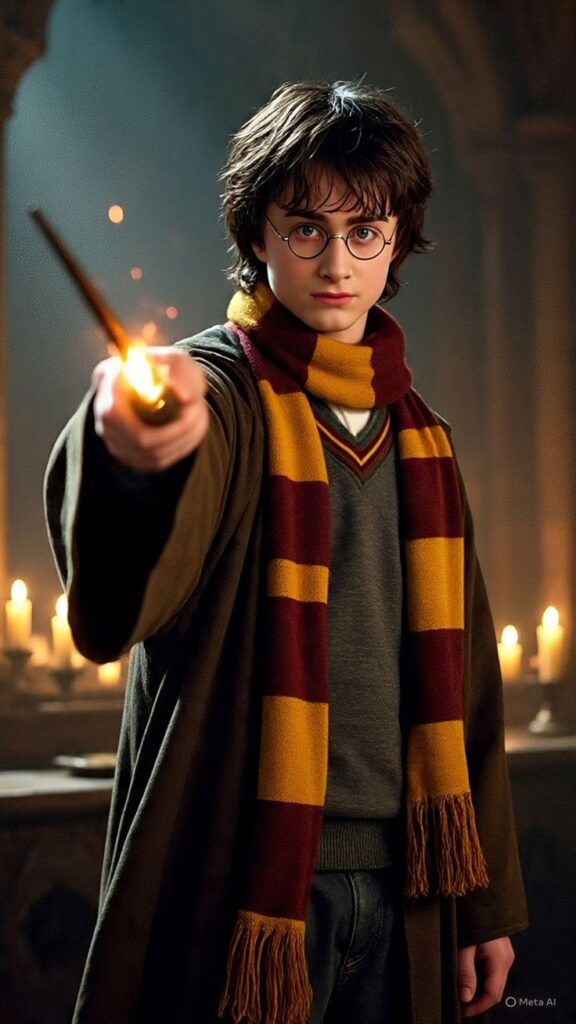
The Movie Cost About $125 Million
According to Box Office Mojo, the movie had a reported production budget of approximately:
$125 million.
That was a major investment in 2001.
Warner Bros. was not simply adapting one successful children’s book.
The studio was building:
Hogwarts,
Diagon Alley,
Quidditch,
magical creatures,
costumes,
sets,
effects,
and potentially an entire film franchise.
The gamble paid off almost immediately. Box Office Mojo
A Huge Opening Weekend
In the United States and Canada, the movie opened with approximately:
$90.3 million
over its domestic opening weekend. Box Office Mojo
For 2001, that was enormous.
The interest was not limited to readers.
The movie had become an event.
Children wanted to see Hogwarts.
Parents went with them.
Book fans wanted to know whether the screen version matched the world they had imagined.
More Than $317 Million Domestically
The original domestic release eventually earned approximately:
$317.6 million
in the United States and Canada. Box Office Mojo
That alone was more than two and a half times the reported production budget.
But the Harry Potter phenomenon was never limited to the United States.
International box office transformed the movie into something much bigger.
Nearly $975 Million in Its Original Run
Box Office Mojo currently lists the original release at approximately:
$974.8 million worldwide.
That included about:
$317.6 million domestic
and:
$657.2 million internationally. Box Office Mojo
At the time, those were blockbuster numbers on an extraordinary scale.
The Biggest Worldwide Movie of 2001
Box Office Mojo’s 2001 worldwide chart places the first Harry Potter film at:
No. 1 worldwide for 2001.
Its original worldwide gross of about $974.8 million placed it ahead of:
The Lord of the Rings: The Fellowship of the Ring,
Monsters, Inc.,
Shrek,
and Ocean’s Eleven. Box Office Mojo
That is especially remarkable because The Fellowship of the Ring was itself launching another enormous fantasy franchise in the same year.
2001 was a major year for fantasy cinema.
Harry Potter came out on top at the worldwide box office.
More Than $1 Billion After Re-Releases
The story did not end with the original theatrical run.
The film has returned to theaters through:
anniversary screenings,
IMAX presentations,
and other re-releases.
As of 2026, Box Office Mojo lists lifetime worldwide theatrical revenue at approximately:
$1.035 billion. Box Office Mojo
That means the first Harry Potter adventure eventually crossed the billion-dollar threshold more than two decades after its original release.
How Did Critics Respond?
The reviews were generally positive, though not universally enthusiastic.
Rotten Tomatoes currently lists:
80% Tomatometer
from 201 critic reviews.
Audience response sits at:
82% Popcornmeter
from more than 250,000 ratings. Rotten Tomatoes
Those numbers suggest something interesting.
This was not a case where critics rejected the movie while audiences loved it.
Both groups responded positively.
Metacritic
Metacritic gives the film:
65/100
based on 37 critic reviews, categorized as:
Generally Favorable.
Its user score currently stands at:
7.9/10. Metacritic
Again, the pattern is consistent.
The movie was well received.
But critics did have reservations.
What Critics Loved
The strongest praise generally focused on how successfully the film brought the book’s world to life.
Reviewers responded to:
the atmosphere,
the casting,
the production design,
the magical locations,
and the sheer pleasure of finally seeing Hogwarts on screen.
Metacritic’s review archive includes especially strong praise for the film’s atmosphere, imagination and faithfulness to the novel. Metacritic
For fans, that faithfulness was extremely important.
This was the first movie.
If Hogwarts did not feel right, the entire franchise could have struggled.
Instead, many visual choices made here became permanent.
What Some Critics Questioned
The movie is long.
Very long for a family film.
At approximately:
2 hours and 32 minutes
it attempts to include a huge amount of material from the novel. Metacritic
That faithfulness could also become a weakness.
Some critics felt the film sometimes behaved like an illustrated version of the book rather than a completely independent piece of cinema.
There are many:
characters,
locations,
classes,
objects,
rules,
and mysteries
to introduce.
The movie often takes its time.
But for many fans, that slow world-building later became part of its charm.
Why the First Movie Feels So Different Today
Later Harry Potter films become:
darker,
more dangerous,
and emotionally heavier.
The first film still feels like discovery.
Christmas at Hogwarts.
Moving staircases.
Chocolate Frogs.
The Sorting Hat.
Quidditch.
Magic lessons.
The Great Hall.
The Hogwarts Express.
Much of the movie is simply allowing Harry—and us—to enjoy being there.
That quality makes it especially nostalgic.
Three Academy Award Nominations
At the 2002 Academy Awards, Harry Potter and the Sorcerer’s Stone received:
3 Oscar nominations.
They were for:
Art Direction,
Costume Design,
and Original Score for John Williams. Oscars
The film did not win any of the three awards.
But the categories themselves tell us something.
The Academy recognized precisely the elements that helped make the magical world convincing:
the environments,
the clothing,
and the music.
The Production Design
Hogwarts had to feel ancient.
Not like a modern movie set with fantasy decorations.
The corridors needed history.
The Great Hall needed scale.
The classrooms needed personality.
Diagon Alley needed to look as though witches and wizards had been shopping there for generations.
The production design created a visual language that the later films could inherit.
Once audiences accepted these spaces as Hogwarts, filmmakers no longer needed to introduce them from scratch.
They felt familiar.
The Costumes
The school robes became immediately iconic.
Black robes.
House colors.
Scarves.
Ties.
Sweaters.
Even viewers who have never worn an official Harry Potter costume understand the basic visual language.
The Academy’s Costume Design nomination recognized Judianna Makovsky’s work on the film. Oscars
Those early costume decisions helped establish how audiences imagined modern cinematic wizarding-school life.
The Famous Trio
The image in your quiz is particularly effective because it captures the three characters at the beginning of everything.
Harry Potter
Daniel Radcliffe
Ron Weasley
Rupert Grint
Hermione Granger
Emma Watson
At this point they are children.
They have no idea what is coming.
No giant war.
No final confrontation.
No understanding of how complicated their lives will become.
They are simply students beginning their first year.
For viewers who later followed all eight movies, seeing them this young carries enormous nostalgia.
One Movie Became Eight
The success of the first film made it possible to continue Harry’s story on an enormous scale.
The main film series eventually included:
Harry Potter and the Chamber of Secrets
Harry Potter and the Prisoner of Azkaban
Harry Potter and the Goblet of Fire
Harry Potter and the Order of the Phoenix
Harry Potter and the Half-Blood Prince
Harry Potter and the Deathly Hallows – Part 1
Harry Potter and the Deathly Hallows – Part 2
But none of those movies could have existed in the form audiences know without the first film successfully establishing the world.
Why Chris Columbus Was the Right Director for the Beginning
Chris Columbus had previously directed family films including:
Home Alone
and:
Mrs. Doubtfire.
That background makes sense when watching the first Harry Potter movie.
He understood how to build a story around children without making the world feel completely childish.
There is humor.
Warmth.
Wonder.
But also genuine danger.
That balance allowed the series to begin in a relatively accessible place before later directors gradually darkened the tone.
Harry Potter by the Numbers
CategoryHarry Potter and the Sorcerer’s StoneU.S. ReleaseNovember 16, 2001DirectorChris ColumbusHarryDaniel RadcliffeRonRupert GrintHermioneEmma WatsonRuntime2h 32mRatingPGReported Budget~$125 millionOpening Weekend~$90.3 millionOriginal Domestic Gross~$317.6 millionOriginal Worldwide Gross~$974.8 millionLifetime Worldwide Gross~$1.035 billionRotten Tomatoes80%Audience Score82%Metacritic65/100Oscar Nominations3
The box-office figures reflect Box Office Mojo’s current listings through 2026; later re-releases explain why the lifetime figure is now above the original theatrical total. Box Office Mojo
Why American Audiences Remember It
For many American viewers who were children or teenagers in 2001, Harry Potter became part of growing up.
The books were already hugely popular.
But the movie added:
faces,
voices,
music,
architecture,
costumes,
and physical locations.
After the movie, it became increasingly difficult to imagine Harry without Daniel Radcliffe.
Ron without Rupert Grint.
Hermione without Emma Watson.
Hagrid without Robbie Coltrane.
Snape without Alan Rickman.
And Hogwarts without John Williams’ music somewhere in the background.
The Power of Nostalgia
That makes this particular movie excellent for your “Remember This Movie?” format.
You do not even need to show a giant fantasy battle.
A simple image of:
Harry,
Ron,
and Hermione
standing together in their school robes can immediately trigger memories.
The glasses.
The red hair.
The broom.
The books.
The robes.
The castle architecture.
Someone who watched the movies as a child may recognize the film before consciously reading any of the answer choices.
That is exactly the kind of nostalgia response your quiz format is designed to create.
More Than a Children’s Movie
On paper, the film is a fantasy adventure aimed at families.
But its emotional structure goes deeper.
Harry begins the story feeling unwanted.
At Hogwarts, he discovers:
friends,
mentors,
a history,
talent,
and somewhere he belongs.
That may explain why the fantasy connected so deeply with audiences.
The magic is exciting.
But underneath it is a very simple wish:
to find the place where you belong.
Final Thought
So if you selected:
B — Harry Potter
you recognized the movie that opened one of the biggest fantasy franchises in modern cinema.
Harry Potter and the Sorcerer’s Stone was produced for approximately:
$125 million
and earned almost:
$975 million worldwide during its original theatrical run.
After subsequent theatrical re-releases, its lifetime worldwide total has climbed to roughly:
$1.035 billion. Box Office Mojo
It became the No. 1 worldwide movie of 2001. Box Office Mojo
It earned three Academy Award nominations. Oscars
And critics and audiences still respond positively more than two decades later, with 80% from critics and 82% from audiences on Rotten Tomatoes. Rotten Tomatoes
But the numbers are only part of its legacy.