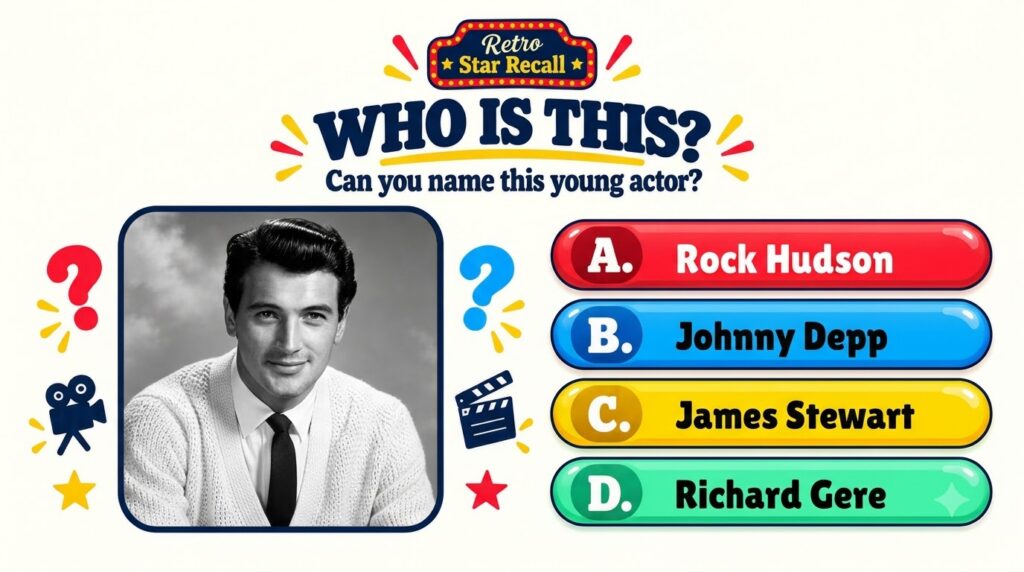
Step back in time with our ‘Retro Star Recall’ quiz! If you participated, you saw a dashing young actor from Hollywood’s Golden Age and were asked to put your classic movie knowledge to the test. The answer to our recent quiz was indeed Rock Hudson, and in this article, we’ll dive deeper into the life and career of this unforgettable star.
Some actors become famous because of a single unforgettable role. Others become symbols of an entire era. Rock Hudson belonged to the second group. Tall, handsome, calm, and effortlessly charismatic, Hudson became one of the defining leading men of classic Hollywood. During the 1950s and 1960s, he appeared in romantic dramas, epic films, comedies, and television, building a career that made him one of the most recognizable American stars of his generation.
The young man in today’s quiz, Rock Hudson, is captured in a photograph that perfectly illustrates why Hollywood studios saw star potential in him so quickly. His classic good looks and imposing presence were undeniable, setting the stage for a remarkable career.
From Humble Beginnings to Hollywood Star
Rock Hudson was born Roy Harold Scherer Jr. on November 17, 1925, in Winnetka, Illinois. His childhood was not especially easy, and he did not grow up surrounded by the entertainment industry. Before becoming an actor, he served in the United States Navy during World War II, a common experience for many men of his generation who would later shape American culture.
After the war, like so many aspiring talents, he moved to California with dreams of entering the film business. At first, success did not come easily. Hudson reportedly struggled with acting, famously needing 38 takes to deliver a single line in his first film, Fighter Squadron (1948).
However, his striking good looks caught the eye of Hollywood agent Henry Willson, who specialized in transforming attractive young men into stars. Willson gave him the name ‘Rock Hudson’—’Rock’ for the Rock of Gibraltar and ‘Hudson’ for the Hudson River—a name that perfectly encapsulated the rugged yet sophisticated persona he would project on screen. Willson’s relentless promotion and a rigorous training regimen in acting, singing, dancing, and even riding helped shape the raw talent into a polished star.
The Golden Age Icon: Versatility and Charisma
The 1950s truly belonged to Rock Hudson. He quickly rose through the ranks at Universal-International, first gaining significant attention in melodramas directed by Douglas Sirk, such as Magnificent Obsession (1954) and All That Heaven Allows (1955). These films cemented his image as a sensitive, strong leading man capable of intense romantic appeal.
His career took an even bigger leap with epic films like Giant (1956), where he starred alongside Elizabeth Taylor and James Dean. This role earned him his only Academy Award nomination for Best Actor and proved his dramatic chops on a grand scale. But it was his pivot to romantic comedies in the late 1950s and early 1960s that truly endeared him to audiences worldwide.
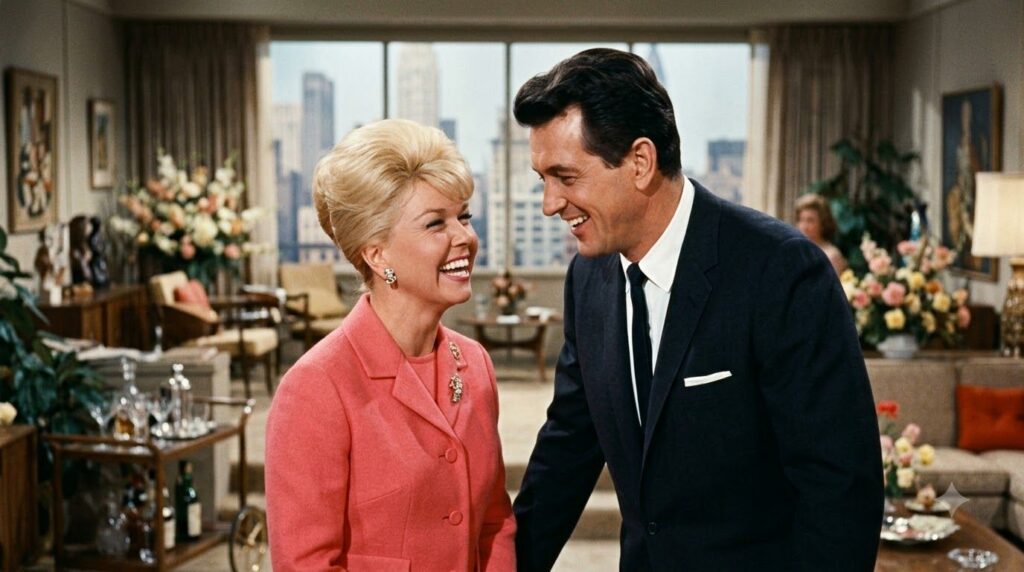
His teaming with Doris Day in films like Pillow Talk (1959), Lover Come Back (1961), and Send Me No Flowers (1964) created one of Hollywood’s most successful and beloved comedic pairings. Their on-screen banter and undeniable chemistry made these films box office gold, showcasing Hudson’s underrated comedic timing and charm. He effortlessly transitioned between serious dramatic roles and lighthearted romantic leads, a testament to his versatility as an actor.
Beyond the Big Screen: Television and Legacy
As the Golden Age of Hollywood began to wane and audience tastes shifted, Hudson successfully transitioned to television in the 1970s. He starred in the popular detective series McMillan & Wife (1971-1977), proving his appeal could translate from the cinema to the small screen. This series further broadened his fan base and kept him a prominent figure in entertainment for another decade.
Rock Hudson’s legacy extends beyond his filmography. His image as the quintessential Hollywood leading man, with his classic looks and commanding screen presence, remains iconic. He represented a certain ideal of masculinity and charm that resonated deeply with audiences for decades. His career spanned melodramas, epics, romantic comedies, and television, demonstrating a remarkable adaptability that few stars achieve.
Even after his passing in 1985, his contributions to film and television are remembered, and he continues to be celebrated as a significant figure in entertainment history. Rock Hudson’s story is a powerful reminder of the enduring magic of Hollywood’s Golden Age and the unforgettable stars who shaped it.
Share Your Memories!
What’s your favorite Rock Hudson movie? Do you remember watching him on TV? Share your nostalgic thoughts and memories in the comments below! We love hearing from fellow fans of classic Hollywood.