Chapter 1: The Man in the Rain
Rain had been falling since morning when Emma Carter began her shift at Bellwood Café. It was a small restaurant tucked between expensive shops in the heart of the city. Emma had worked there for nearly two years, earning just enough to pay the rent on her tiny apartment, a constant dance with overdue notices.
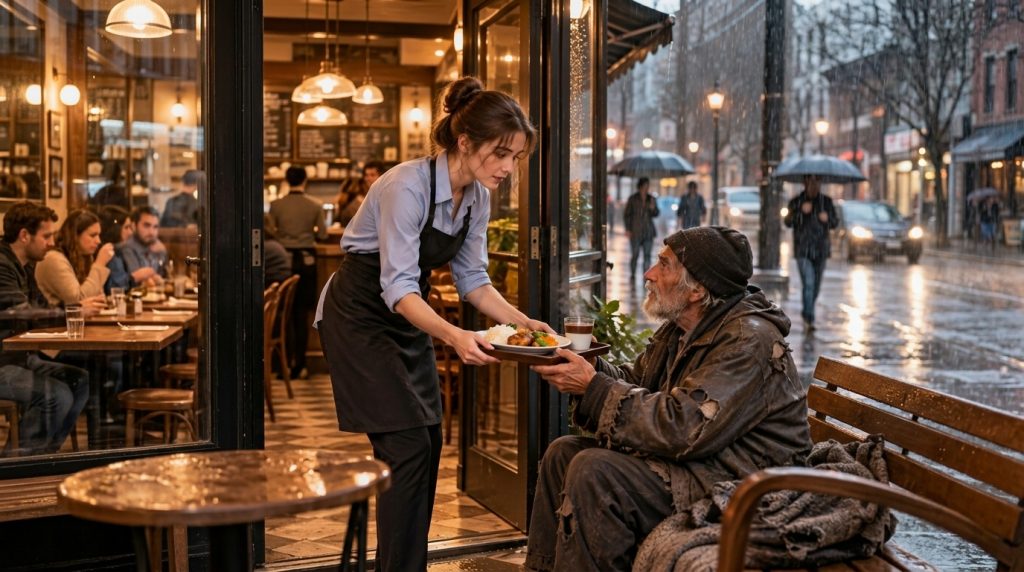
Around noon, the lunchtime rush was in full swing, but Emma’s attention kept drifting to the window. An elderly man sat outside beneath the narrow awning, hunched against the relentless downpour. His coat was torn, his gray beard was soaked, and his hands trembled from the cold, clutched around nothing.
Customers walked past him without a second glance, their faces shielded by umbrellas and indifference. Emma watched him through the window for several minutes, a familiar ache settling in her chest. She knew that look of deep-seated weariness and quiet desperation.
Finally, she picked up the lunch the kitchen had prepared for her, a simple but hearty stew with a side of warm bread, and walked outside. Her coworker, Sarah, called after her, a hint of exasperation in her voice. “Emma, that’s your lunch!”
“I know,” Emma replied, her voice soft but firm, pushing open the glass door into the cool, damp air. She approached the man cautiously, placing the tray gently in front of him on the small bench. “Here.”
He flinched, startled, then stared at the steaming food with wide, disbelieving eyes. His gaze flickered from the meal to Emma’s face, a mixture of suspicion and a raw, almost childlike hunger warring in their depths. “For me? I didn’t ask you for anything.”
“I know,” Emma said again, a gentle smile touching her lips. The rain plastered strands of hair to her forehead, but she didn’t mind. “You don’t have to explain anything.”
The old man’s expression softened, a subtle shift that spoke volumes. It had been years since anyone had spoken to him without pity, suspicion, or demands. His eyes, though weary, held a surprising depth of intelligence. “Why are you helping me?” he rasped, his voice gravelly from disuse.
Emma hesitated, looking out at the glistening street. “Because being hungry shouldn’t require an explanation,” she answered simply. She didn’t wait for a response, just offered a small nod and turned to go back inside, leaving him alone with the unexpected warmth of the meal and a flicker of something he hadn’t felt in a very long time: hope.
Chapter 2: A Familiar Shadow
For the next few days, the old man became a silent fixture. He didn’t sit directly outside Bellwood Café, but a block away, near the entrance to the park, always within Emma’s line of sight through the wide front window. He never approached, never asked, just sat on a different bench, observing the world. Emma noticed. She always noticed.
Sometimes, when the café was quiet, she’d make an extra coffee, or wrap up a leftover pastry, then discreetly take her break near his bench. She wouldn’t offer it directly, but leave it on the edge of the bench, pretending to tie her shoe or check her phone. He would wait until she was gone, then slowly reach for it, a subtle nod of acknowledgement in her direction that no one else ever saw.
Sarah, Emma’s coworker, was less subtle. “Still feeding the stray, Emma?” she’d ask, her tone a mix of amusement and genuine bewilderment. “Mr. Harrison won’t like it if customers start complaining about vagrants. It’s bad for business.”
Emma just shrugged, her gaze softening as she glanced out the window. “He’s not bothering anyone, Sarah. He’s just… there.” Mr. Harrison, the café owner, hadn’t explicitly said anything, but Emma felt his watchful eyes. She knew her job was precarious enough without inviting trouble.
One afternoon, as Emma left a forgotten newspaper on the bench near him, the old man surprised her. “Thank you,” he said, his voice clearer than she expected. He wasn’t looking at her, but at the headlines. “The market is quite volatile this week.”
Emma paused, surprised. “You… you follow the market?”
He gave a dry chuckle, a sound that held both bitterness and a ghost of something sophisticated. “I used to follow more than that. Before the fall.” He didn’t elaborate, just returned his gaze to the paper, but Emma caught a glimpse of a past life in his eyes—a life of intellect, perhaps even success. It made her wonder, made her heart ache a little more for the man.
The next morning, the man wasn’t there. Nor the day after. Emma felt a growing unease, a cold knot in her stomach that had nothing to do with the weather. Had he moved on? Was he alright? The park bench lay empty, a stark reminder of his sudden absence. She found herself scanning every face on the street, every corner, a silent prayer forming on her lips for his safety. Where could he have gone?
Chapter 3: Unveiling the Past
Three days later, the rain returned with a vengeance, mirroring Emma’s growing anxiety. She was closing the café, Mr. Harrison having left early, when she saw him. Not on his usual bench, but huddled in a darkened alley, barely visible beneath a dumpster, shivering violently. He looked worse than ever, his face pale and clammy, his breath ragged. Fear spiked through her.
Without a second thought, Emma pulled out her phone. Her first instinct was to call for medical help, but she hesitated. He looked fragile, easily frightened. She decided on a different approach. She rummaged through her purse, pulling out nearly all her cash—enough for a cheap motel room for one night, just to get him out of the cold and wet. She knew it was a risk, both for her wallet and her safety, but she couldn’t leave him.
“Sir?” she said, her voice soft. He barely stirred. She knelt beside him, gently touching his shoulder. His skin felt like ice. “Please, you need to get inside. I found a place, just for tonight. Warmth, a bed.”
He groaned, his eyes fluttering open. They were bloodshot and glazed, but a flicker of recognition passed through them. “Go away,” he rasped, trying to push her hand away weakly. “I’m not worth it.”
“Everyone is worth it,” Emma insisted, her voice firm, pulling him gently to a sitting position. With surprising strength, she helped him to his feet, supporting his trembling frame. The walk to the cheap motel on the edge of downtown was slow and arduous, but they made it. Inside the small, sterile room, with its faded wallpaper and clean sheets, he collapsed onto the bed.
Emma brought him a cup of hot tea from the lobby and sat by his side. “My name is Emma,” she said softly. “What’s yours?”
He took a long sip of the tea, the warmth slowly seeping into him. The exhaustion seemed to crack his defenses. “Arthur,” he mumbled, his gaze fixed on the peeling paint on the ceiling. “Arthur Finch.”
Then, the words began to tumble out, broken and disjointed at first, then gaining a somber rhythm. He was an architect, once renowned. A visionary, he had called himself. A bad investment, a series of reckless decisions, and then the drinking. His wife left, his daughter, Clara, stopped speaking to him. He lost his firm, his home, everything. The guilt was a tangible thing, weighing him down more than any physical hardship. “I ruined everything, Emma. I abandoned my own family.”
Emma listened, her heart aching for the proud, broken man before her. She saw not a vagrant, but a man haunted by his past, desperate for a redemption he didn’t believe he deserved. A resolve hardened within her. She wouldn’t just give him food; she would try to help him find his way back. But how could a waitress with barely two cents to rub together even begin to fix a life so profoundly shattered?
Chapter 4: The Bridge Back
The next morning, after ensuring Arthur had a meal and clean clothes she’d bought with her dwindling funds, Emma went to work. But her mind was miles away, consumed by Arthur’s story. During her lunch break, she found an old computer at the library and typed “Arthur Finch, Architect” into the search bar. The results confirmed his tragic tale: articles detailing his rise, then a scandal, followed by a quiet disappearance. She also found a recent obituary for his wife and, more importantly, a current address for his daughter, Clara.
It felt like crossing a line, but Emma knew she couldn’t just leave Arthur to his despair. She wrote Clara a careful, heartfelt letter, explaining her encounter with Arthur, not sugarcoating his present condition but emphasizing his profound regret and the flicker of hope she saw in him. She enclosed the motel address and her café number, hoping it wasn’t a mistake.
Days later, a woman in a smart business suit walked into Bellwood Café. She had Arthur’s eyes, but sharper, hardened by years of pain. “Are you Emma?” she asked, her voice strained. “I’m Clara Finch.”
Emma’s heart pounded. She led Clara to a quiet corner booth, explaining everything again, watching Clara’s face carefully. Clara listened, her expression unreadable, a mix of sorrow and old resentment. “He destroyed our family,” Clara said, her voice barely a whisper. “He chose alcohol over us. Why should I believe he’s changed?”
“He’s not asking for forgiveness, Clara,” Emma said gently. “He’s just… lost. And he misses you. More than anything, I think.”
Later that day, Emma convinced Arthur to come to the café, under the pretense of a warm meal and a chat. He looked a little better, the motel bed and food having done him some good. As he sat at a small table, sipping coffee, Emma saw Clara enter. Their eyes met across the bustling café. The air grew thick with unspoken history, heavy with emotion.
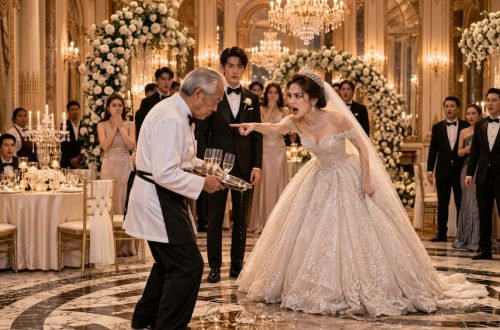
Arthur gasped, a sound of raw disbelief and pain. Clara stood frozen, tears welling in her eyes, seeing her once-proud father reduced to this. Sarah, wiping down the counter, paused, her usual cynicism replaced by a look of genuine concern. Even Mr. Harrison, emerging from his office, stopped to watch the unfolding drama, his usual stern expression softening with understanding.
Clara walked slowly toward Arthur, her steps heavy. “Dad?” she whispered, her voice cracking. Arthur reached out a trembling hand, tears streaming down his weathered cheeks. “Clara… my sweet Clara.” The chasm of years and pain seemed to stretch between them. Would Clara be able to forgive the man who had shattered her world, or would the bridge Emma had tried to build collapse?
Chapter 5: A New Dawn
The reunion was not a simple, instantaneous embrace. It was a delicate dance of pain, hesitation, and tentative hope. Clara sat opposite Arthur, her hand resting uncertainly on his. They spoke for hours, tears flowing freely from both. Arthur poured out years of remorse, recounting the shame, the regret, the daily struggle. Clara, in turn, shared her own wounds, the loneliness, the anger, the longing for the father she once knew.
Emma, watching from a distance, saw the wall between them begin to crumble, brick by painful brick. Clara, though still hurt, saw not just the broken man, but the genuine contrition, the flicker of the brilliant father she remembered. By the time the café closed, Clara made a decision that brought tears to Emma’s eyes. “Come home, Dad,” she said, her voice thick with emotion. “Let’s try to heal.”
Arthur, overwhelmed, could only nod, his hand clutching hers tightly. He was going home. The transformation wasn’t immediate, nor was it easy. Arthur moved into Clara’s spare room, slowly beginning to mend the fractured pieces of his life. Therapy, support groups, and the unwavering presence of his daughter became his new anchors. He started small, helping Clara with minor repairs around her house, slowly regaining his confidence and a sense of purpose.
A few months later, a distinguished-looking man walked into Bellwood Café. His beard was neatly trimmed, his clothes clean and well-fitting, and his eyes held a clarity Emma hadn’t seen before. It was Arthur. He wasn’t the broken man in the rain anymore. He was himself, or a close approximation of the man he once was, and perhaps, even better.
Clara was with him, a radiant smile on her face. They ordered coffee and sat at Emma’s usual quiet booth. “Emma,” Arthur began, his voice strong and clear, “I wanted to thank you. You didn’t just give me a meal; you gave me my life back.” Clara nodded, her eyes full of gratitude. “She saved him,” Clara added, squeezing Emma’s hand. “You saved our family.”
Arthur then pulled out a blueprint. “I’ve been doing some design work for Clara. Thought I might offer my services. That old counter of yours could use a redesign, wouldn’t you say? On the house, of course.” Emma laughed, a genuine, joyful sound. Mr. Harrison, witnessing the scene, gave Arthur a rare, approving nod. He’d even offered Emma a small raise, noting her exceptional empathy and dedication.
Emma watched Arthur and Clara leave, a warmth spreading through her chest that had nothing to do with the café’s heating. Her small act of kindness had rippled outwards, mending a family, restoring a soul, and quietly, profoundly, changing her own life too. The rain still fell sometimes, but for Emma, it no longer carried the same chill. It was just water, washing the world clean, making way for new beginnings.