Gardening Wisely: Incompatible Plant Pairs You Should Know!
Imagine your garden as a thriving community, where every plant has neighbors that either help them flourish or hinder their growth. Just like people, some plants simply don’t get along, and planting them side-by-side can lead to stunted growth, increased pest issues, or lower yields. Understanding these ‘unfriendly’ pairings is a cornerstone of successful organic gardening and sustainable growing practices.
By making thoughtful choices about where you place each plant, you can significantly improve the health and productivity of your entire garden. This isn’t just about avoiding problems; it’s about creating a harmonious ecosystem where every plant has the best chance to thrive. Let’s explore some common plant pairings that are best kept separate, and discover why these strategic decisions can make all the difference in your backyard oasis.
The Core Principle: Why Some Plants Don’t Mix
Companion planting is a time-honored tradition in gardening, where certain plants are grown together for mutual benefit, like pest deterrence or improved growth. The flip side of this is understanding incompatible plant pairs. Reasons for incompatibility can include:
- Shared Pests and Diseases: Plants from the same family often share the same vulnerabilities, making it easier for diseases or pests to spread rapidly when planted close together.
- Competition for Resources: Some plants are heavy feeders or have extensive root systems that outcompete their neighbors for water, nutrients, and sunlight.
- Allelopathy: Certain plants release chemicals into the soil that inhibit the growth of other plants.
- Different Needs: Plants with vastly different requirements for soil pH, water, or nutrients can struggle when planted in the same bed.
By recognizing these dynamics, you can make informed decisions that benefit your entire garden layout.
Key Incompatible Plant Pairings to Avoid
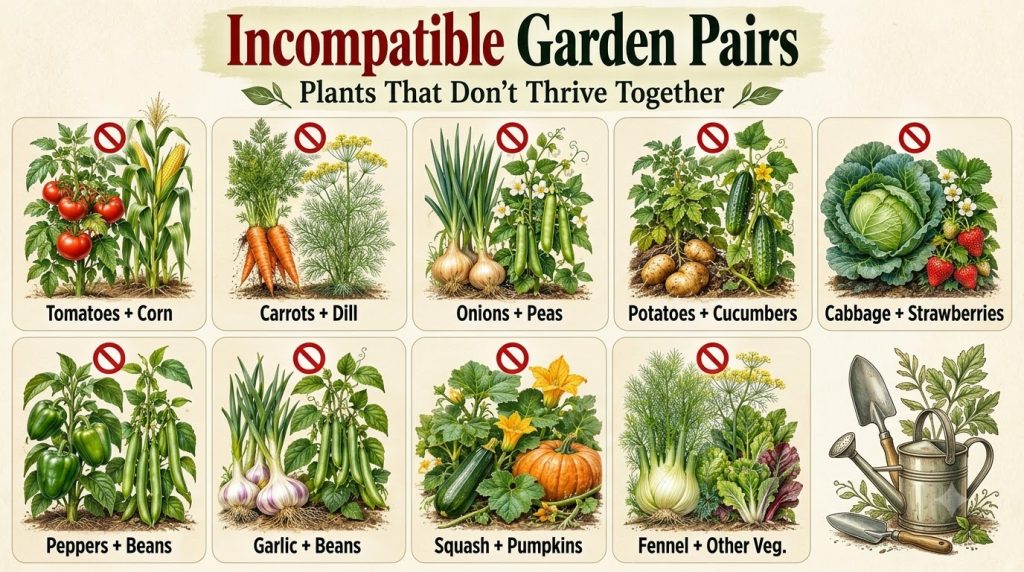
1. Tomatoes & Cabbage (and Other Brassicas)
Tomatoes (Solanum lycopersicum) are warm-season annuals, sun-loving, and heavy feeders, typically grown in USDA Zones 3-10 as annuals. Cabbage (Brassica oleracea var. capitata) is a cool-season annual or biennial, also a heavy feeder, grown in Zones 2-11. The primary issue here is competition for nutrients, as both are very hungry plants. Additionally, brassicas like cabbage are often attacked by cabbage worms and other pests that can incidentally affect nearby tomatoes.
- Practical Tip: Give both plants ample space and dedicated nutrient sources. Consider planting legumes or herbs nearby that can support soil health rather than compete.
- Warning: Avoid planting any brassica (broccoli, kale, cauliflower, collards) near tomatoes.
2. Carrots & Dill
Carrots (Daucus carota subsp. sativus) are root vegetables, grown as annuals in Zones 3-10. Dill (Anethum graveolens) is an aromatic herb, typically grown as an annual in Zones 2-11. While dill can attract beneficial insects, it is also in the same plant family (Apiaceae/Umbelliferae) as carrots. This means they share susceptibility to pests like the carrot rust fly, which can be attracted to dill and then easily move to the carrot crop. Dill can also sometimes stunt the growth of carrots due to allelopathic effects or competition if grown too close.
- Practical Tip: Plant dill a good distance away from carrots, or choose to grow dill in containers.
- Warning: The shared pest risk is significant, making this a pairing to generally avoid.
3. Potatoes & Tomatoes
Both Potatoes (Solanum tuberosum) and Tomatoes (Solanum lycopersicum) belong to the nightshade family (Solanaceae). This family shares many common pests, such as the Colorado potato beetle, and diseases like early and late blight. Planting them together creates an ideal environment for these issues to spread rapidly between crops, potentially devastating both. Potatoes are typically grown as annuals in Zones 3-10, while tomatoes are warm-season annuals in Zones 3-10.
- Practical Tip: Isolate potatoes and tomatoes in separate garden beds or at opposite ends of a large garden to minimize disease transmission. Rotate crops annually.
- Warning: This is one of the most crucial incompatible pairings to avoid due to disease risk.
4. Lettuce & Broccoli
Lettuce (Lactuca sativa) is a cool-season leafy green, grown as an annual in Zones 4-9. Broccoli (Brassica oleracea var. italica) is another cool-season brassica, grown as an annual in Zones 3-10. Both plants are heavy feeders, especially broccoli, and compete for nutrients in the soil. Broccoli can also overshadow lettuce as it grows taller, reducing the light lettuce receives. The strong flavors of some brassicas might also subtly influence nearby delicate greens.
- Practical Tip: Practice succession planting. Harvest fast-growing lettuce before slower-growing broccoli matures and shades it out. Provide plenty of organic matter to the soil for both.
- Warning: Ensure adequate spacing and rich soil if you must grow them in proximity.
5. Onions & Asparagus
Onions (Allium cepa) are cool-season biennials (often grown as annuals), typically in Zones 3-9. Asparagus (Asparagus officinalis) is a long-lived perennial vegetable, hardy in Zones 3-8. While onions are sometimes cited as beneficial for deterring asparagus beetles, some gardeners observe that alliums (onions, garlic) can inhibit asparagus growth due to allelopathic effects or simply by competing for essential nutrients and root space with the established perennial asparagus crowns. More critically, both can be susceptible to fungal diseases like fusarium wilt, making a monoculture of these problematic if either becomes infected.
- Practical Tip: Give asparagus its own dedicated bed, as it’s a perennial that will occupy the space for years.
- Warning: Observe your specific microclimate; some growers report no issue, but general advice leans towards separating them to ensure optimal growth for both.
6. Beans & Onions
Beans (e.g., green beans, Phaseolus vulgaris) are warm-season annual legumes, typically grown in Zones 3-10. Onions (Allium cepa) are cool-season annuals/biennials, Zones 3-9. Onions, along with garlic and chives, are often said to inhibit the growth of beans. Some theories suggest that alliums can interfere with the nitrogen-fixing bacteria on the roots of legumes, which are crucial for bean growth and soil enrichment. This can lead to stunted bean plants and reduced yields.
- Practical Tip: Plant beans and onions in separate sections of your garden or use a physical barrier between them to prevent potential negative interactions.
- Warning: Prioritize bean health by keeping alliums at a distance to support their nitrogen-fixing capabilities.
7. Cabbage & Strawberries
Cabbage (Brassica oleracea var. capitata) is a heavy-feeding cool-season annual. Strawberries (Fragaria x ananassa) are perennial fruits, typically hardy in Zones 3-10, known for their shallow root systems and spreading habit. Both plants are susceptible to common pests like slugs and various fungal diseases. Cabbage’s large leaves can also shade out low-growing strawberries, reducing their fruit production. They also compete for soil nutrients and can harbor some of the same pests, such as root nematodes.
- Practical Tip: Plant strawberries as a ground cover under fruit trees or in dedicated raised beds, far from heavy feeders like cabbage.
- Warning: Ensure good air circulation and appropriate spacing to prevent disease spread for both.
8. Corn & Tomatoes
Corn (Zea mays) is a tall, heavy-feeding warm-season annual, typically grown in Zones 3-10. Tomatoes (Solanum lycopersicum) are also warm-season, heavy-feeding annuals. The main issues here are resource competition and shared pests. Both plants require significant amounts of water and nutrients. Additionally, the corn earworm, a common pest of corn, is the same species as the tomato fruitworm, which can bore into ripening tomatoes. Planting them together can intensify pest problems. Corn’s height can also shade out tomato plants, reducing their fruit set.
- Practical Tip: Plant corn in blocks for better wind pollination, and keep your tomato plants a good distance away to avoid pest crossover and light competition.
- Warning: Both plants are susceptible to the same type of worm pest, making proximity risky.
9. Cucumbers & Aromatic Herbs (Specifically Sage)
Cucumbers (Cucumis sativus) are vining, warm-season annuals, grown in Zones 4-11, requiring consistent moisture and trellising. Sage (Salvia officinalis) is a woody perennial herb, hardy in Zones 4-8. While many herbs are beneficial companions, some aromatic herbs, particularly sage, are thought to stunt the growth of cucumbers. The strong aroma of sage might also confuse pollinators or simply outcompete young cucumber plants for soil moisture and nutrients if planted too closely. Sage prefers drier conditions and less rich soil than moisture-loving cucumbers.
- Practical Tip: Grow sage in a separate herb garden or in a container. Ensure cucumbers have consistently moist, rich soil away from herbs with different needs.
- Warning: Be mindful of differing moisture and nutrient requirements; these two plants simply prefer different environments.
Common Mistakes to Avoid in Plant Pairing
Beyond the specific pairings, there are general principles to follow:
- Ignoring Family Ties: Plants from the same botanical family often share pests and diseases. Researching plant families (e.g., brassicas, solanaceous plants, alliums) can help you avoid many problems.
- Overlooking Resource Competition: Understand how large plants will grow and how much water and nutrients they’ll need. Don’t crowd heavy feeders together.
- Forgetting About Light: Taller plants can cast significant shade. Ensure your sun-loving smaller plants aren’t inadvertently shaded out.
- Neglecting Soil Needs: Some plants thrive in acidic soil, others prefer alkaline. Mismatched soil pH can stress plants and make them more susceptible to problems.
- Copying Without Understanding: Don’t just follow a companion planting chart without understanding the underlying reasons. What works in one climate or soil type might not work in another.
Cultivating a Harmonious Garden
Understanding which plants to keep separate is just as vital as knowing which ones to pair for mutual benefit. By being a mindful observer in your garden and learning about the individual needs and characteristics of your plants, you can make smarter planting decisions. This approach reduces stress on your plants, minimizes pest and disease pressure, and ultimately leads to a more bountiful and beautiful harvest.
Start applying these gardening tips this season, and watch your garden flourish with newfound vigor. Happy growing!