Are your beloved plants sending out subtle cries for help that you might be missing? Just like us, plants communicate their needs, but they do it through their leaves, stems, and even their flowers. Understanding what your plants are trying to tell you is the first step toward a thriving, beautiful garden. No more guessing games!
Many common plant problems stem from nutrient deficiencies. These aren’t always obvious at first glance, but once you learn the signs, you’ll be able to quickly diagnose and address them with natural, organic solutions. Let’s learn to decode your plant’s secret language and turn those struggling greens into happy, healthy specimens.
Decoding Your Plant’s Secret Language
Plants rely on a range of essential nutrients to grow strong and produce abundant harvests or beautiful blooms. When one of these nutrients is scarce in the soil, your plant will start to show symptoms. These signs are often specific to the deficient nutrient and can appear on different parts of the plant, such as older leaves, new growth, or even the fruit.
Factors like soil pH, watering habits, and even compacted soil can affect a plant’s ability to absorb nutrients, even if they are present in the soil. That’s why understanding both the symptom and the context is key.
Common Plant Deficiency Symptoms & Natural Fixes
Here’s a guide to some of the most common plant deficiency symptoms you might encounter in your garden, along with practical, natural remedies to help your plants recover.
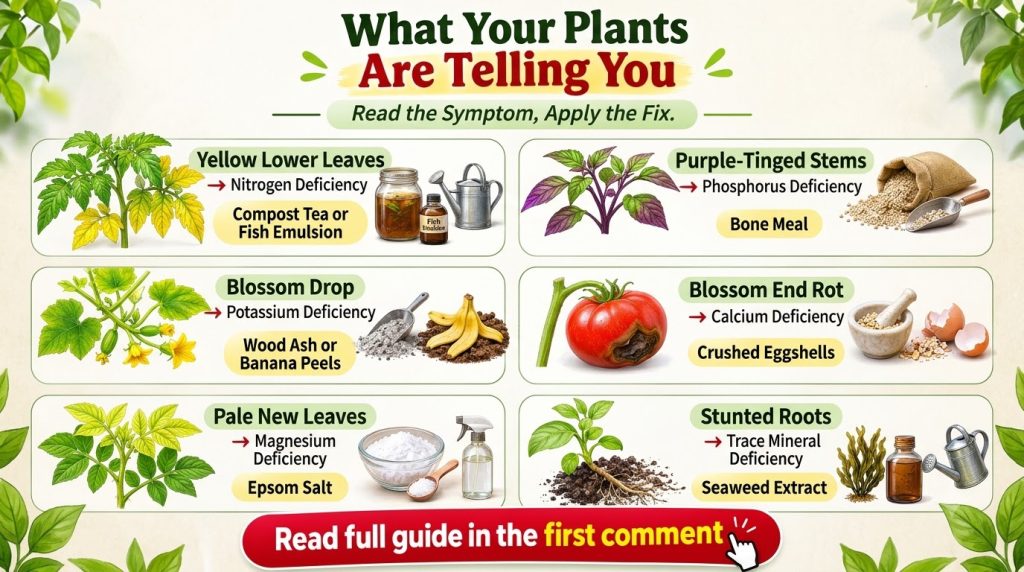
Yellowing Older Leaves (Nitrogen Deficiency)
What it looks like: If your plant’s older, lower leaves are turning a pale green or yellow, especially starting from the tips and edges, while the veins remain somewhat greener, your plant is likely lacking nitrogen. You might also notice stunted growth and an overall weak appearance.
Natural Fixes: Nitrogen is crucial for leafy growth. Boost it with nitrogen-rich organic matter such as well-rotted compost, aged animal manure (chicken or cow), coffee grounds, or blood meal. You can also brew a compost tea to deliver a quick liquid feed.
Purple/Reddish Leaves (Phosphorus Deficiency)
What it looks like: When leaves, particularly on the underside or around the edges, develop a purplish or reddish tint, phosphorus might be the culprit. This deficiency often leads to stunted root development, poor flowering, and reduced fruit set. It’s common in cold soil conditions.
Natural Fixes: Incorporate bone meal, rock phosphate, or another generous layer of well-rotted compost into the soil. Ensuring your soil pH is between 6.0 and 7.0 will also help plants absorb available phosphorus more effectively.
Brown Edges on Leaves (Potassium Deficiency)
What it looks like: Leaf edges turning yellow, then brown and crispy, often starting on older leaves, are classic signs of potassium deficiency. Plants may also have weak stems, be more susceptible to disease, and produce poor quality fruit or flowers.
Natural Fixes: Add wood ash (use sparingly to avoid drastically changing soil pH), kelp meal, or green sand to your soil. A balanced compost also contributes potassium over time.
Pale Yellowing Between Veins on New Leaves (Iron Deficiency)
What it looks like: This deficiency, known as chlorosis, typically affects new growth first. The youngest leaves turn pale yellow or even almost white, but the veins remain distinctly green. It’s often seen in alkaline soils where iron is present but unavailable to the plant.
Natural Fixes: To make iron more available, acidify your soil slightly. You can do this by adding acidic organic matter like pine needles, peat moss, or sulfur. A direct application of iron chelate or a foliar spray of compost tea can also provide a quick boost.
Yellowing Between Veins on Older Leaves (Magnesium Deficiency)
What it looks like: Similar to iron deficiency but affecting older leaves first, magnesium deficiency causes yellowing between the veins of the leaves. Sometimes, reddish-brown spots may appear, and the leaves might feel brittle to the touch.
Natural Fixes: Epsom salts (magnesium sulfate) dissolved in water make for an excellent foliar spray or soil drench. You can also amend your soil with dolomitic lime, which adds both calcium and magnesium.
Blossom End Rot & Stunted Growth (Calcium Deficiency)
What it looks like: Perhaps most famously seen as blossom end rot in tomatoes, peppers, and squash, calcium deficiency can also manifest as stunted growth, deformed or curled new leaves, and weak stems. It’s often due to inconsistent watering rather than a lack of calcium in the soil itself.
Natural Fixes: Provide a consistent watering schedule to ensure calcium transport within the plant. You can also amend the soil with crushed eggshells (they break down slowly), gypsum, or bone meal. Avoid over-fertilizing with high-nitrogen fertilizers, which can interfere with calcium uptake.
General Tips for Happy, Healthy Plants
- Build Rich Soil: The foundation of healthy plants is healthy soil. Regularly amend your garden beds with homemade compost to provide a continuous supply of macro and micronutrients.
- Water Wisely: Deep, infrequent watering encourages strong root growth. Consistent moisture helps plants absorb nutrients effectively and prevents issues like blossom end rot.
- Provide Adequate Light: Ensure your plants receive the right amount of sunlight for their specific needs. Too little or too much light can stress plants, making them more vulnerable to deficiencies.
- Practice Companion Planting: Some plants help each other by deterring pests or improving soil nutrients.
- Observe Regularly: Take a few minutes each day to simply look at your plants. Early detection of problems can save your plants and your harvest.
Listen Closely, Grow Beautifully
Your plants are truly amazing communicators. By learning to recognize the subtle signals they send, you gain the power to keep them healthy and vibrant. It’s a rewarding journey of observation, learning, and connection with nature.
So, next time you’re in your garden, take a moment to really listen to what your plants are telling you. Your efforts will be repaid with a flourishing garden full of life and beauty!