Your skin is your body’s largest organ, and it often provides crucial warnings when something isn’t quite right. Recognizing these signs early can make a profound difference, especially when it comes to conditions like skin cancer. Early detection is a powerful tool in increasing successful treatment outcomes and safeguarding your long-term health.
Understanding what to look for during a self-skin check can empower you to take proactive steps. While a professional dermatologist is always the best resource for diagnosis, knowing the potential red flags can prompt you to seek timely medical attention. This guide will walk you through nine critical signs of skin cancer you should never ignore.
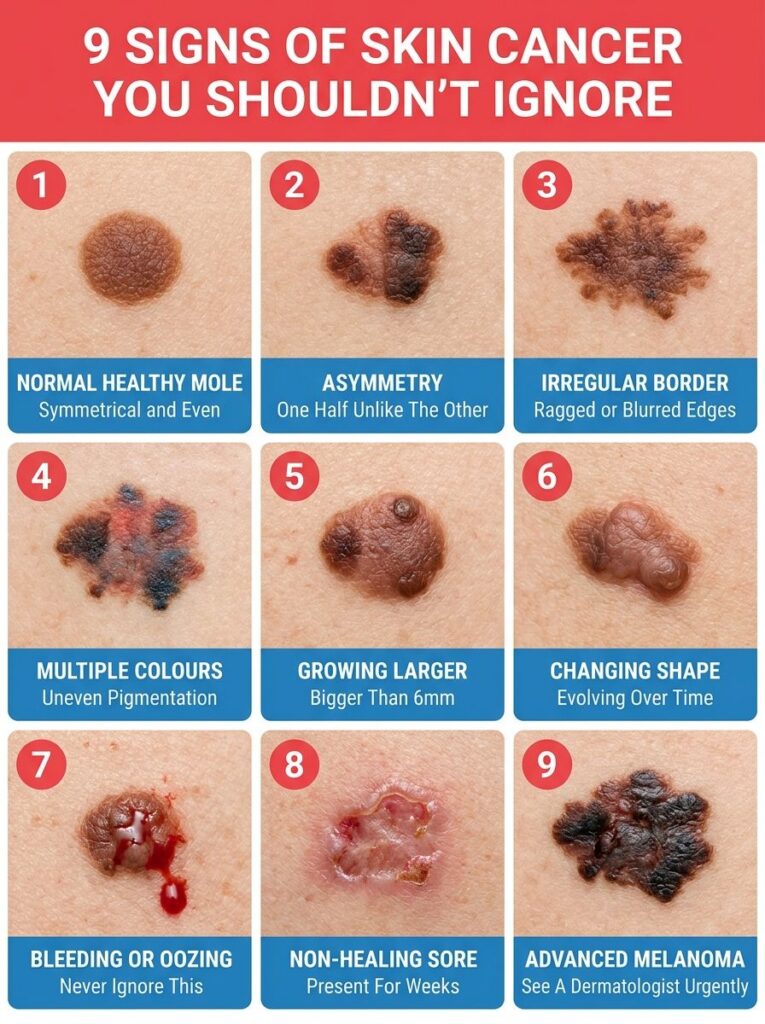
The ABCDEs and Beyond: Key Signs to Watch For
When examining your moles, many dermatologists recommend using the ‘ABCDE’ rule. However, skin cancer can manifest in various ways, so it’s essential to be aware of other symptoms as well. Let’s break down the nine signs highlighted by health experts.
1. Asymmetry: The Imbalance Test
A healthy mole is typically symmetrical. If you draw a line through the middle of it, both halves should roughly match. If one half of the mole doesn’t match the other half in shape, color, or elevation, it could be a sign of concern. This asymmetry is one of the earliest indicators of melanoma.
2. Irregular Borders: Jagged Edges
Benign moles usually have smooth, even borders. Moles with irregular, notched, scalloped, or poorly defined borders can be a warning sign. These uneven edges suggest uncontrolled growth patterns, which are characteristic of cancerous lesions.
3. Multiple Colors: A Spectrum of Shades
Most healthy moles are a single shade of brown. However, a mole that displays a variety of colors within the same lesion—such as different shades of brown, black, tan, or even red, white, or blue—should be examined by a doctor. The presence of multiple colors indicates irregular pigment distribution, a common feature of melanoma.
4. Diameter: When Size Matters
While some melanomas can be quite small, a diameter greater than 6 millimeters (about the size of a pencil eraser) is often considered a concerning sign. It’s not just the current size that matters, but also if you notice a mole growing larger over time, regardless of its initial size.
5. Evolving or Changing: The Most Critical Sign
Changes in a mole are perhaps the most important warning sign. Any change in size, shape, color, elevation, or any new symptoms such as bleeding, itching, or crusting, warrant immediate medical attention. This evolution can occur over weeks or months and is a strong indicator of potential malignancy.
6. Changing Shape: Unpredictable Growth
Beyond changes in diameter, pay attention if a mole’s overall shape begins to distort or become less regular. This could involve the development of new bumps, uneven growth patterns, or an otherwise healthy-looking mole transforming into something less defined.
7. Bleeding or Oozing: Beyond a Minor Scratch
A mole that spontaneously bleeds, oozes, or becomes crusty without being scratched or injured is a significant red flag. Healthy moles typically do not bleed. This symptom can indicate that the lesion is ulcerated or highly vascularized, often associated with more advanced skin cancers.
8. Non-Healing Sores: Persistent Wounds
Any sore or wound on your skin that doesn’t heal within a few weeks should be evaluated by a healthcare professional. While not always a mole, non-healing sores, especially those that reappear, bleed easily, or are persistently painful, can be a sign of basal cell carcinoma or squamous cell carcinoma, two common types of skin cancer.
9. Advanced Melanoma: Never Ignore This
Advanced melanoma can present with a combination of these signs, often exhibiting rapid growth, significant changes in color and texture, bleeding, or forming a nodule. If you notice a mole that looks drastically different from others, has grown very quickly, or shows any of the severe signs mentioned, it’s crucial to see a dermatologist urgently. Early detection of advanced melanoma is still vital for the best treatment outcomes.
Your Role in Skin Health: Self-Checks and Professional Care
Regular self-skin exams are a powerful tool in early detection. Take time each month to examine your skin from head to toe, including areas not exposed to the sun. Use a full-length mirror and a hand mirror for hard-to-see areas. Pay attention to new moles, or changes in existing ones. If you have a partner, ask them to check your back and scalp.
Remember, this information is for awareness and education. It’s not a substitute for professional medical advice. If you notice any of these signs or have any concerns about a mole or spot on your skin, do not hesitate to schedule an appointment with a dermatologist. They can provide an accurate diagnosis and guide you on the best course of action. Your skin health is an integral part of your overall well-being.