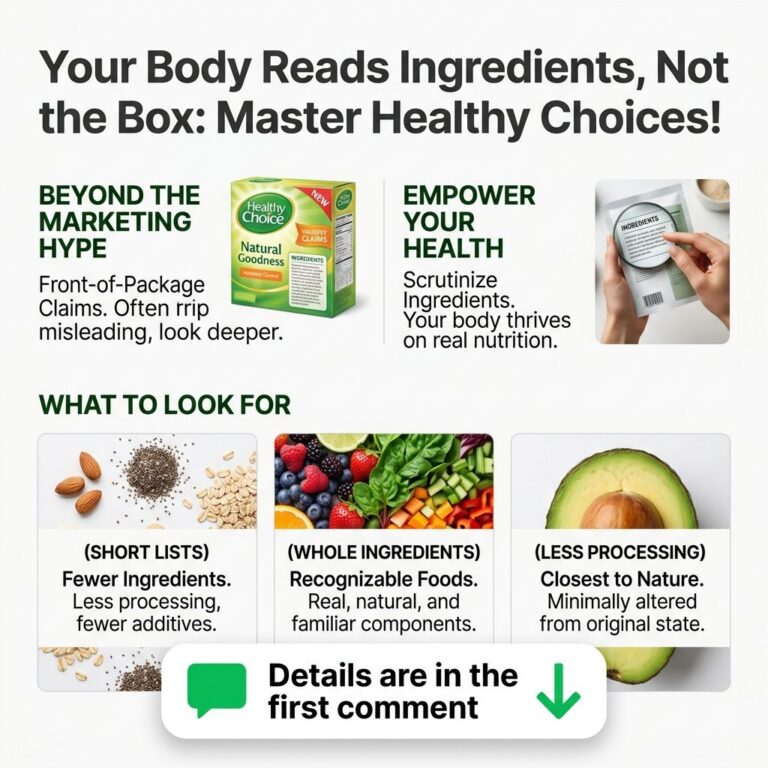
When it comes to nourishing your body, what’s truly inside your food matters far more than what’s advertised on the outside. “Your Body Reads Ingredients, Not the Box” – this simple truth is a powerful reminder that mastering healthy choices begins with understanding food labels. In a world saturated with appealing marketing claims, it’s easy to be swayed by buzzwords like ‘natural,’ ‘organic,’ or ‘low-fat.’ However, true health empowerment comes from looking beyond the hype and diving into the ingredient list.
This guide will help you decipher food labels, empowering you to make informed decisions that genuinely support your well-being. We’ll explore how to identify misleading marketing, what key elements to seek in ingredient lists, and practical ways to prioritize whole, less processed foods.
Beyond the Marketing Hype: Decoding Front-of-Package Claims
Food manufacturers often use clever marketing tactics to make their products appear healthier than they are. The front of a package might boast ‘high fiber’ or ‘zero trans fat,’ yet a glance at the ingredient list could reveal added sugars, artificial flavors, or excessive sodium. These claims, while sometimes technically true, can distract you from the overall nutritional profile of the product.
Don’t fall for the ‘health halo’ effect. A product labeled ‘gluten-free’ isn’t automatically healthy if it’s loaded with sugar and refined starches. Similarly, ‘organic’ doesn’t mean calorie-free. Always approach front-of-package claims with a critical eye, remembering that their primary purpose is to sell, not always to fully inform.
Empower Your Health: The Power of Reading Ingredient Lists
The true story of a food product lies in its ingredient list. This is where transparency lives, detailing exactly what goes into what you’re about to consume. Taking the time to read and understand these lists is perhaps the most significant step you can take towards making genuinely healthy choices.
When you empower yourself to read ingredient lists, you gain control over what you put into your body. It allows you to identify hidden sugars, unhealthy fats, artificial additives, and unnecessary preservatives that can undermine your health goals. This practice transforms you from a passive consumer into an active participant in your nutritional well-being.
What to Look For: Key Principles for Healthy Choices
Navigating the supermarket aisles can be overwhelming, but with a few simple principles, you can confidently identify nourishing foods. Focus on these three core indicators when scrutinizing ingredient lists.
Embrace Short Ingredient Lists
Generally, the shorter the ingredient list, the better. Foods with minimal ingredients tend to be closer to their natural state and contain fewer additives. Think of foods like plain almonds, natural chia seeds, or whole rolled oats. These are typically single-ingredient items or have very few, clearly identifiable components.
- Almonds: Often just ‘almonds.’ A healthy snack packed with protein, fiber, and healthy fats.
- Chia Seeds: Simply ‘chia seeds.’ A powerhouse of omega-3s, fiber, and protein, perfect for adding to smoothies or making chia pudding.
- Oats: Look for ‘rolled oats’ or ‘steel-cut oats’ with no added sugars or flavors. An excellent source of complex carbohydrates and soluble fiber for sustained energy.
Conversely, be wary of products with long, complicated ingredient lists featuring many unfamiliar names. These often indicate highly processed foods with numerous artificial components.
Prioritize Whole, Recognizable Ingredients
Your body thrives on whole, unprocessed foods. These are foods that are as close to their natural form as possible, with minimal alteration. When you read an ingredient list, ask yourself if you recognize each item as a food rather than a chemical compound.
Think vibrant, colorful berries bursting with antioxidants or fresh, chopped vegetables rich in vitamins and minerals. These ingredients are easily identifiable and provide a spectrum of nutrients essential for health. Prioritizing whole ingredients means choosing foods where the main components are fruits, vegetables, lean proteins, whole grains, and healthy fats.
- Colorful Berries: Strawberries, blueberries, raspberries – packed with antioxidants and natural sweetness.
- Chopped Vegetables: Broccoli, bell peppers, carrots – provide essential vitamins, minerals, and fiber.
Avoid ingredients like artificial colors, flavors, sweeteners (e.g., sucralose, aspartame), and emulsifiers, which offer no nutritional value and may have adverse health effects for some individuals.
Opt for Less Processed Foods
Processing changes food from its natural state. While some processing is necessary and even beneficial (like pasteurization of milk), excessive processing can strip foods of nutrients and introduce unhealthy additives. Opting for ‘less processed’ means choosing foods that have undergone minimal changes from their original form.
A perfect example of a minimally processed food is an avocado. It’s a whole, nutrient-dense fruit that requires no processing before consumption. Compare this to highly processed snacks like flavored chips, sugary cereals, or ready-to-eat meals, which often contain numerous ingredients, preservatives, and artificial components.
Look for foods where the nutritional value is largely intact and the ingredient list reflects simplicity. This approach naturally leads you to healthier options that support better digestion, stable blood sugar, and sustained energy levels.
Practical Tips for Smart Grocery Shopping
- Plan Ahead: Make a grocery list based on whole, unprocessed ingredients.
- Shop the Perimeter: The outer aisles of most grocery stores typically house fresh produce, dairy, and lean proteins, while the inner aisles contain more processed packaged goods.
- Read Labels Every Time: Even if you’ve bought a product before, formulations can change.
- Look for Added Sugars: Sugars can hide under many names (e.g., high-fructose corn syrup, dextrose, maltose).
- Mind the Sodium: High sodium content can contribute to blood pressure issues.
- Understand Serving Sizes: Pay attention to the serving size and how many servings are in a package.
Frequently Asked Questions About Ingredient Reading
Q: What are common hidden sugars to watch out for?
A: Beyond obvious sugar, look for corn syrup, high-fructose corn syrup, dextrose, maltose, sucrose, fruit juice concentrate, and anything ending in ‘-ose’.
Q: How can I identify unhealthy fats on an ingredient list?
A: Watch for trans fats (partially hydrogenated oils), excessive saturated fats, and highly refined vegetable oils like soybean, corn, or cottonseed oil. Prioritize healthier fats from sources like avocados, nuts, seeds, and olive oil.
Q: Is ‘natural flavor’ always a healthy choice?
A: ‘Natural flavor’ can still be derived from various sources and undergo significant processing, often containing chemical solvents and preservatives. While not always harmful, it’s generally best to opt for foods flavored with real ingredients rather than vague ‘natural flavors’ for truly clean eating.