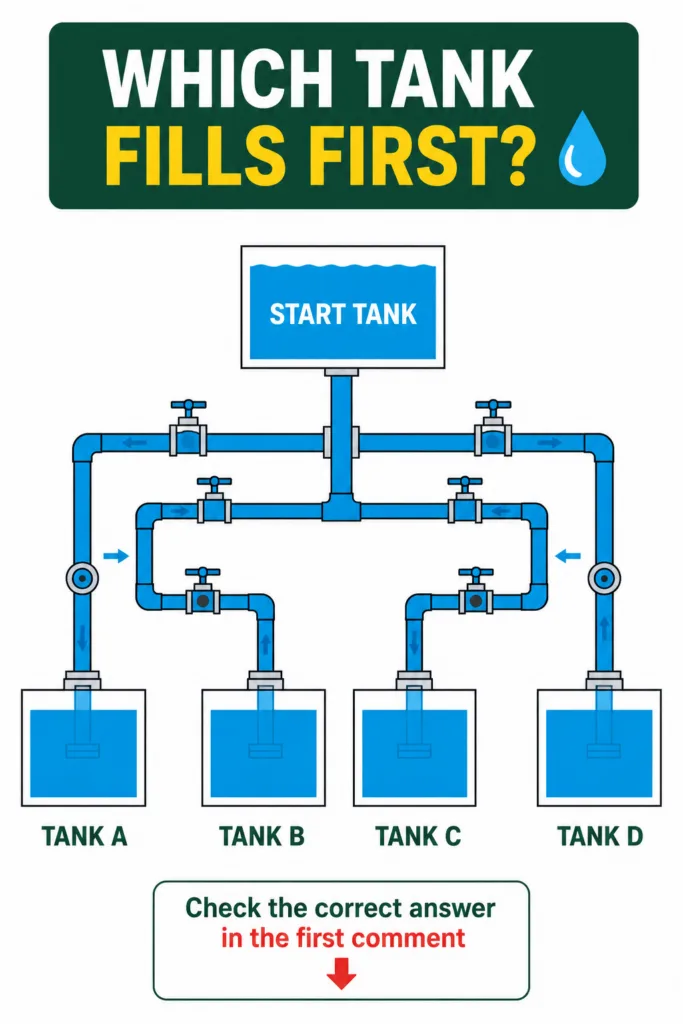
At first glance, this puzzle appears complicated because the starting tank connects to several pipes, valves, and four different tanks labeled A, B, C, and D. However, once we trace the water from the source and compare the available routes, the solution becomes much clearer.
The Correct Answer: Tanks A and D Fill First
Based on the diagram, Tank A and Tank D should fill first at approximately the same time.
The pipe system is designed symmetrically. Water leaving the start tank can travel through the upper left branch toward Tank A and through the upper right branch toward Tank D. These two routes are shorter and more direct than the routes leading to Tanks B and C.
Step-by-Step Explanation
1. Water leaves the start tank
The water begins inside the tank at the top of the image. It flows downward through the main vertical pipe until it reaches the central junction.
At this point, the water can move into several branches.
2. The upper pipe splits in two directions
The upper horizontal pipe sends water:
- To the left toward Tank A
- To the right toward Tank D
Both sides appear to have the same pipe diameter, similar valves, and nearly identical travel distances.
This means the water should reach Tanks A and D at almost the same moment.
3. Tanks A and D have the most direct routes
Tank A is connected to the outer pipe on the left side, while Tank D is connected to the outer pipe on the right side.
The routes are approximately:
- Start tank → central junction → left outer pipe → Tank A
- Start tank → central junction → right outer pipe → Tank D
There are no additional loops in these routes before the water reaches the tanks.
4. Tanks B and C have longer routes
To reach Tank B or Tank C, the water must travel through the lower inner pipe system.
These paths contain more turns and longer sections:
- Start tank → central junction → inner left branch → Tank B
- Start tank → central junction → inner right branch → Tank C
Because these routes are longer, Tanks B and C should begin receiving water slightly later than Tanks A and D.
Why There Is No Single First Tank
Many puzzle viewers automatically search for one answer: A, B, C, or D. But the key detail is that the pipe system is almost perfectly symmetrical.
Tank A and Tank D have matching connections on opposite sides. Unless one valve is closed or one pipe is narrower, there is no clear reason for one of them to fill before the other.
Therefore, this puzzle has a shared answer rather than one individual tank.
Important Assumptions
This answer assumes that:
- All illustrated valves are open.
- Every pipe has the same internal diameter.
- Water pressure is distributed evenly.
- Tanks A, B, C, and D have the same capacity.
- There are no hidden blockages inside the pipes.
- The arrows are decorative flow indicators rather than one-way valves or pumps.
Under these normal puzzle assumptions, the system remains balanced on both sides.
What Happens After A and D?
Once water begins flowing into all open routes:
- Tanks A and D receive water through the shorter outer pipes.
- Tanks B and C receive water through the longer inner pipes.
- Tanks A and D reach full capacity before Tanks B and C.
- Because the left and right sides are symmetrical, A and D should finish together.
Final Answer
✅ Tanks A and D fill first—at the same time.
The reason is simple: both tanks are connected to the shortest and most direct routes from the starting tank, and the pipe network is symmetrical on the left and right sides.
Did you choose one tank, or did you notice that two tanks could fill together? 💧