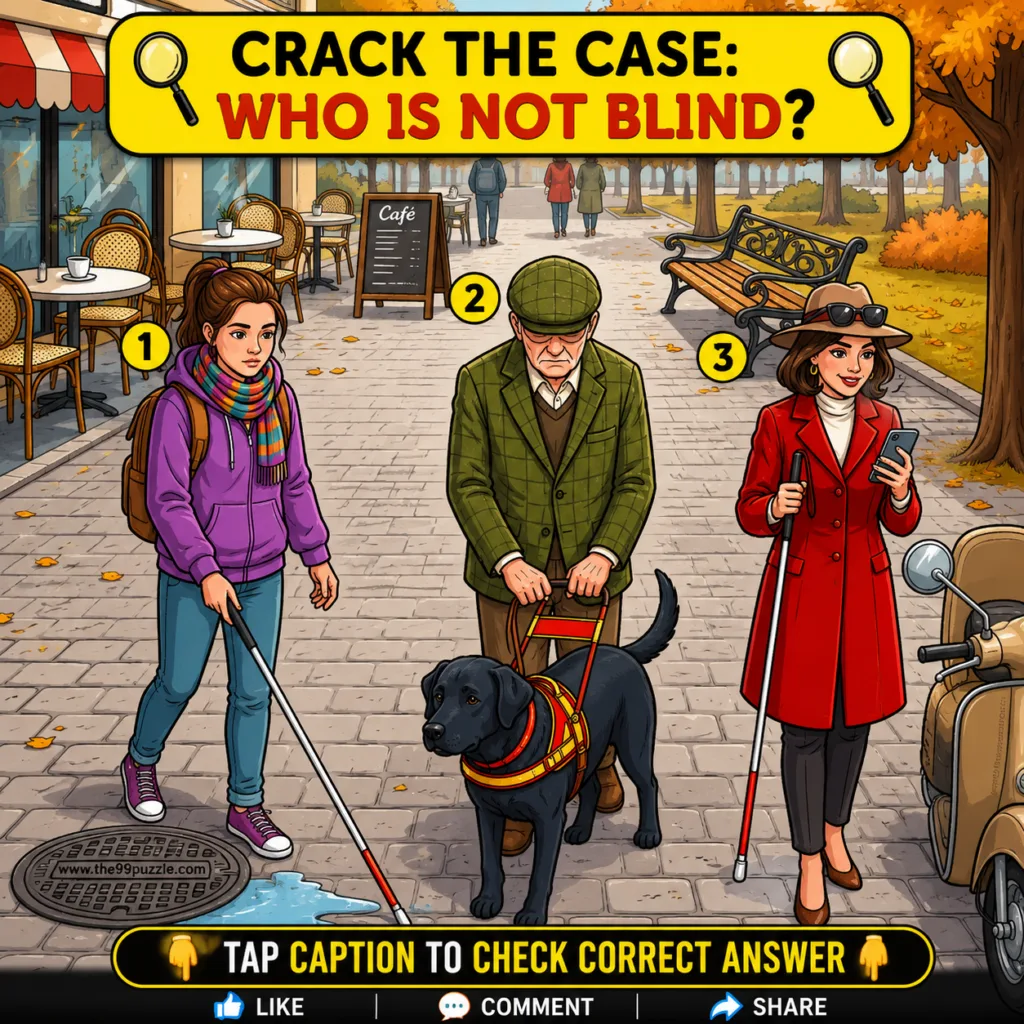
Can you spot the one person who isn’t actually blind?
At first glance, all three people seem to be visually impaired because they are carrying white canes or walking with a guide dog. However, one small detail reveals the truth.
Let’s examine each person carefully.
The Puzzle
Three people are walking down a sidewalk:
① A young woman using a white cane.
② An elderly man walking with a guide dog.
③ A stylish woman in a red coat using a white cane while looking at her smartphone.
The question is simple:
Who is NOT blind?
Let’s Analyze Each Person
Person #1
The young woman is using her white cane correctly.
Notice how:
- She is sweeping the cane in front of her.
- The cane reaches the edge of a puddle.
- Her attention appears focused on navigating the sidewalk.
Everything about her movement is consistent with someone who relies on a mobility cane.
There is no obvious clue suggesting she can see.
Person #2
The elderly man is walking with a guide dog.
Guide dogs undergo extensive training to help people with severe visual impairments safely navigate public spaces.
Notice that:
- The dog is wearing a proper guide harness.
- The man is holding the harness correctly.
- His posture matches someone following the dog’s guidance.
Nothing unusual stands out.
Person #3
This is where the puzzle becomes interesting.
The woman in the red coat is:
- Holding a white cane.
- Smiling confidently.
- Looking directly at the screen of her smartphone.
A person who is completely blind would not visually read a smartphone screen in this manner.
While many blind people absolutely do use smartphones—with screen readers, voice commands, and accessibility features—they typically are not visually focused on the display the way this illustration depicts.
The artist intentionally drew her eyes directed toward the phone to provide the key clue.
Why This Is the Correct Answer
The puzzle depends on visual observation rather than real-world disability knowledge.
The intended clue is:
- She appears to be reading or viewing her phone normally while simultaneously using a white cane.
That combination suggests she still has functional vision.
✅ Correct Answer: Person #3
The woman labeled 3 is the intended answer.
A Real-Life Note
It’s important to remember that this puzzle is a simplified illustration.
In reality:
- Not everyone using a white cane is totally blind.
- Many people are partially sighted or have low vision.
- Some individuals with low vision can still recognize faces, read enlarged text, or use smartphones with magnification and accessibility tools.
- Guide dogs and white canes are used by people with a wide range of visual impairments.
So, in everyday life, you cannot determine someone’s level of vision simply by looking at them.
This puzzle relies on an exaggerated visual clue created for entertainment.
Why This Puzzle Tricks So Many People
Many players immediately assume:
- “The guide dog must be fake.”
- “The woman isn’t using her cane correctly.”
- “The young girl stepped near the puddle.”
But these details are distractions.
The artist wants your attention to land on one obvious inconsistency:
The woman in red appears to be visually looking at her smartphone.
Final Answer
🏆 Answer: Person #3
She is depicted looking directly at her smartphone, making her the intended answer in this visual brain teaser.
Did You Solve It?
Did you pick #3 right away, or did another clue catch your attention first? Share your reasoning in the comments and compare your answer with other puzzle lovers!