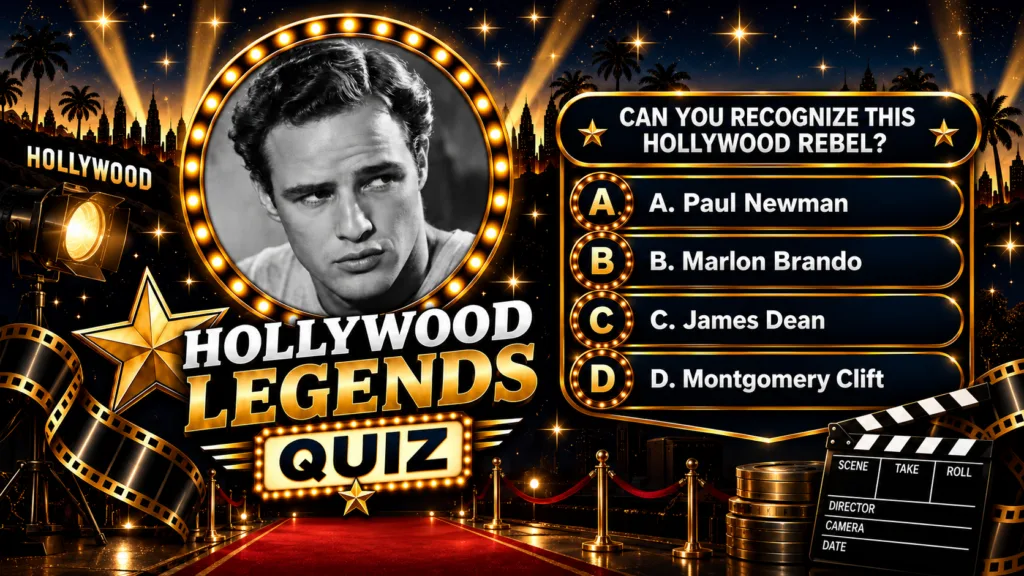
Welcome to our Hollywood Legends Quiz! Today, we’re diving deep into the golden era of cinema to celebrate an actor whose impact is still felt decades later. Look closely at the portrait presented in our quiz – an intense, slightly defiant expression that broke the mold of traditional leading men. He was a force of nature, a new kind of screen presence in the postwar era, ushering in a more emotional and unpredictable masculinity.
Are you ready to test your classic Hollywood knowledge? Who is this iconic figure who left an indelible mark on film history?
The Revolutionary Face of Postwar Cinema
Before the 1950s, Hollywood’s leading men often embodied polished elegance and predictable heroism. Then came a new wave, and at its forefront was an actor who commanded the screen with raw intensity and a method acting approach that felt revolutionary. His early performances, notably in the film adaptation of A Streetcar Named Desire, showcased a vulnerability and a simmering intensity that audiences had rarely witnessed. This wasn’t the perfectly mannered hero; this was something real, visceral, and utterly captivating.
Iconic Roles That Defined a Generation
This mysterious actor quickly became synonymous with characters who felt different, challenging the status quo. His resume reads like a highlight reel of cinematic history, each role contributing to his legend:
- A Streetcar Named Desire (1951): As Stanley Kowalski, he delivered a raw, powerful performance that earned him his first Oscar nomination and cemented his image as a brooding, magnetic figure.
- The Wild One (1953): His portrayal of Johnny Strabler, the rebellious biker, created one of the most enduring pop-culture images of the 1950s. That leather jacket and defiant stare became a symbol of youthful rebellion.
- On the Waterfront (1954): Playing longshoreman Terry Malloy, Brando delivered one of cinema’s most famous monologues (

