Did you guess correctly? If you chose D. Al Pacino, you hit the bullseye! Few actors possess a face, voice, and screen presence as instantly recognizable as Al Pacino. This legendary young actor graced the screen in some of the greatest films ever made, captivating audiences with his raw intensity and transformative performances.
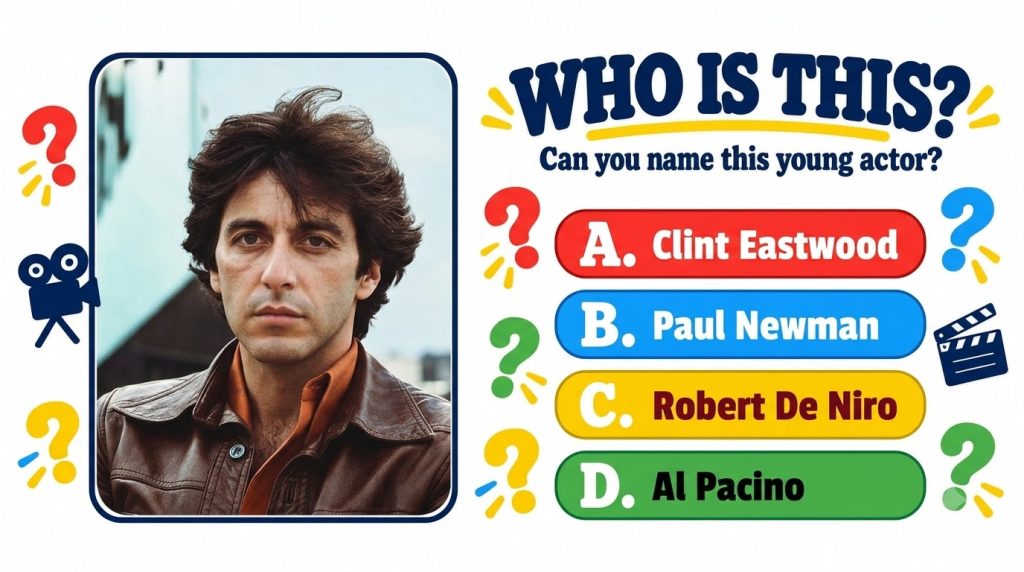
From the quiet intensity of Michael Corleone to the explosive energy of Tony Montana, Pacino created some of the most unforgettable characters in American cinema. He became one of the defining actors of the 1970s and built a career that continued successfully for decades, earning him a place among the greatest actors of his generation.
The Formative Years of a Legend
Alfredo James Pacino was born on April 25, 1940, in New York City. He grew up in the gritty Bronx, where his early experiences likely shaped the profound depth he would later bring to his roles. It was at a young age that Pacino became intensely interested in acting, a passion that would lead him down a path of rigorous training and dedication.
Pacino studied seriously, including crucial training at the esteemed Actors Studio. Here, he honed his craft, developing the emotionally intense and naturalistic acting style that would later define many of his most celebrated performances. Before making his indelible mark on film, Pacino worked extensively in theater, earning critical acclaim and building a solid foundation for his explosive big-screen debut.
The Role That Changed Everything: The Godfather (1972)
The role that undeniably changed everything for Al Pacino, catapulting him into international stardom, was that of Michael Corleone in Francis Ford Coppola’s masterpiece, The Godfather (1972). Pacino played the youngest son of crime boss Vito Corleone, portrayed by the legendary Marlon Brando.
At the beginning of the film, Michael wants little to do with the family business, seeking a more conventional, American life. But as the story progresses, he slowly transforms into a ruthless leader, inheriting the mantle of his father and becoming even more formidable. Pacino’s portrayal of this chilling metamorphosis, from war hero to cold-blooded mob boss, is considered one of the greatest performances in film history, earning him his first Academy Award nomination.
The Golden Age: A String of Iconic 1970s Roles
The 1970s proved to be a golden era for Al Pacino, as he followed up The Godfather with a series of critically acclaimed and commercially successful films that solidified his status as a cinematic powerhouse.
- Serpico (1973): In this biographical crime drama, Pacino played Frank Serpico, an honest New York City police officer who exposes corruption within the force. His raw, committed performance earned him another Oscar nomination.
- The Godfather Part II (1974): Reprising his role as Michael Corleone, Pacino delivered an even darker and more complex portrayal, showcasing the depths of Michael’s moral decay. This sequel, often considered one of the greatest films ever made, earned Pacino another Academy Award nomination for Best Actor.
- Dog Day Afternoon (1975): Pacino shone as Sonny Wortzik, a desperate bank robber in this acclaimed true-story crime drama. His frantic, emotional, and ultimately sympathetic performance captured the desperation of the era and further cemented his versatility.
An Enduring Legacy and Later Career Highlights
As the decades progressed, Al Pacino continued to challenge himself with diverse roles, adding more memorable characters to his impressive filmography. From the explosive Cuban drug lord Tony Montana in Scarface (1983) to the charismatic blind former Army lieutenant colonel in Scent of a Woman (1992), for which he finally won his long-deserved Academy Award for Best Actor, Pacino consistently delivered compelling performances.
His work in films like Heat (1995), where he famously shared the screen with Robert De Niro, and more recently in films like The Irishman (2019) and House of Gucci (2021), proves his enduring appeal and talent. Al Pacino is not just an actor; he is an institution, a vital part of classic Hollywood’s rich tapestry, and a beloved figure for generations of film enthusiasts.
What’s Your Favorite Al Pacino Film?
Which of Al Pacino’s many iconic roles stands out as your favorite? Share your thoughts and memories in the comments below! We love hearing from fellow classic film fans.