Every thriving garden, bursting with vibrant flowers, lush vegetables, or fragrant herbs, begins with a secret ingredient often overlooked: healthy soil. Think of your garden’s soil not just as dirt, but as the living foundation that nourishes every plant you grow. Understanding the different types of soil and matching them with the right plants is a fundamental step toward cultivating a productive and sustainable garden. It’s about working with nature, not against it, creating an environment where your plants don’t just survive, but truly flourish.
This guide will demystify the common soil types, helping you identify what you have and how to optimize it for an abundant harvest or breathtaking display. Get ready to transform your approach to gardening, one spadeful at a time!
The Foundation Beneath Your Feet: Why Soil Matters
Soil is far more than just a medium to hold plants upright. It’s a complex ecosystem comprising mineral particles (sand, silt, clay), organic matter (decomposed plants and animals), water, and air. This intricate mix provides physical support, anchors roots, stores and filters water, cycles nutrients, and houses a universe of beneficial microorganisms. Different plants have evolved to thrive in specific soil conditions, making soil knowledge a cornerstone of successful gardening.
Understanding the Six Key Soil Types
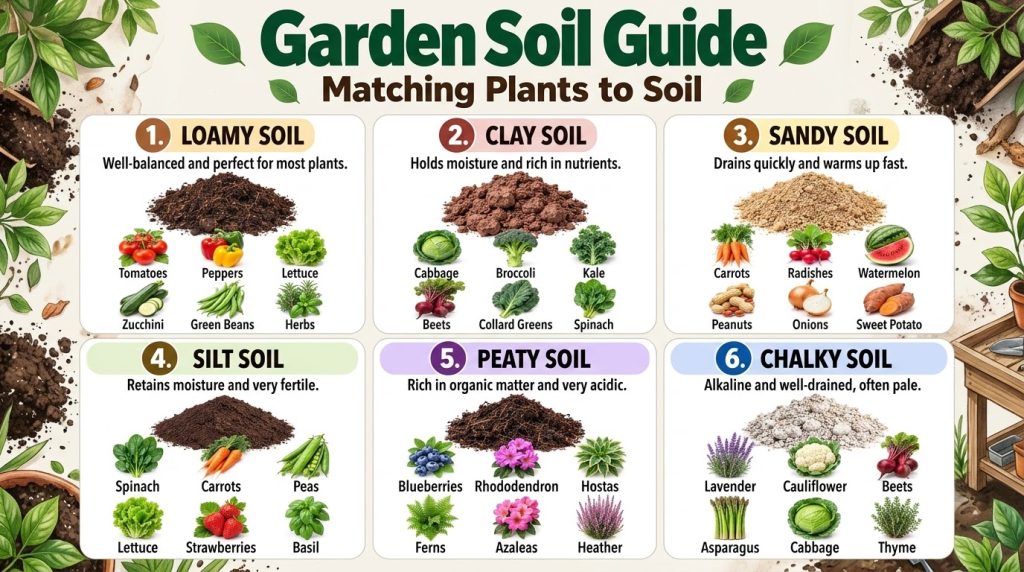
Let’s explore the distinct characteristics of six common soil types and the plants that call them home. While every garden has unique conditions, understanding these basics will empower you to make informed decisions for your plants.
Sandy Soil: Quick Drainage, Fast Warmth
Sandy soil is characterized by large, coarse particles that allow water to drain very quickly. It warms up rapidly in spring, which is great for early planting, but it struggles to retain moisture and nutrients. This rapid drainage means nutrients can leach away easily, so regular amendment with organic matter is crucial.
- Carrot (Daucus carota subsp. sativus): Roots grow straight and true in loose, sandy soil without obstruction. Sow seeds directly in early spring after the last frost. Ensure consistent moisture for germination and early growth.
- Potato (Solanum tuberosum): Sandy loam is ideal for potato tubers to expand freely, making harvest easier. Plant seed potatoes about 4-6 inches deep in early spring. ‘Hilling’ potatoes as they grow helps develop more tubers.
- Zucchini (Cucurbita pepo): While adaptable, zucchini appreciates sandy loam for good drainage and quick warming, which promotes rapid growth. Plant after all danger of frost has passed. Provide plenty of space and consistent watering.
- Asparagus (Asparagus officinalis): This perennial thrives in well-drained, sandy loam. Its long-lived crowns dislike ‘wet feet.’ Plant 1-year-old crowns in trenches about 6-8 inches deep in early spring.
- Lettuce (Lactuca sativa): Loose, well-draining sandy soil helps lettuce establish quickly. Ensure rich organic matter to provide nutrients, as sandy soil can be lean. Plant in early spring and fall.
- Radish (Raphanus sativus): Like carrots, radishes need loose soil for proper root development. Sandy soil allows for rapid growth and prevents misshapen roots. Sow seeds every 1-2 weeks for a continuous harvest.
Silty Soil: The Balanced Performer
Silty soil has medium-sized particles, smaller than sand but larger than clay. It feels smooth and somewhat powdery. This soil type offers a good balance: it retains moisture well, provides decent drainage, and is generally quite fertile due to its ability to hold nutrients. It’s often considered highly desirable for agriculture.
- Corn (Zea mays): A heavy feeder, corn loves deep, fertile, silty loam that provides ample moisture and nutrients. Plant in blocks for good pollination after soil has warmed.
- Wheat (Triticum aestivum): As a major field crop, wheat thrives in silty loams that support its extensive root system and nutrient needs. While not a typical home garden crop, it illustrates the productivity of silty soil.
- Cabbage (Brassica oleracea var. capitata): Cabbage requires consistent moisture and rich, fertile soil to develop large, dense heads. Silty loam offers the ideal balance of moisture retention and good drainage.
- Broccoli (Brassica oleracea var. italica): Similar to cabbage, broccoli needs a steady supply of moisture and nutrients, which silty soils provide effectively. Plant in spring for summer harvest or late summer for fall.
- Onion (Allium cepa): Onions prefer well-drained, fertile silty soil that allows bulbs to expand without resistance. Avoid heavy clay, which can stunt bulb development or cause rot.
- Pepper (Capsicum annuum): Peppers love warm, well-draining, fertile soil. Silty loam provides the consistent moisture and nutrient availability they need for strong fruit production.
Clay Soil: Nutrient-Rich, Needs Airflow
Clay soil is composed of very fine particles that pack tightly together. It’s rich in nutrients because its particles bind well to them, but it drains poorly and can become easily compacted, leading to waterlogging and poor root aeration. Amending clay soil with organic matter like compost is vital to improve its structure, drainage, and workability.
- Beans (Phaseolus vulgaris): Beans can tolerate heavier clay soils if they are well-amended with organic matter to improve drainage and aeration. They are nitrogen fixers, benefiting from good soil health.
- Peas (Pisum sativum): Similar to beans, peas prefer well-drained soil but can manage in amended clay. Ensure good aeration to prevent root diseases. Plant early in spring when soil is still cool.
- Potatoes (Solanum tuberosum): While sandy loam is preferred, potatoes can grow in clay if it’s heavily amended with compost and sand to loosen it. This prevents misshapen tubers and makes harvesting easier.
- Lettuce (Lactuca sativa): Lettuce can grow in clay soil, but it’s crucial to lighten it with organic matter to improve drainage and prevent compaction, which can stress the shallow roots.
- Broccoli (Brassica oleracea var. italica): Broccoli can be productive in clay soils, especially if they are rich in organic matter. Good drainage is still key to prevent root rot.
- Cabbage (Brassica oleracea var. capitata): Like broccoli, cabbage benefits from the nutrient-holding capacity of clay but requires significant organic amendment to prevent waterlogging.
Peaty Soil: Embracing Acidity and Organic Richness
True peaty soil is primarily composed of decomposed organic matter, typically found in bogs. It is very acidic, holds a tremendous amount of moisture, and is often black or dark brown. In most home gardens, ‘peaty soil’ often refers to soil that is very high in organic matter and leans acidic, often achieved through amendments. For plants that love these conditions, it’s a dream!
- Blueberry (Vaccinium corymbosum): Blueberries are famous for needing highly acidic soil (pH 4.5-5.5) and consistent moisture, which peaty or heavily amended garden soil provides. Plant in full sun. Hardiness: USDA Zones 3-8.
- Cranberry (Vaccinium macrocarpon): Similar to blueberries, cranberries thrive in very acidic, moist, peaty conditions. Best for specialized bog gardens or large containers in acidic medium. Hardiness: USDA Zones 2-7.
- Rhododendron (Rhododendron spp.): These stunning shrubs demand acidic, well-drained, yet consistently moist soil rich in organic matter. Peaty conditions are ideal. Plant in partial shade. Hardiness: USDA Zones 4-9, depending on species.
- Azalea (Rhododendron spp.): Closely related to rhododendrons, azaleas share the same preference for acidic, organic-rich soil. Many are deciduous, others evergreen. Hardiness: USDA Zones 4-9, depending on species.
- Heather (Calluna vulgaris): Heather flourishes in poor, acidic, well-drained, sandy-peaty soils, mimicking its native moorland habitats. Plant in full sun for best flowering. Hardiness: USDA Zones 4-8.
- Camellia (Camellia japonica): Camellias require consistently moist, well-drained, acidic soil with plenty of organic matter. They are often grown in partial shade to protect delicate blooms. Hardiness: USDA Zones 7-9.
Chalky Soil: Managing Alkalinity and Drainage
Chalky soil is typically found over limestone or chalk bedrock. It’s usually stony, alkaline (high pH), and well-draining, which can lead to rapid nutrient leaching, particularly of micronutrients like iron, causing chlorosis (yellowing leaves) in some plants. Improving chalky soil involves adding plenty of organic matter to improve fertility and moisture retention while buffering the high pH.
- Beetroot (Beta vulgaris): While beets prefer slightly acidic to neutral soil, they can tolerate mildly alkaline conditions better than many vegetables. Ensure good drainage and amend with compost.
- Spinach (Spinacia oleracea): Spinach also prefers a neutral to slightly acidic pH but can tolerate moderately alkaline conditions if the soil is rich in organic matter and consistently moist.
- Honeysuckle (Lonicera spp.): Many honeysuckle varieties are quite tolerant of alkaline, chalky soils, provided there’s good drainage. They are versatile vines or shrubs. Hardiness: USDA Zones 4-9, depending on species.
- Lilac (Syringa vulgaris): Lilacs famously thrive in alkaline soil conditions, making them an excellent choice for chalky areas. They need full sun and good air circulation for best bloom. Hardiness: USDA Zones 3-7.
- Clematis (Clematis spp.): Many clematis cultivars prefer alkaline to neutral soil and good drainage, tolerating chalky conditions well. They like their ‘heads in the sun, feet in the shade.’ Hardiness: USDA Zones 4-9, depending on species.
- Cabbage (Brassica oleracea var. capitata): Cabbage can adapt to a range of pH, including slightly alkaline, but it’s crucial to amend chalky soil heavily with compost to provide necessary nutrients and improve water retention.
Loamy Soil: The Gardener’s Dream
Loam is often considered the ideal soil type by gardeners because it has a balanced mix of sand, silt, and clay particles. This perfect blend results in excellent drainage, good moisture retention, superior fertility, and optimal aeration. It’s easy to work with and supports a vast array of plants.
- Tomato (Solanum lycopersicum): Tomatoes thrive in rich, well-drained loamy soil with a slightly acidic to neutral pH. They are heavy feeders and benefit from consistent moisture.
- Rose (Rosa spp.): Roses are famously appreciative of rich, well-drained loamy soil. They need consistent moisture and good air circulation to prevent fungal diseases. Hardiness: USDA Zones 4-9, depending on cultivar.
- Strawberry (Fragaria x ananassa): Strawberries love fertile, well-drained loamy soil. Good drainage prevents crown rot, while fertility supports abundant fruit production.
- Squash (Cucurbita spp.): Most squash varieties flourish in rich, well-drained loamy soil, which supports their vigorous growth and heavy fruiting. Plant after all danger of frost.
- Cucumber (Cucumis sativus): Cucumbers need consistent moisture and fertile, well-drained loamy soil. Provide a trellis or support for vining varieties to save space and promote air circulation.
- Eggplant (Solanum melongena): Eggplant thrives in warm, rich, well-drained loamy soil. They are heat-lovers and produce best in full sun with consistent watering.
General Soil Improvement Strategies
Even if your garden doesn’t boast ideal loamy soil, you can dramatically improve its health and structure. The golden rule of soil improvement is adding organic matter. This includes:
- Compost: The undisputed champion of soil amendments. It improves drainage in clay, boosts water retention in sand, and adds vital nutrients. Aim to work 1-3 inches of compost into your garden beds annually.
- Cover Crops: Planting cover crops like clover or winter rye in off-seasons protects soil from erosion, adds organic matter when tilled in, and can even fix nitrogen.
- Mulching: A layer of organic mulch (shredded leaves, straw, wood chips) conserves soil moisture, suppresses weeds, and slowly breaks down to enrich the soil.
- Soil Testing: The best way to know your soil’s specific needs (pH, nutrient levels). Local extension services often offer affordable testing.
Common Soil Mistakes to Avoid
Even experienced gardeners can make mistakes that harm their soil. Here are a few to watch out for:
- Compaction: Walking on wet garden beds or tilling too frequently can compress soil particles, reducing air and water flow. Stick to designated paths and minimize unnecessary digging.
- Over-fertilizing: Too much synthetic fertilizer can harm soil microbes and lead to nutrient imbalances. Focus on building healthy soil with organic matter, which naturally provides nutrients.
- Ignoring pH: A plant’s ability to absorb nutrients is heavily influenced by soil pH. If your plants are struggling despite good care, a pH imbalance might be the culprit. Adjust pH gradually with amendments like lime (to raise) or elemental sulfur (to lower).
Adapting to Your Region: USDA Zones and Microclimates
While soil type is a global concept, your local climate and specific USDA Hardiness Zone (which indicates average minimum winter temperatures) will influence how you manage your soil. Gardeners in colder zones (e.g., Zones 3-5) might focus on warming heavy soils faster in spring, while those in warmer zones (e.g., Zones 9-11) may prioritize moisture retention and heat mitigation. Always consider your local conditions, frost dates, and average rainfall when planning your garden and amending your soil. Local university extension services are an invaluable resource for region-specific advice.
Start Digging for Success!
Understanding your soil is the most empowering step you can take toward becoming a more confident and capable gardener. By recognizing its type, addressing its needs, and nurturing it with organic matter, you’re not just growing plants; you’re cultivating a vibrant, resilient ecosystem. Take the time to observe your soil, get your hands dirty, and you’ll soon see a remarkable difference in the health and productivity of your garden. Happy growing!