Are you dreaming of stronger, more sculpted calves? Achieving that defined look and building lower leg strength is often easier than you think! Incorporating targeted exercises into your fitness routine can make a significant difference. Strong calves aren’t just about aesthetics; they play a crucial role in overall leg strength, stability, and athletic performance. This guide will walk you through four simple yet effective moves to help you build definition and strength effectively.
Remember, consistency is key, and listening to your body is always important. Before starting any new exercise program, it’s always a good idea to consult with a healthcare professional, especially if you have any underlying health conditions.
Understanding Your Calf Muscles
Your calves are primarily made up of two main muscles: the gastrocnemius and the soleus. The gastrocnemius is the larger, more visible muscle, responsible for the ‘pop’ at the back of your lower leg. The soleus sits underneath the gastrocnemius and is crucial for endurance and posture. To effectively sculpt your calves, it’s beneficial to target both of these muscles with a variety of exercises.
The 4 Simple Moves for Sculpted Calves
These exercises can be performed at home or in the gym and require minimal equipment.
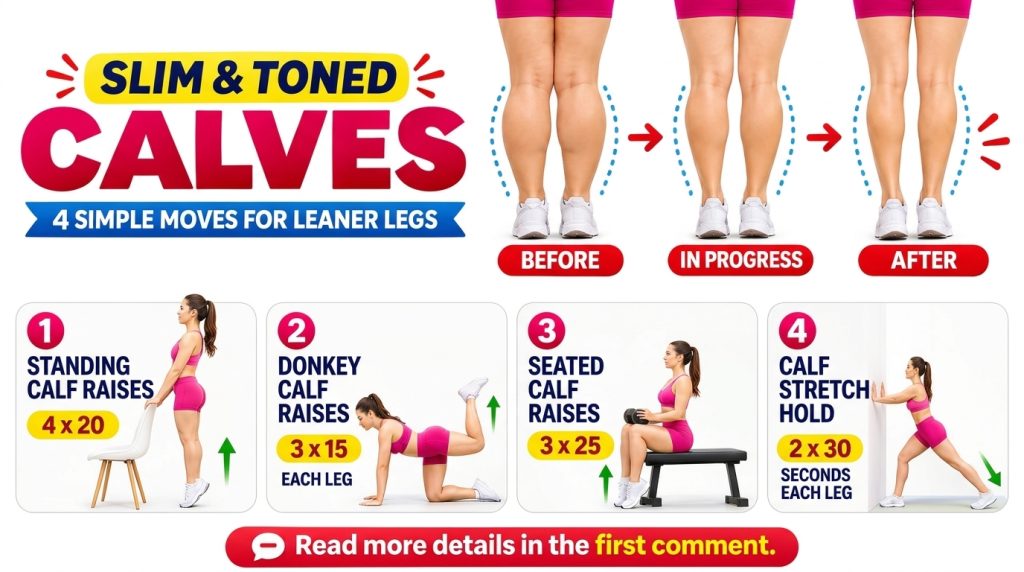
1. Standing Calf Raises
Standing calf raises primarily target the gastrocnemius muscle. This move is fantastic for building definition and power.
How to Perform:
- Stand tall with your feet hip-width apart, holding onto a wall or sturdy chair for balance if needed.
- Slowly raise yourself up onto the balls of your feet, lifting your heels as high as possible.
- Squeeze your calves at the top of the movement.
- Slowly lower your heels back down to the starting position, controlling the movement throughout.
Tips for Success:
- Focus on a full range of motion, going as high as you can and as low as you can comfortably.
- Avoid bouncing. Use a controlled, deliberate motion.
- Aim for 3 sets of 15-20 repetitions.
2. Donkey Calf Raises
Donkey calf raises are an excellent way to isolate the calf muscles with added resistance, often targeting a slightly different angle and potentially engaging the gastrocnemius effectively.
How to Perform:
- Stand with your hands on a sturdy surface (like a bench or wall) and bend at your waist, keeping your back flat and legs mostly straight (a slight bend in the knees is fine).
- Lift one leg slightly off the floor, or keep both feet down if you prefer.
- Raise your heels as high as possible, contracting your calf muscles.
- Slowly lower your heels back down, feeling the stretch.
Tips for Success:
- Keep your core engaged to maintain a flat back.
- You can place a weight plate or a dumbbell on your lower back (with caution and proper form) for added resistance, or have a partner gently apply pressure.
- Perform 3 sets of 12-15 repetitions.
3. Seated Calf Raises
This exercise primarily targets the soleus muscle, which is essential for endurance and lower leg thickness. Since the soleus is active when the knee is bent, seated calf raises hit it directly.
How to Perform:
- Sit on a bench or chair with your feet flat on the floor, knees bent at a 90-degree angle.
- Place a dumbbell or weight plate on your thighs, just above your knees, or use a seated calf raise machine.
- Keeping your heels on the ground, slowly lift the balls of your feet as high as you can, contracting your calves.
- Slowly lower your feet back down, feeling the stretch in your calves.
Tips for Success:
- Use a weight that allows you to complete the repetitions with good form but still feels challenging.
- Focus on a slow, controlled movement to maximize muscle engagement.
- Aim for 3 sets of 15-20 repetitions.
4. Calf Stretch Hold
While not a strengthening exercise, stretching is crucial for flexibility, recovery, and preventing injury, allowing your muscles to grow and remain pliable.
How to Perform:
- Stand facing a wall, placing your hands on it at shoulder height.
- Step one foot back, keeping your heel on the ground and your leg straight.
- Lean forward into the wall, bending your front knee until you feel a stretch in the calf of your back leg.
- Hold the stretch for 20-30 seconds, then switch legs.
Tips for Success:
- Ensure your back heel stays firmly on the ground.
- Don’t bounce during the stretch; hold it steadily.
- Perform 2-3 repetitions on each leg after your calf workout or as part of your cool-down routine.
Integrating Calf Work into Your Routine
You can incorporate these calf exercises into your regular leg day routine or dedicate a few minutes to them 2-3 times a week on non-consecutive days. As your strength improves, you can increase the number of sets, repetitions, or add more resistance to continuously challenge your muscles.
Remember that visible results take time and consistency. Focus on proper form, progressive overload, and a balanced diet for the best outcomes. By including these four simple moves, you’ll be well on your way to achieving strong, sculpted calves that not only look great but also contribute to your overall lower body strength and wellness!
Disclaimer: This article is for informational purposes only and is not intended to be a substitute for professional medical advice, diagnosis, or treatment. Always seek the advice of your physician or other qualified health provider with any questions you may have regarding a medical condition or before starting any new exercise program.