You will wish you had known this sooner! A simple household paste made from four everyday ingredients can help tackle stubborn yellow stains on pillows and freshen up white fabrics that have seen better days. Most of what you need is probably already in your kitchen and bathroom cabinet.
Many common stains, such as sweat marks on white shirts, dingy spots on washable towels, and grimy patches on fabric sofas, seem to set in no matter how often they go through the wash. A thick, spreadable paste lets you apply cleaning ingredients exactly where they are needed instead of soaking the whole item. This makes everyday cleaning easier and more effective.
This guide is for anyone who wants a practical, budget-friendly DIY option for laundry and fabric care. You do not need special tools or hard-to-find products. In this article, you will learn what goes into the paste, how to mix it, where it works best, which surfaces to avoid, and how to store and use it safely.
Quick Summary
- Preparation Time: About 5 minutes
- Application Time: 15 to 30 minutes of dwell time before washing
- Difficulty Level: Beginner
- Best Uses: Pillow stains, sweat stains on white clothing, fabric sofa spots, and white washable towels
- Suitable Surfaces: White and colorfast washable cotton, polyester blends, and sturdy upholstery fabric (test first)
- Storage Time: Make only what you need and use it the same day
Why You Will Love This DIY Solution
- Uses ingredients you likely already have at home
- Budget-friendly compared with many specialty stain removers
- Easy to mix with a bowl and a spoon
- Thick texture stays where you apply it
- Works on several types of fabric stains
- Quick to prepare and simple for beginners
Ingredients and Materials
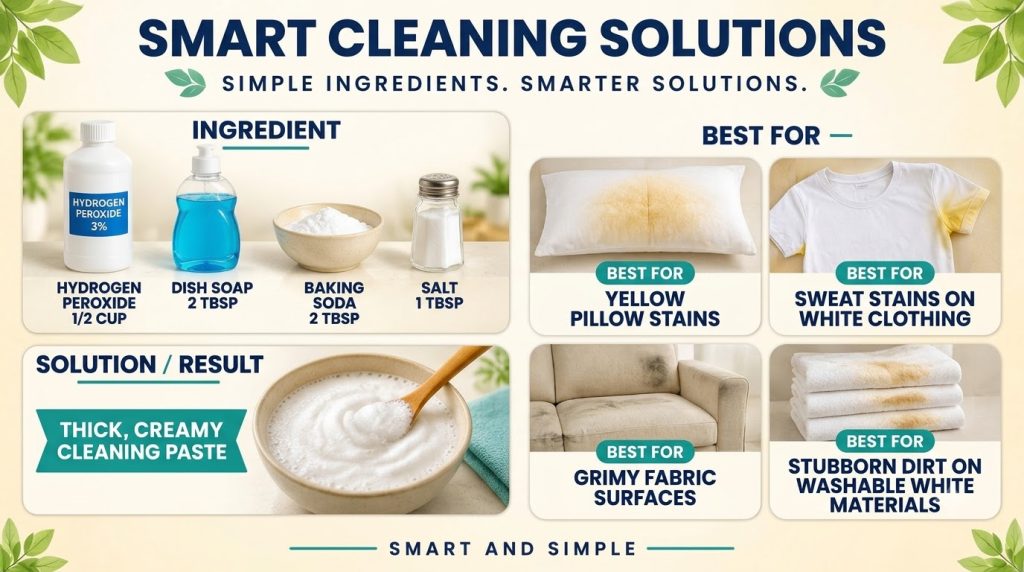
- 1/2 cup 3% hydrogen peroxide
- 2 tablespoons dish soap (a basic, clear or blue liquid works well)
- 2 tablespoons baking soda
- 1 tablespoon table salt
Equipment Needed
- Small ceramic or glass mixing bowl
- Measuring spoons and a measuring cup
- Wooden or plastic spoon
- Soft old toothbrush or cloth for spreading
- Rubber gloves
- Clean white cloth for blotting
Step-by-Step Instructions
- Add the dry ingredients. Put 2 tablespoons of baking soda and 1 tablespoon of salt into your bowl and stir them together. Tip: Use a dry bowl so the powders mix evenly. Time: about 1 minute.
- Add the dish soap. Pour in 2 tablespoons of dish soap and stir until the mixture looks like a thick, smooth paste. Tip: Stir slowly to avoid splashes. Time: about 1 minute.
- Add the hydrogen peroxide slowly. Pour in the 1/2 cup of 3% hydrogen peroxide a little at a time while stirring gently. Expected result: The mixture becomes foamy and creamy. Stop adding liquid once it reaches a thick, spreadable texture. Time: about 2 minutes.
- Test on a hidden area. Dab a small amount on an inside seam or corner of the fabric. Wait 10 minutes, then blot with a white cloth. If the color changes or the fabric looks damaged, do not use the paste on that item.
- Apply to the stain. Use your soft toothbrush or cloth to spread a thin layer of paste over the stained area. Work gently from the outside of the stain toward the center. Time: about 2 minutes.
- Let it sit. Leave the paste on the fabric for 15 to 30 minutes. Do not let it dry completely. Time: 15 to 30 minutes.
- Rinse and wash. Rinse the area with cool water to remove the paste, then launder the item as the care label recommends. Check the stain before drying. If it is still visible, repeat the process. Do not put the item in the dryer until the stain is gone, since heat can set stains.
Best Uses
Pillow Stains
Yellowing and body oil marks on pillow covers and pillowcases respond well to this paste when used on white or colorfast cotton. Gently blot rather than rub too hard so you do not damage the fabric.
Sweat Stains on White Clothing
Underarm stains on white shirts can be treated before washing. Apply the paste to the stained area and let it sit before laundering as usual.
Sofa and Upholstery Spots
Light grime on fabric sofas can be lifted with a small amount of paste on a cloth. Always test first, because some upholstery fabrics are sensitive to moisture and may leave a ring or water spot.
Washable White Towels
Stubborn dirt on white towels can be treated before a regular wash. Use a soft brush to work the paste into the fibers.
Surfaces to Avoid
Do not use this paste on silk, wool, leather, suede, unsealed natural stone, or delicate colored fabrics unless you have tested them carefully and the results are safe. Avoid use on any item that is not labeled washable or that you cannot test in a hidden spot.
Safety Notes
- Wear rubber gloves while mixing and applying the paste.
- Always test on a small hidden area first to check for color change or damage.
- Keep the paste away from children and pets.
- Never mix hydrogen peroxide with vinegar or other cleaners. Use this recipe on its own.
- Never mix this paste with bleach or ammonia.
- Make sure the room has good ventilation while you work.
- Rinse thoroughly after use so no residue remains on the fabric.
Expert Tips
- Work on the stain while it is fresh for the best results.
- Use a soft toothbrush for delicate fabrics rather than a stiff brush.
- Blot instead of scrubbing hard to protect the fibers.
- Check the care label before you start.
- Do not let the paste dry on the fabric, because it can be harder to rinse out.
- Air-dry or check the stain before using the dryer.
- If a stain does not fully lift after one treatment, repeat the process rather than using stronger products.
Storage Instructions
This paste is best made fresh. Hydrogen peroxide loses strength over time, and the mixture can build up pressure if sealed in a container. Make only what you need for one session and use it the same day. Discard any leftover paste after use. Keep all ingredients in their original containers, stored in a cool, dry place away from children and pets.
Frequently Asked Questions
Can I store this paste for later?
It is best to make it fresh each time. Hydrogen peroxide breaks down over time, and the mixture can change or build pressure in a closed container.
How long does the paste last?
Use it within the same day. Throw away any leftovers rather than saving them.
Can I use this on colored fabrics?
Only if the fabric is colorfast and you have tested a hidden area first. Some dyes may lighten, so caution is important.
Can I replace an ingredient?
It is best to follow the recipe as written. Changing ingredients may change the texture and results, and you should test any change on a hidden area first.
Is this safe around pets?
Keep the paste away from pets while you work and until the fabric is fully rinsed and dry. Wash the item thoroughly before letting pets lie on it.
Can I use this on sofas?
You can try it on fabric sofas, but test first. Use only a small amount, blot gently, and avoid soaking the cushions.
Will this remove every stain?
No single solution works on every stain. Some stains may need repeated treatment or professional cleaning.
Conclusion
A simple paste made from hydrogen peroxide, dish soap, baking soda, and salt can be a helpful addition to your home cleaning routine. It is easy to mix, budget-friendly, and useful for many everyday fabric stains. Remember to test first, wear gloves, keep the paste away from children and pets, and never mix it with other cleaners. Give it a try on a small area, and enjoy fresher, brighter fabrics with a practical DIY solution you can make in minutes.